

Opening: 7 a.m. in a cotton field
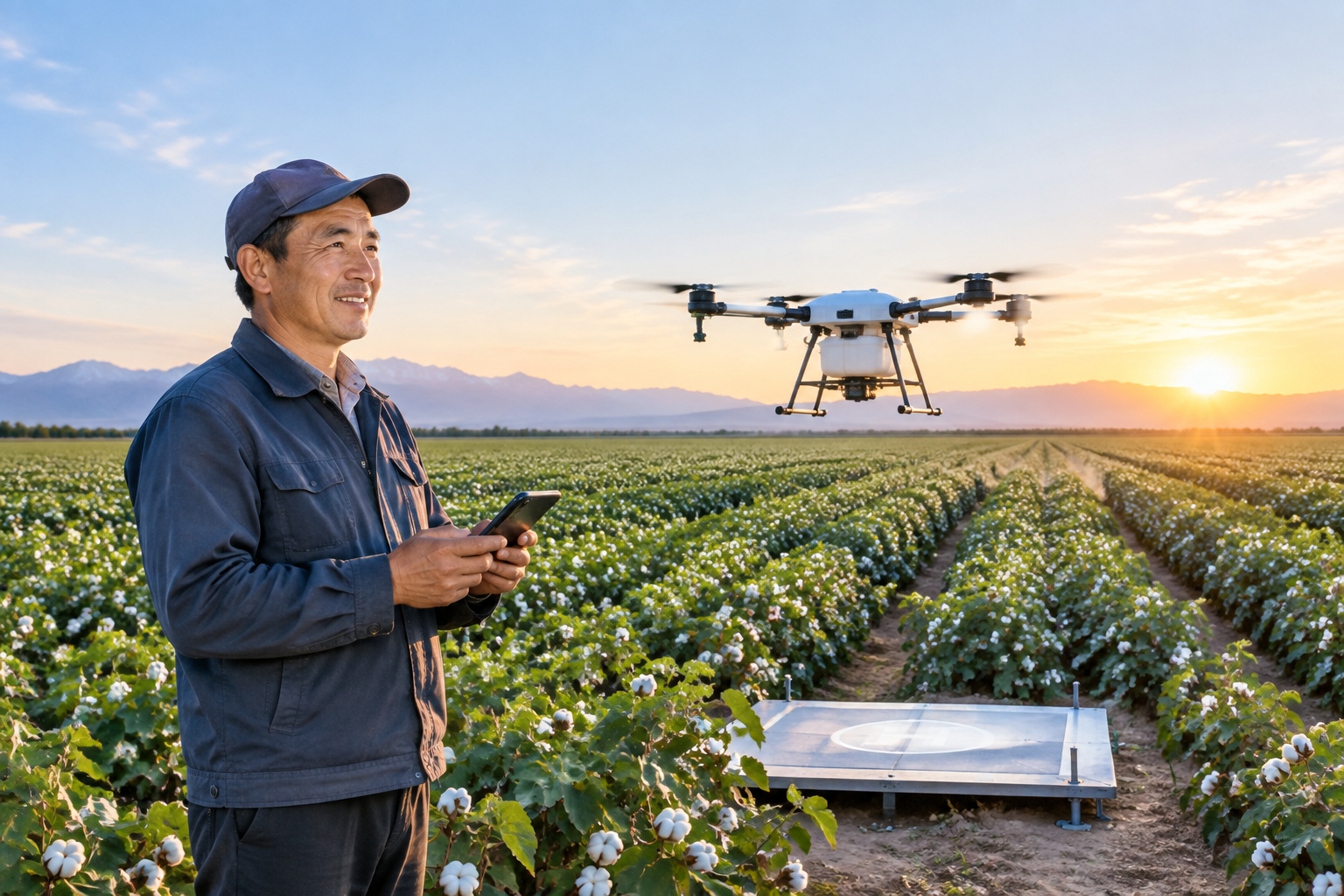
It’s 7 a.m. in Yuli County, Xinjiang. The sun is just up. Zhang Jianjun, a cotton farmer in his 50s, stands at the edge of a field that runs to the horizon. He doesn’t pick up a hoe. He takes out his phone.
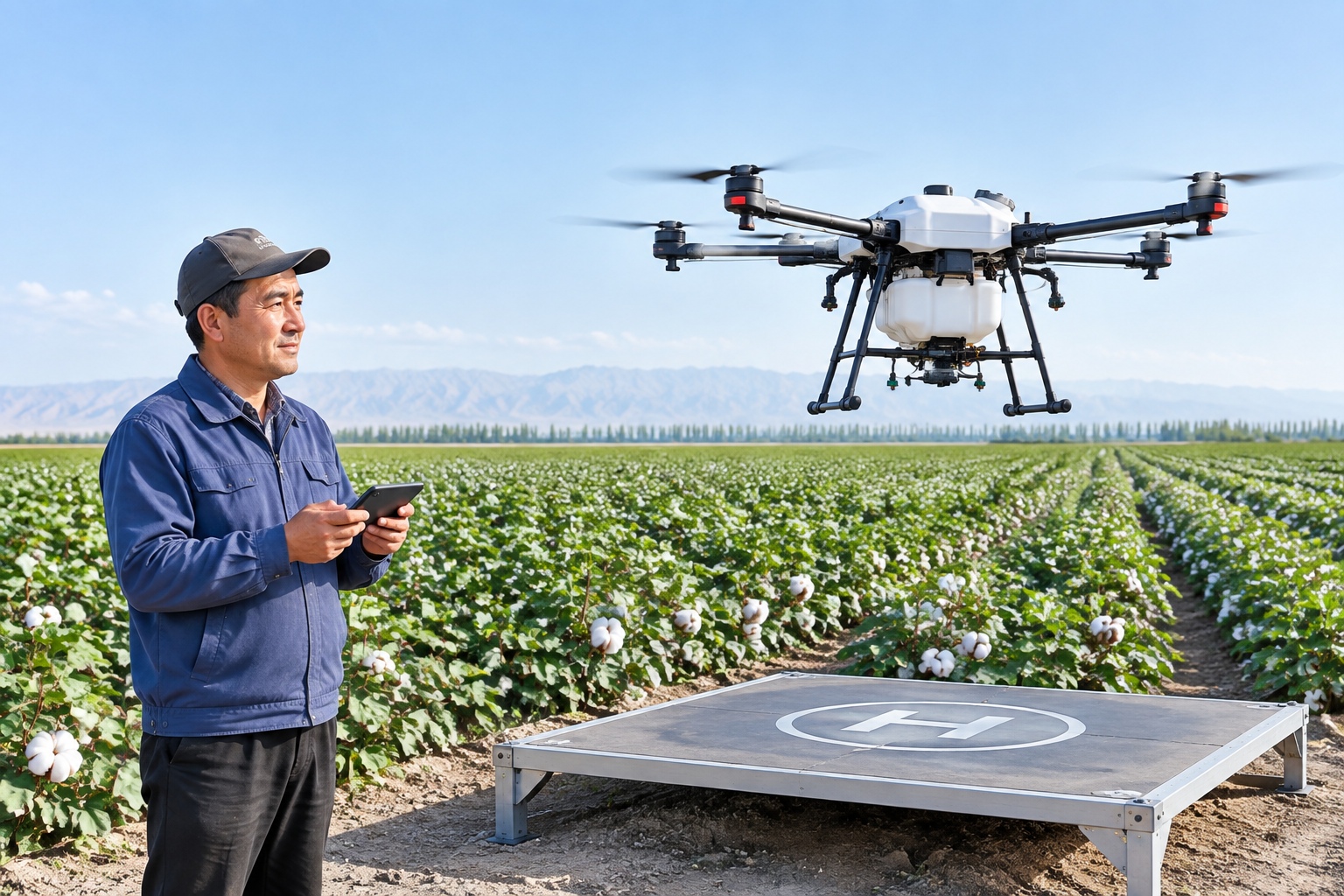
On the screen, a small map shows his 200 mu (about 33 acres) of cotton. A blue dot marks a drone. He taps it. A few seconds later, a white drone lifts off from a small platform near the field, hums over the green rows, and starts spraying.
“Used to take three people two days to spray this field,” he says. “Now it’s done before lunch.”
That scene is not a tech demo. It’s how a growing number of farmers in Xinjiang—China’s largest cotton-producing region—work today. The question is simple: how many steps does it take to grow a crop now? The answer is about five, but the real change is that the phone has become a farm tool.
Step 1: Before planting—use your phone to “see” the field
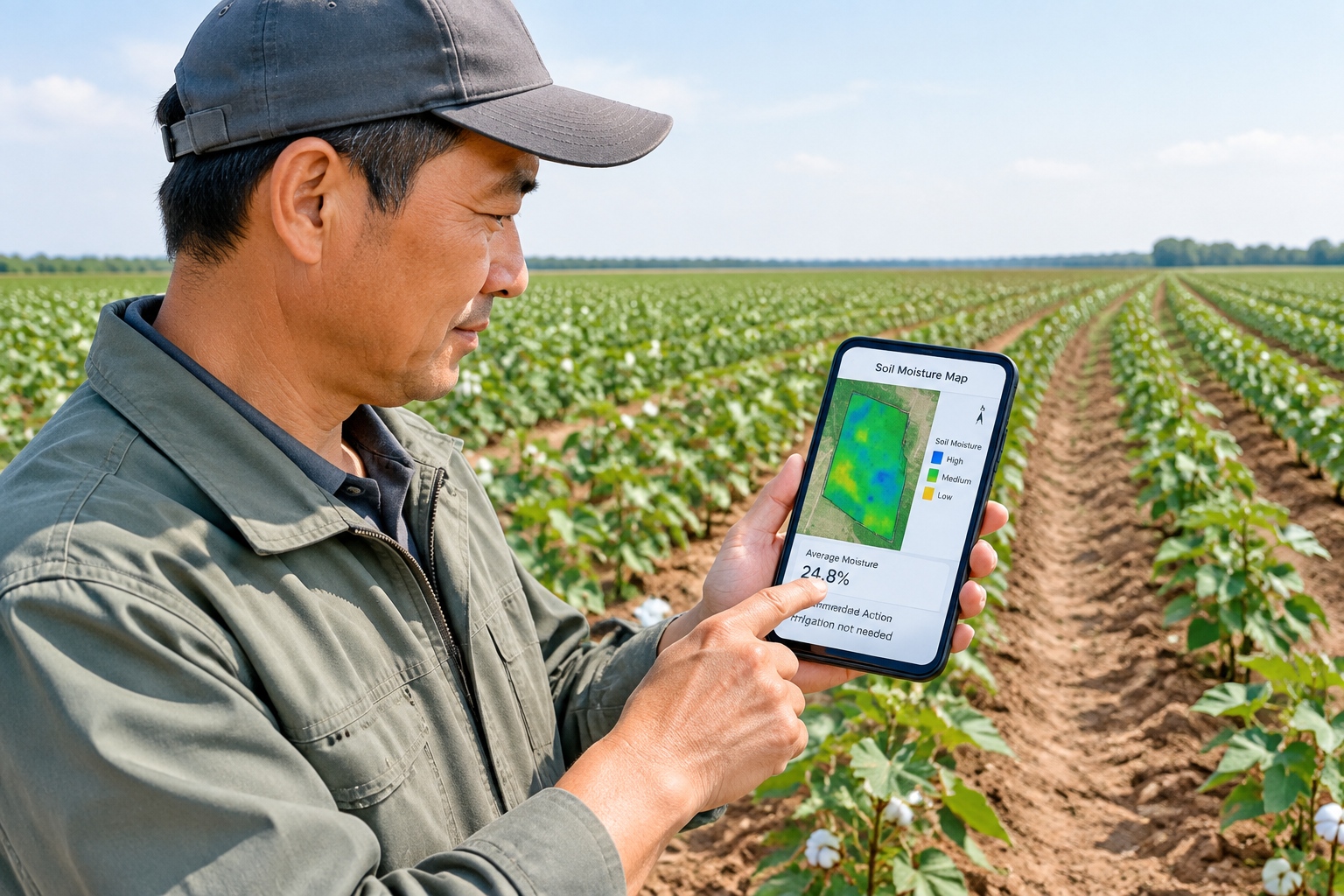
Farming starts before the seed goes in. In the past, a farmer would walk the field, squeeze soil in his hand, and guess. Today, many fields in Xinjiang have small soil sensors buried a few inches down. They measure moisture, temperature, and salinity.
That data goes to an app. A farmer can see, for example, that the north corner is drier than the south. Or that the salt level is a bit high. The app might suggest flushing the field with water before planting.
Satellite images add another layer. Some cooperatives use free or low-cost satellite data to check crop health. If a patch looks yellow on the map, it might need fertilizer. “It’s like a weather app, but for your field,” says Ma Xiaoyan, an agronomist in Changji.
This step is still uneven. Not every field has sensors. In some villages, farmers rely on experience and the local extension officer. But the direction is clear: data is becoming a normal input, like seed and fertilizer.
Step 2: Planting—the tractor drives itself
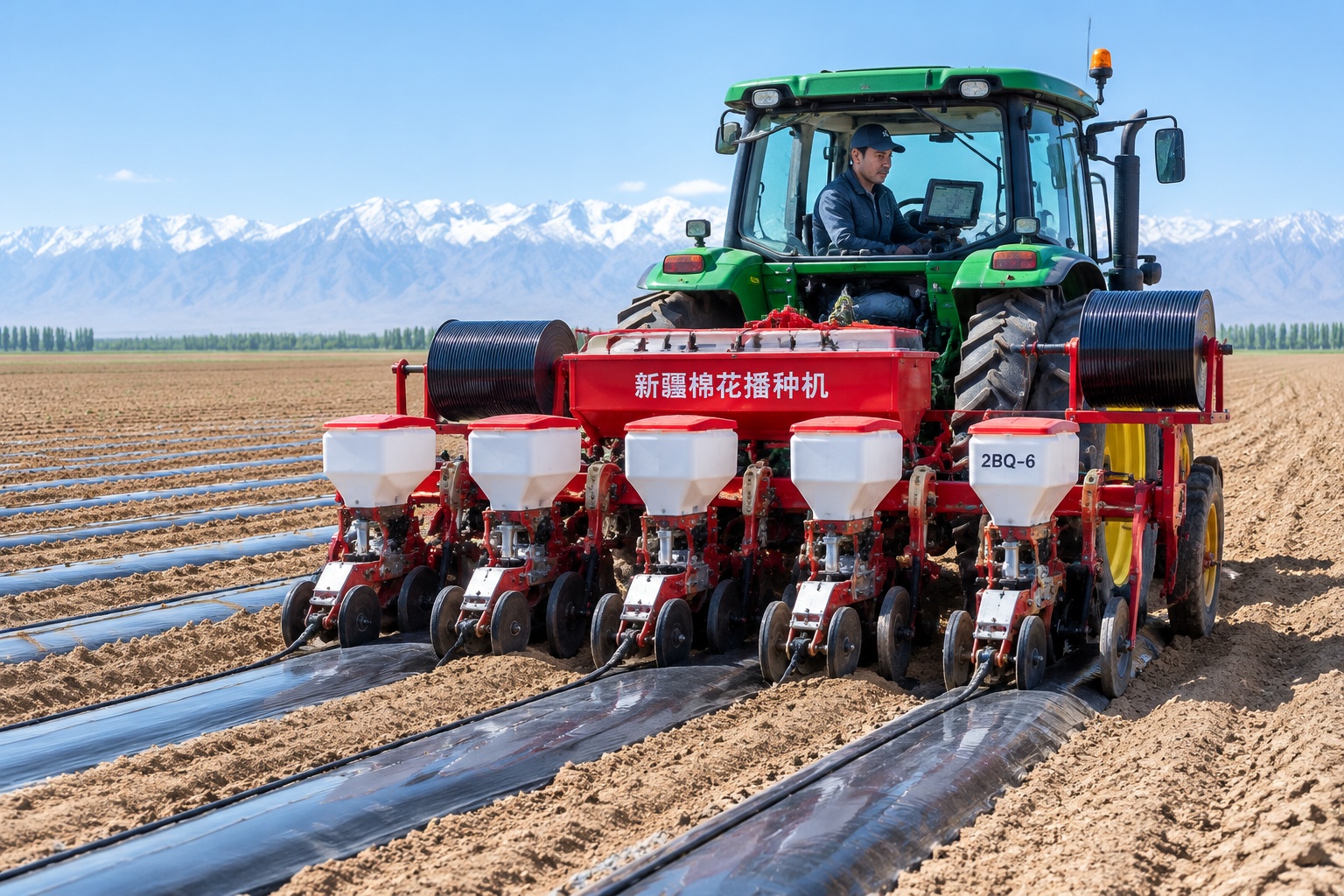
In April, when the soil warms up, planting begins. A modern cotton planter in Xinjiang does several things at once: it lays plastic mulch, installs drip irrigation tape, and drops seeds at precise spacing. The tractor pulling it can steer itself using BeiDou, China’s satellite navigation system.
The farmer doesn’t hold the steering wheel. He sits in the cab and watches a screen. The tractor follows a straight line within a few centimeters. That matters because straight rows make later spraying and harvesting easier. It also saves fuel and seed.
Drip irrigation is the quiet hero here. Xinjiang is dry. A lot of farmland depends on irrigation from rivers and groundwater. Drip tape delivers water directly to the roots, cutting water use by 30% to 50% compared with flood irrigation. For a region where water is scarce, that’s not a small thing.
Step 3: Growing season—drones spray, phone controls water
Once the plants are up, the work shifts to protection. Pests and weeds don’t wait. This is where drones have changed the game.
A plant protection drone can carry 10 to 40 liters of pesticide or foliar fertilizer. It flies a few meters above the crop, spraying a fine mist. A single drone can cover 200 to 300 mu a day—much faster than a person with a backpack sprayer. It also uses less pesticide because the mist lands more precisely on the plants.
In many places, farmers don’t buy a drone. They hire a service team. A call or a message in a WeChat group, and a drone operator shows up with a truck, a generator, and two drones. The cost is often lower than hiring laborers.
Water management also moved to the phone. With drip irrigation, valves can be controlled remotely. A farmer can open a valve from home, or set a schedule. Some systems use soil moisture data to decide when to water. “I used to walk the field three times a day to check the ditches,” says Zhang. “Now I check my phone.”
5G coverage helps. In many agricultural areas, 5G base stations have been built to support video monitoring, drone control, and data transmission. It’s not everywhere, but where it exists, it makes real-time decisions possible.
Step 4: Harvest—machines do the heavy lifting
Harvest used to be the biggest labor bottleneck. Cotton picking, in particular, drew hundreds of thousands of seasonal workers from other provinces every autumn. That has changed.
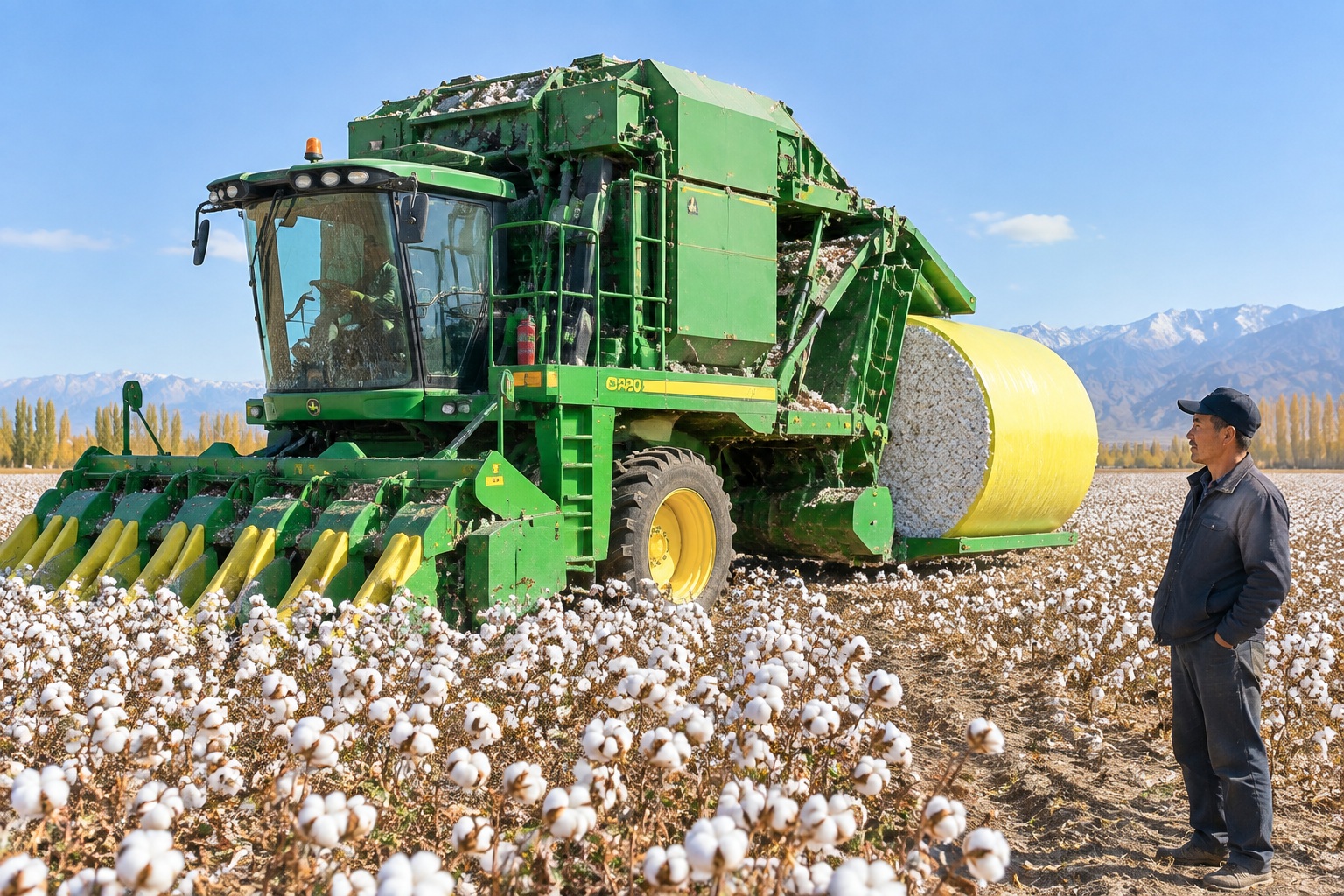
Today, more than 80% of Xinjiang’s cotton is harvested by machine. A six-row cotton picker can harvest 500 mu a day. It rolls through the field, sucks the cotton from the bolls, and packs it into a round module. The farmer watches from the edge, or checks the yield map on a tablet.
Other crops are following. Tomato harvesters work the fields in the north. Combine harvesters cut wheat and corn. For fruit like apples and dates, much is still picked by hand, but sorting and packing lines are increasingly automated.
This step is not perfect. Machines are expensive. Small fields can be hard to access. But the trend is clear: the back-breaking part of farming is shrinking.
Step 5: Selling—the phone becomes a storefront
The last step happens after the crop is in the warehouse. More farmers are selling directly to consumers through livestreaming and e-commerce.
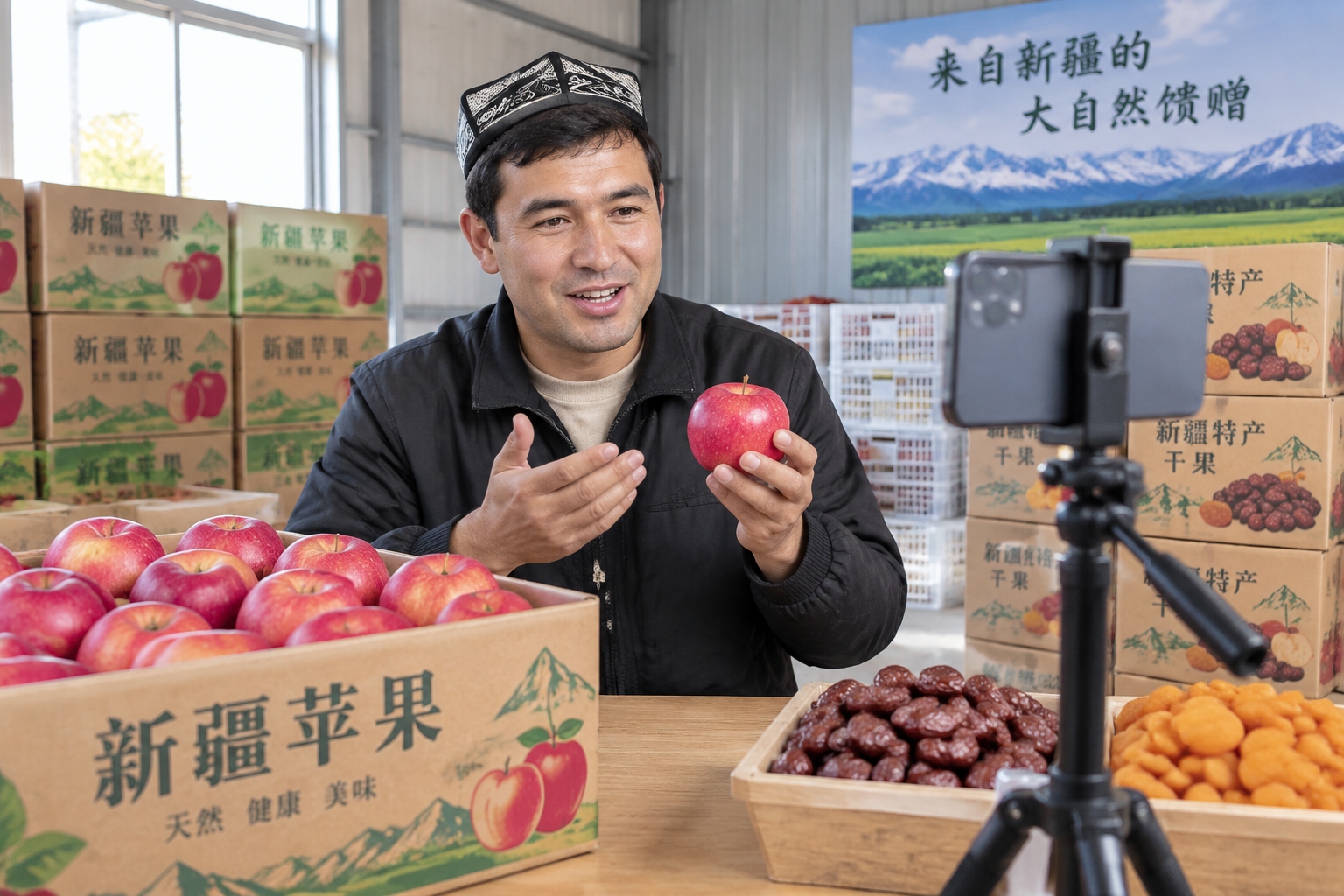
A farmer in Aksu might stand in front of a pile of red apples, phone on a tripod, and talk to viewers for an hour. Orders come in. A local courier picks up the boxes. The next day, the apples are on a truck to Beijing or Shanghai.
This is not just for young people. Cooperatives often hire a young host to run the livestream while the farmers handle the packing. Platforms like Douyin and Pinduoduo have programs to train rural sellers. It’s still a small share of total sales, but it gives farmers another option besides selling to a middleman.
So how many steps? And what’s different from other countries?
You can count five steps: plan, plant, protect, harvest, sell. But the more honest answer is that the steps are blurring. A phone can manage irrigation while a drone sprays. A tractor can plant and fertilize in one pass.
Compared with large farms in the U.S. or Australia, Xinjiang’s agriculture is a mix. There are big state-owned farms and large cooperatives, but also many smallholders with 20 to 100 mu. The interesting part is how small farmers get access to expensive technology.
They don’t all buy it. They share it. Drone service teams, custom harvesting crews, and cooperative-owned machinery let a farmer use a $50,000 machine for a few hundred yuan. Government subsidies have helped lower the price of drones, drip tape, and GPS-guided tractors. It’s a model of “technology as a service.”
That’s different from the classic image of a self-sufficient family farm. It’s also different from a fully corporate mega-farm. It’s a patchwork, and it works because the service providers fill the gaps.
What do ordinary farmers think?
Ask a farmer and you get a mixed answer. Most like the convenience. Spraying with a drone means no more walking through pesticide-soaked rows in 35°C heat. Drip irrigation means less time fixing ditches. Harvesting with a machine means the crop comes in before the weather turns.
But there are frustrations. Equipment breaks. A drone needs a trained operator. The app sometimes has a bad signal. Older farmers may struggle with the touchscreen. “I can use it, but my father still calls me to help,” says a young farmer in Manas.
Younger people are more willing to stay in agriculture if the work is less physical and more digital. Some return from cities to run family farms or start drone services. That’s a change from a decade ago, when leaving the village was the goal.
The horizon: water, energy, and more data
Two big forces will shape the next steps. One is water. Xinjiang’s agriculture depends on irrigation, and climate change is making water supplies less predictable. Better sensors, drip systems, and data can help stretch every drop.
The other is energy. Solar panels are appearing on farm roofs and in fields, powering pumps and sensors. Electric tractors and drones are still rare, but the direction is set. The future farm may be a small solar-powered network.
For now, Zhang’s day ends with a check on his phone. The drone is back on its platform. The irrigation valve is closed. He taps the app, sees the soil moisture is fine, and goes home for dinner. The field will be there tomorrow. And so will the phone.
Start the discussion at forum.chinacomes.com