

A crack the width of a hair
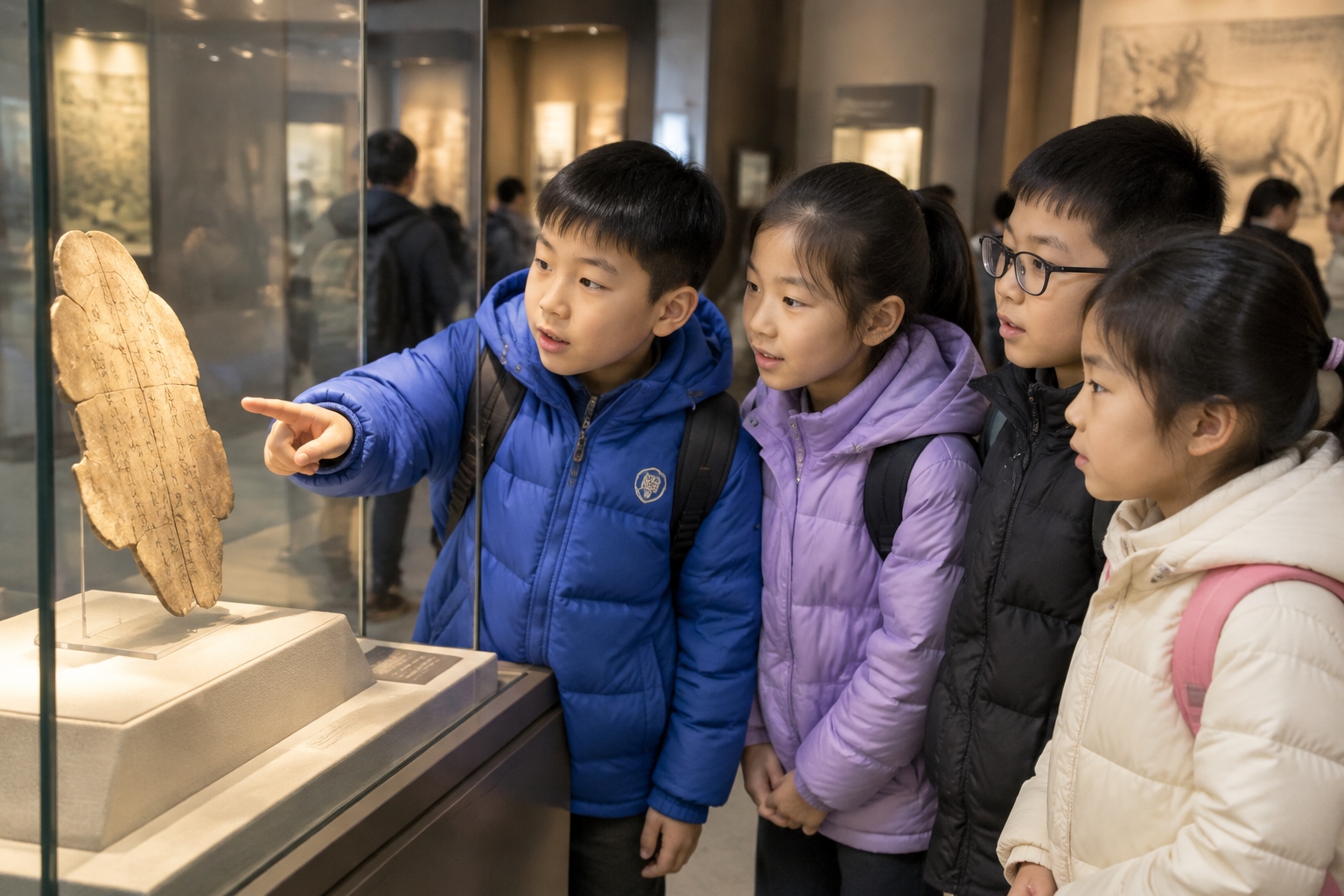
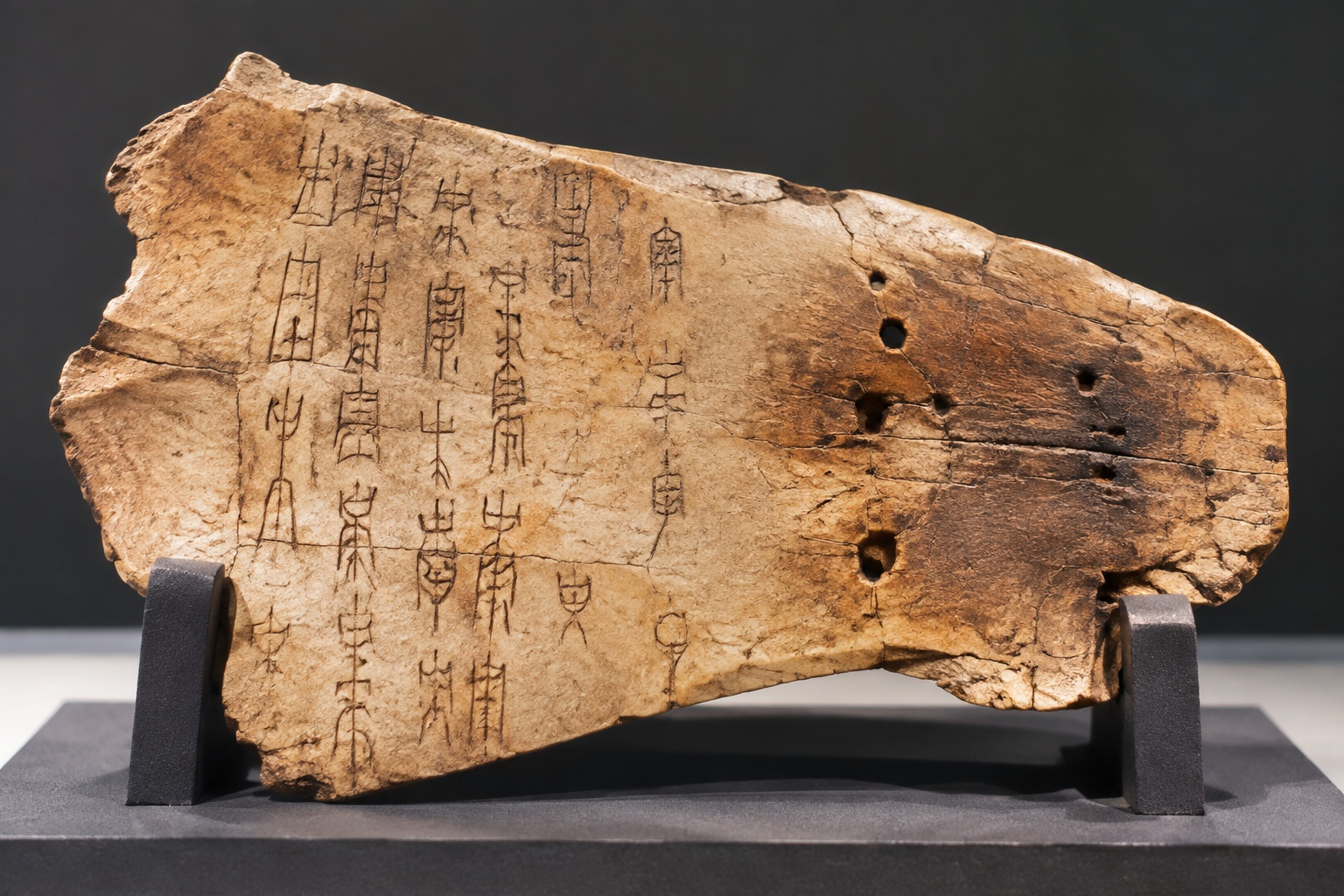
ANYANG, Henan — In the second gallery of the Yinxu Museum, a school group has stopped at a case the size of a shoebox. Inside lies the shoulder blade of an ox, brown as old furniture. A crack runs down its face, thin as a hair, shaped exactly like the Chinese character 卜.
A boy in a padded jacket presses his finger to the glass. “That’s the character,” he says. “That one, right?”
It is. The crack formed about 3,000 years ago, when someone pressed a heated bronze rod against the back of this bone. The person watching it split was not performing a trick. They were asking a question — and waiting for the bone to answer.
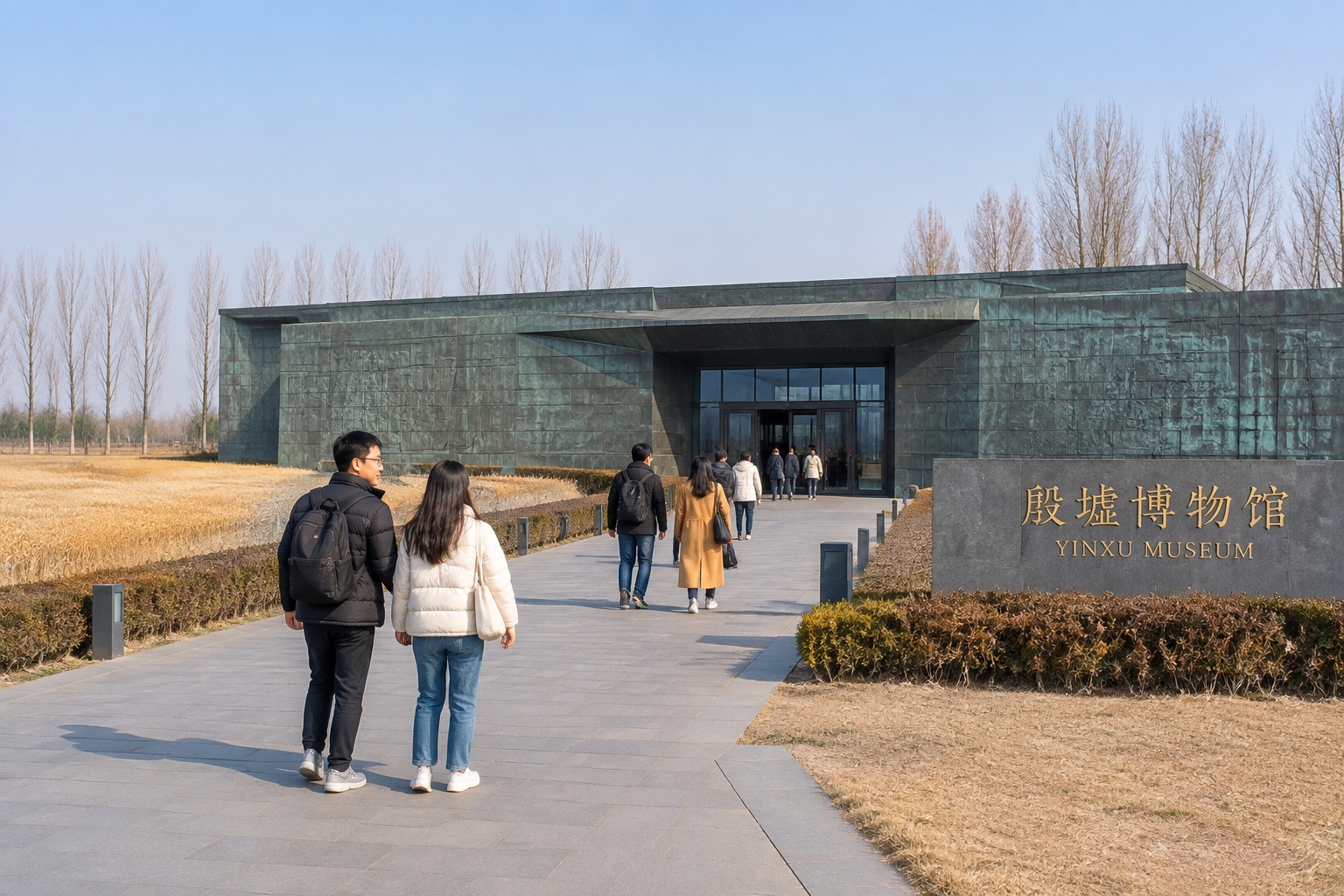
Yinxu, literally “the ruins of Yin,” lies in the northwest of Anyang, a city of roughly 5.4 million people in northern Henan. From about 1300 BC to 1046 BC this was the capital of the Shang dynasty, the earliest Chinese state that left behind writing in large quantities. UNESCO added the site to its World Heritage list in 2006. The museum that opened beside it in February 2024 puts close to 4,000 objects on display, most of them never exhibited before.
For a visitor who knows nothing about the Shang, the surprising thing is not the gold or the jade. It is how ordinary the questions were.
How the ruins were found — in a pharmacy
Farmers around Xiaotun village had been turning up bone fragments and bronze for generations. Some sold the bones to Chinese medicine shops as “dragon bones,” ground into powder for wounds. In 1899, a scholar-official named Wang Yirong, sick with malaria in Beijing, noticed marks on a piece of bone in his medicine packet and recognized them as an ancient script.
Tracing the supply back led to Xiaotun. The first scientific dig began in 1928, run by the newly founded Institute of History and Philology. Work stopped in 1937 during the war with Japan, resumed in 1950, and has continued in some form ever since.
Around 150,000 inscribed fragments have been recovered so far. They carry roughly 4,500 distinct characters, of which scholars can confidently read about a third. In 2017, UNESCO added the oracle bone script to its Memory of the World register.
That number — one third — is worth sitting with. Two-thirds of what the Shang wrote is still, in a literal sense, unreadable.
Divination as daily administration
Asking bones was not a rare ceremony. It was how the court did business. A typical inscription has four parts: the date and the diviner’s name; the question; the king’s reading of the cracks; and sometimes a note on what actually happened afterwards.
The questions repeat in a way that feels familiar. Will it rain? Will the harvest be good? Should the king hunt at such-and-such a place? Will the coming ten days pass without disaster — a formula, 旬亡祸, that shows up again and again, like a weekly risk report.
Some are startlingly personal. One sequence asks whether Lady Fu Hao’s childbirth will go well; the king reads the cracks and predicts a boy; the record adds that it was a girl. Another asks about the king’s toothache.
Mechanically it worked like this: hollows were carved into the back of a turtle plastron or an ox scapula, heat was applied, and on the front a crack split open in the shape of 卜. The direction it ran was the answer. Only later, and only sometimes, was the question carved into the bone next to the crack.
The Shang also acknowledged a high god, Di, who could send rain, drought or victory, and who was asked for things rather than bargained with. There was no obvious moral accounting in the relationship. You asked, you read the crack, you moved on.
The pit that held 17,000 pieces
In June 1936, excavators opened a pit known as YH127 — less than two meters across, packed with 17,096 fragments, most of them turtle shell. It remains the largest single cache of oracle bones ever found. The whole pit was wrapped in plaster and shipped to Nanjing for laboratory work, an operation that took weeks.
It is a good reminder of where this archive came from. Not a library, but a rubbish pit that happened to be sealed and dry. Some bones are royal records; others are apprentice carvers practising their strokes, and their mistakes survived alongside the king’s questions.
What was actually for dinner
Food shows up everywhere in the record. Inscriptions name millet, wheat, rice and beans, and list animals brought for ritual: cattle, sheep, pigs, dogs and deer from the hunt. Archaeobotanists working at Yinxu have recovered millet, wheat, rice and soybean remains; millet appears to have been the everyday staple.
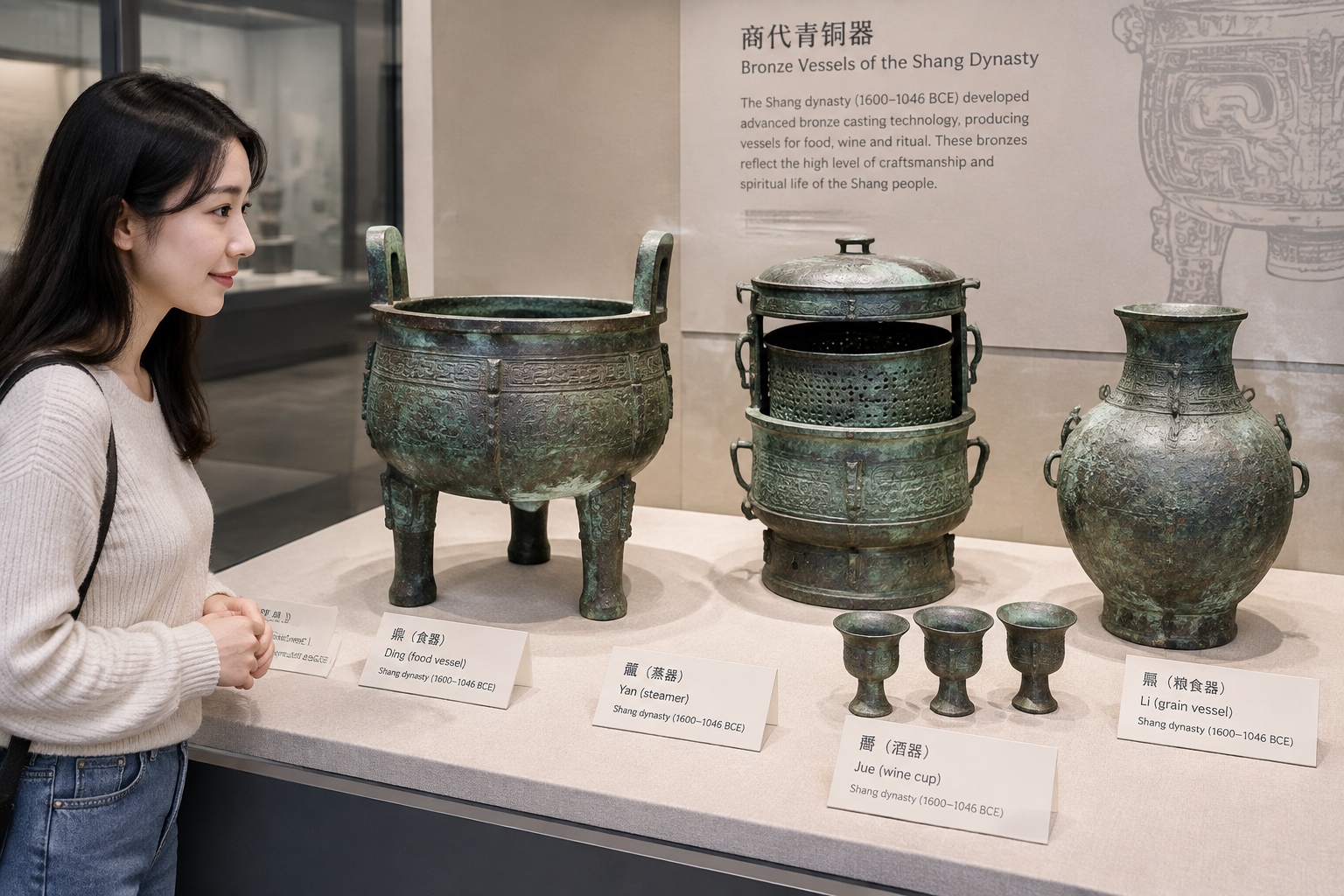
The bronze vessels in the museum are, functionally, a kitchen. The ding is a three-legged cauldron for boiling meat. The yan is a steamer — a pot with a perforated inner basket, which means people here were steaming food more than 3,000 years ago. The gui held grain; the jue and gu were wine cups.
They drank a lot. Shang elites consumed millet wine at rituals on a scale that later Zhou writers used as evidence of moral decay — the famous accusation of “a lake of wine and a forest of meat” comes from the dynasty that overthrew them, so treat it as propaganda with a kernel of truth.
The largest bronze vessel ever found in China came out of the ground a few kilometers from the palace area, in 1939: the Houmuwu ding, 832.84 kilograms, cast for ritual offerings of meat to a queen. It now lives in the National Museum of China in Beijing. Anyang got a replica.
The tombs, and what they admit
In 1976, archaeologist Zheng Zhenxiang found the tomb of Fu Hao — the only intact royal tomb at Yinxu, and one of the great discoveries of twentieth-century Chinese archaeology. It held more than 1,600 objects: about 460 bronzes, 750 jades, 560 bone pieces and some 6,800 cowrie shells, the currency of the time. Fu Hao, one of King Wu Ding’s consorts, also led troops; the bones record her campaigns.
She was not buried alone. Sixteen people and six dogs were placed in the tomb with her — a fact the museum states plainly on its labels, as does the site’s World Heritage documentation.
Human sacrifice at Shang royal tombs could reach far larger scale. At Xibeigang, the royal cemetery north of the Huan River, the big tombs were looted centuries ago, but the pits around them survive, some with hundreds of victims. The presentation of this material in Chinese museums has become noticeably more direct over the past two decades. The label says what it says.
Walking through those galleries, it is hard to hold a single feeling. The same civilization that produced the earliest Chinese writing — characters still legible today — also buried servants and captives with its dead, and steamed millet for gods who answered with cracks in a bone.

Living beside 3,000 years
The site is not a sealed-off zone. Xiaotun is still a working village. Wheat and corn grow inside the protected area, where construction is restricted and some families have been relocated. Villagers work as guards, guides, cleaners and drivers. On the road out you pass bicycle shops, e-bike repair stalls and a steel plant, because Anyang is also an ordinary industrial city in Henan and always has been.
Something new is happening to the writing itself. A national cloud platform for oracle bone studies, built with university partners, has digitized tens of thousands of rubbings and photographs. Researchers at Anyang Normal University and elsewhere are training models to do something extremely tedious by hand: matching broken fragments that fit together, and proposing readings for characters nobody has cracked. Roughly 1,500 of about 4,500 characters are considered decoded. Progress is measured in single characters per year, and each one makes the local news.
Children who come to the museum can check the connection themselves. 日 for sun, 月 for moon, 雨 for rain, 田 for field. On a good label, the Shang form and the modern character sit side by side, and a nine-year-old can see it.
Dusk on the Huan River
Outside, the light goes orange over the flat fields. A man cycles past the fence along the Huan River with a bag of vegetables on his handlebars. Somewhere under that soil are more bones, more bronzes, more questions waiting for someone to read them.
The Shang spent their days asking whether the next ten days would bring trouble. Most of the answers they wrote down are lost. What remains is the habit of asking — of pressing a hot rod to a bone and wanting to know.
Start the discussion at forum.chinacomes.com