

Twelve-thirty, and the floor goes dark
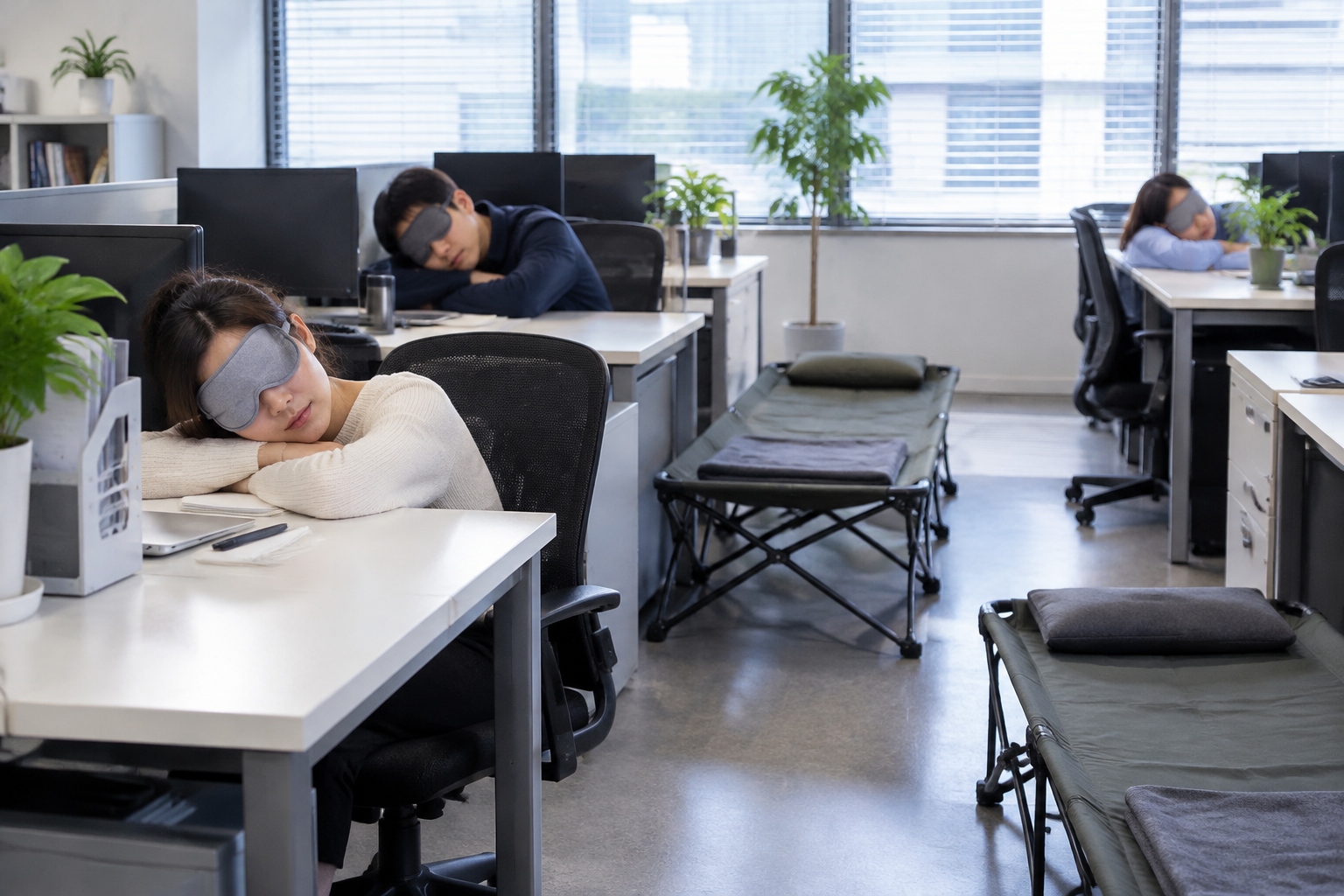
At 12:28 in a software company in Chengdu, a project manager named Liu closes his laptop halfway, pulls a gray eye mask down over his face, and tips his chair back as far as it will go. The person beside him has already unrolled a thin mat under the desk. Across the open-plan office, someone dims the overhead lights. A phone buzzes once, then goes silent. By 12:35, roughly forty adults are asleep at their jobs—and nobody finds this strange.
If you walked in at that moment, you might think you’d stumbled into a power outage, or an evacuation drill gone quiet. In fact, you’ve witnessed one of the most ordinary scenes in Chinese working life: the collective noon nap, or wǔxiū (午休). For about an hour after lunch, a large share of the country’s offices, schools, factories, and government buildings simply switch off.
What the ritual actually looks like
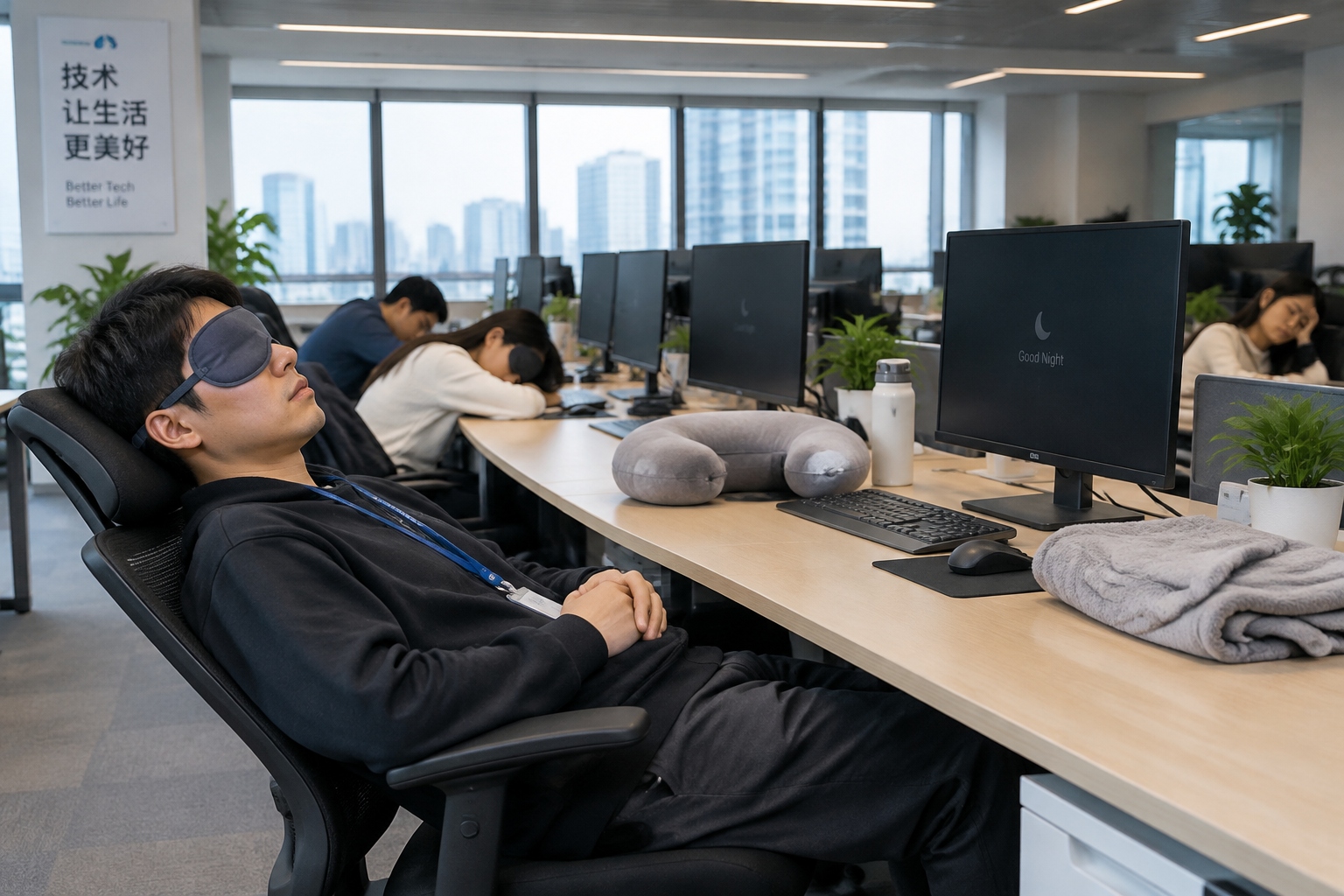
The props are specific and widely shared. Foldable aluminum cots—light enough to tuck behind a filing cabinet, cheap enough to buy on an e-commerce app for under 150 yuan (about 20 US dollars)—have become standard office furniture. Many workers keep an eye mask, a small travel pillow, and a thin blanket in a desk drawer. Some lay their heads directly on the desk, cushioned by a folded arm or a dedicated nap pillow with a hole for breathing.
In schools, the ritual is enforced. Primary and secondary students put their heads down on their desks after lunch, and in some newer schools in Guangdong and Hunan, classrooms now come with reclining chairs so children can lie almost flat. State media has reported on this as a wellness measure, not an indulgence.
The timing is remarkably consistent. Lunch runs from roughly 12:00 to 12:30; the nap fills the window until 1:30 or 2:00, when the afternoon shift begins. The quiet is a shared agreement. People lower their voices in the hallway. Meetings are rarely scheduled in that hour. If you call a Chinese office at one in the afternoon, you may simply get no answer.
Why a whole country lies down after lunch
The habit has deep roots. Traditional Chinese medicine holds that the body needs rest when yang energy peaks at midday, and the phrase zǐ wǔ jiào—a nap during the noon hours—has circulated for centuries. For older generations, resting after lunch was simply common sense about health, passed down the way advice about not drinking cold water after a meal gets passed down.
There’s a practical history too. In the planned-economy decades, many Chinese worked and lived on the same danwei, or work unit, compound. Home was a short walk from the workbench, lunch was long, and a nap after it was built into the rhythm of the day. The two-hour midday break was once written into schedules across much of the country. Even as cities sprawled and commutes lengthened, the nap survived—just relocated from the home bed to the office desk.
How modern companies learned to manage the nap
What’s interesting is that fast-growing private companies didn’t kill the tradition. They absorbed it. Tech firms in particular have reframed the noon nap as a productivity tool rather than a holdover.
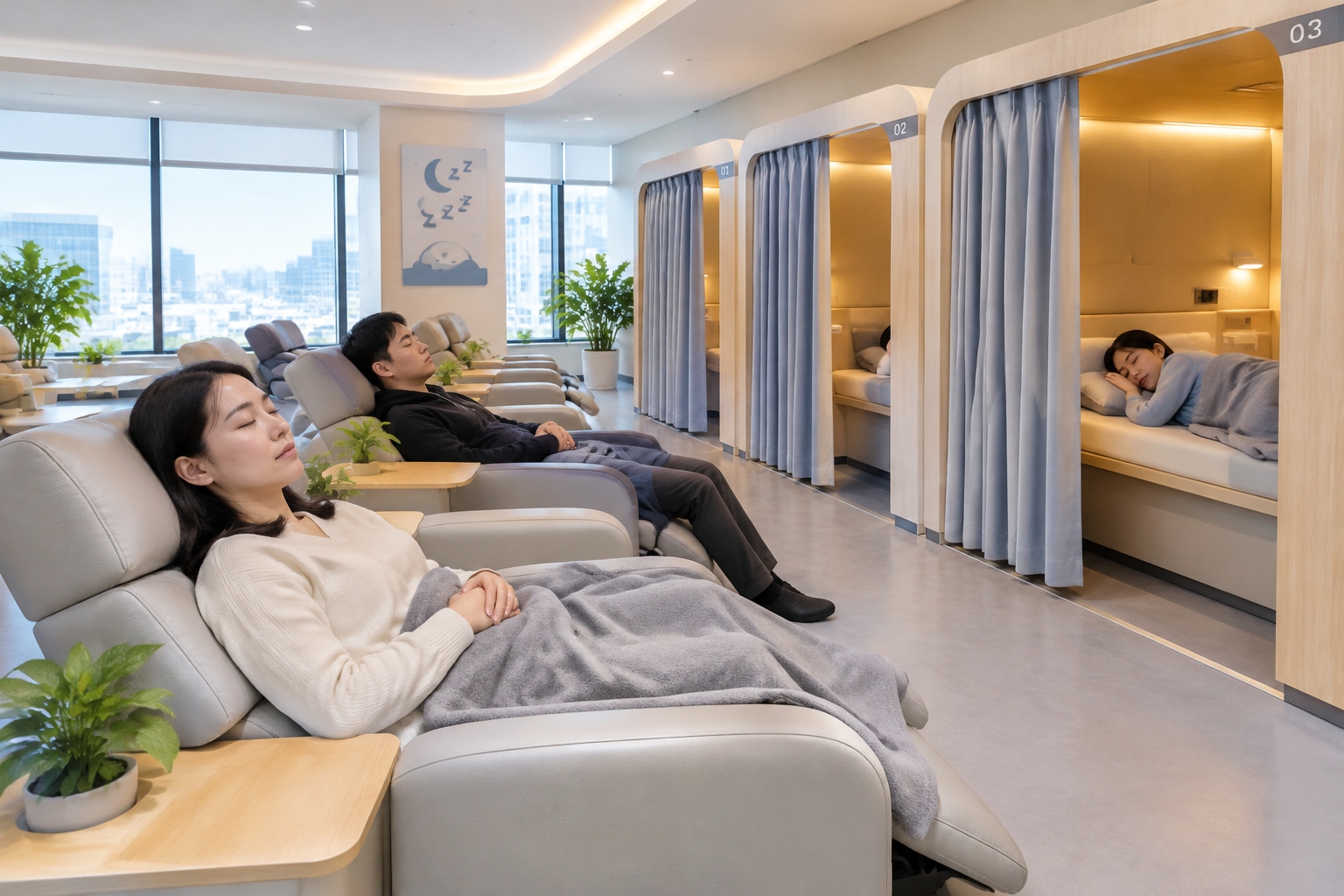
Walk through the campus of a large internet company in Hangzhou or Shenzhen and you’ll find dedicated rest areas: dim rooms with rows of recliners, nap pods, even curtained bunk zones. Lights are on timers. The logic is explicit and often stated by HR: a rested employee codes better from 2 to 6 p.m. than a groggy one. In an industry famous—and infamous—for long hours, the nap is treated as basic maintenance.
This coexists with a harder reality. China’s tech sector gained global attention for “996”—working 9 a.m. to 9 p.m., six days a week—a schedule that sparked public backlash and was later ruled illegal by China’s top court in 2021. The noon nap sits inside that tension. For some, it’s a genuine recharge. For others, it’s the only horizontal moment in a very long vertical day.
Different industries, different naps
The ritual isn’t uniform. It bends to the shape of each kind of work.
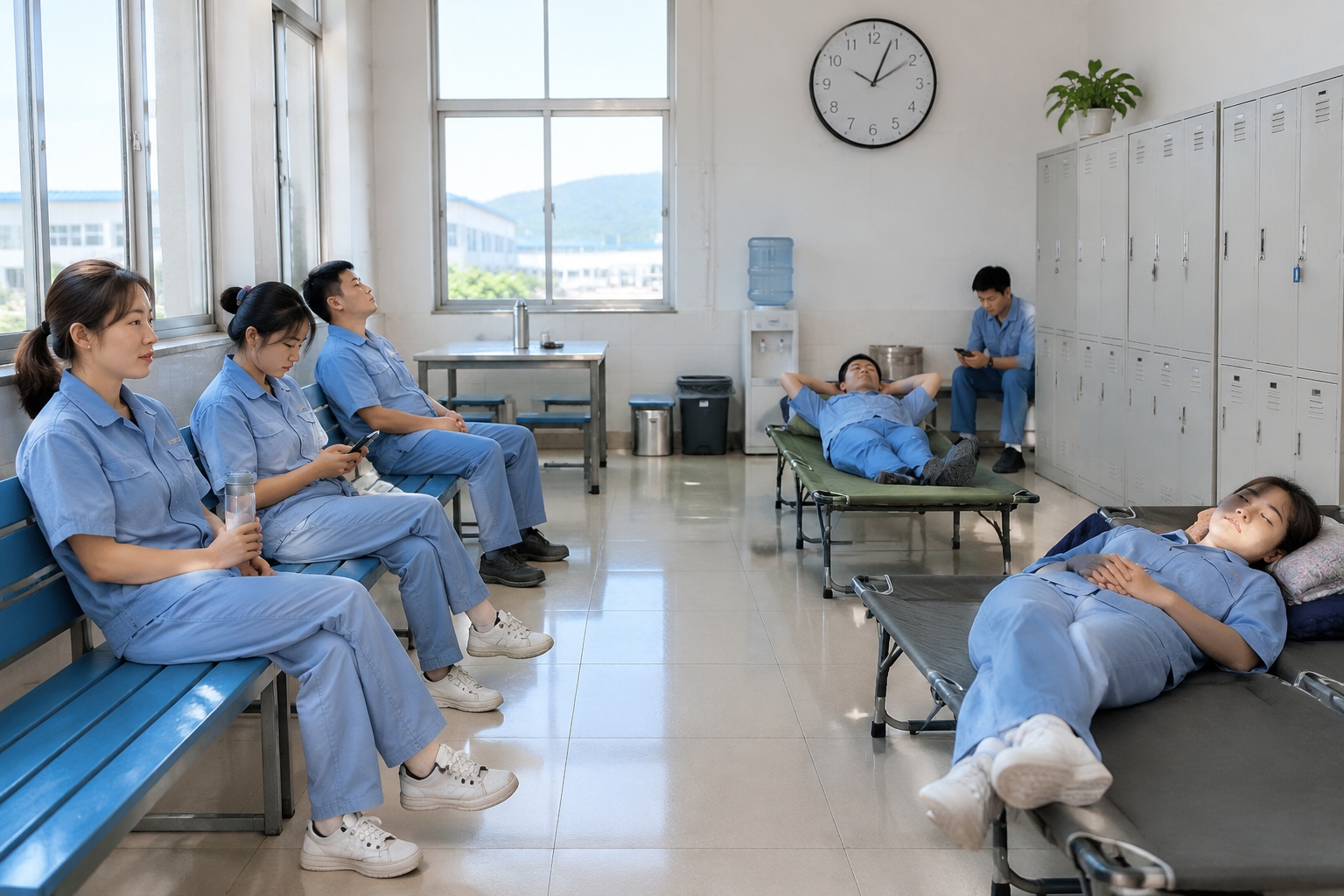
In IT and internet companies, the nap is semi-institutionalized, with rest rooms and a relaxed attitude toward how you sleep. In finance and law, where client-facing hours are rigid and desks sit in full view, the nap is quieter and more discreet—an eye mask and twenty minutes with the head down, not a full cot. In manufacturing, nap time follows the shift schedule precisely; on an assembly line in Dongguan or Suzhou, workers eat in a canteen and rest in a break room before the line restarts on a fixed bell.
Government offices and schools keep the most traditional version, with the longest and most protected break. Startups are the wild card: a ten-person hardware company might have everyone sprawled across beanbags, while another skips the nap entirely because the founder doesn’t believe in it.
Does the younger generation still want it?
Attitudes are shifting, but not in the direction outsiders might guess. Many Gen Z workers embrace the nap more openly, not less. They buy ergonomic desk pillows, share “best office cot” reviews online, and treat midday rest as a legitimate part of work-life balance rather than something to hide.
At the same time, they’re more willing to question the surrounding culture. A twenty-six-year-old designer in Shanghai put it plainly to me: she loves the nap but resents when it’s the only break a job allows. Younger workers increasingly separate the ritual they value from the overwork it can quietly cover for.
The bigger disruptor is where work happens. Remote and hybrid work expanded sharply after 2020, and for people working from home, the office nap dissolves into something looser—a real bed, a longer or shorter rest, no shared signal of lights going down. Some miss the collective quiet; the synchronized stillness of a whole floor resting at once is hard to replicate alone in an apartment.
A ritual that does more than rest the body
That synchronized stillness is the point. The noon nap is not only about sleep. It’s a shared pause that marks the day in two halves and quietly binds a group of people together. When an entire office lowers its voice at the same minute, it’s performing a small act of mutual trust.
Foreign visitors often read a sleeping office as laziness. Spend a week inside one and the reading flips. The nap is disciplined, bounded, and productive by design—a cultural habit old enough to predate the modern economy, flexible enough to survive inside it, and intimate enough that losing it, as remote work spreads, feels like losing something more than an hour.
At 1:30, Liu’s eye mask comes off. The lights brighten. Keyboards start again, first a few, then all of them. The floor has reappeared, and the afternoon has begun.
Start the discussion at forum.chinacomes.com