

A cold plate that confuses first-time visitors
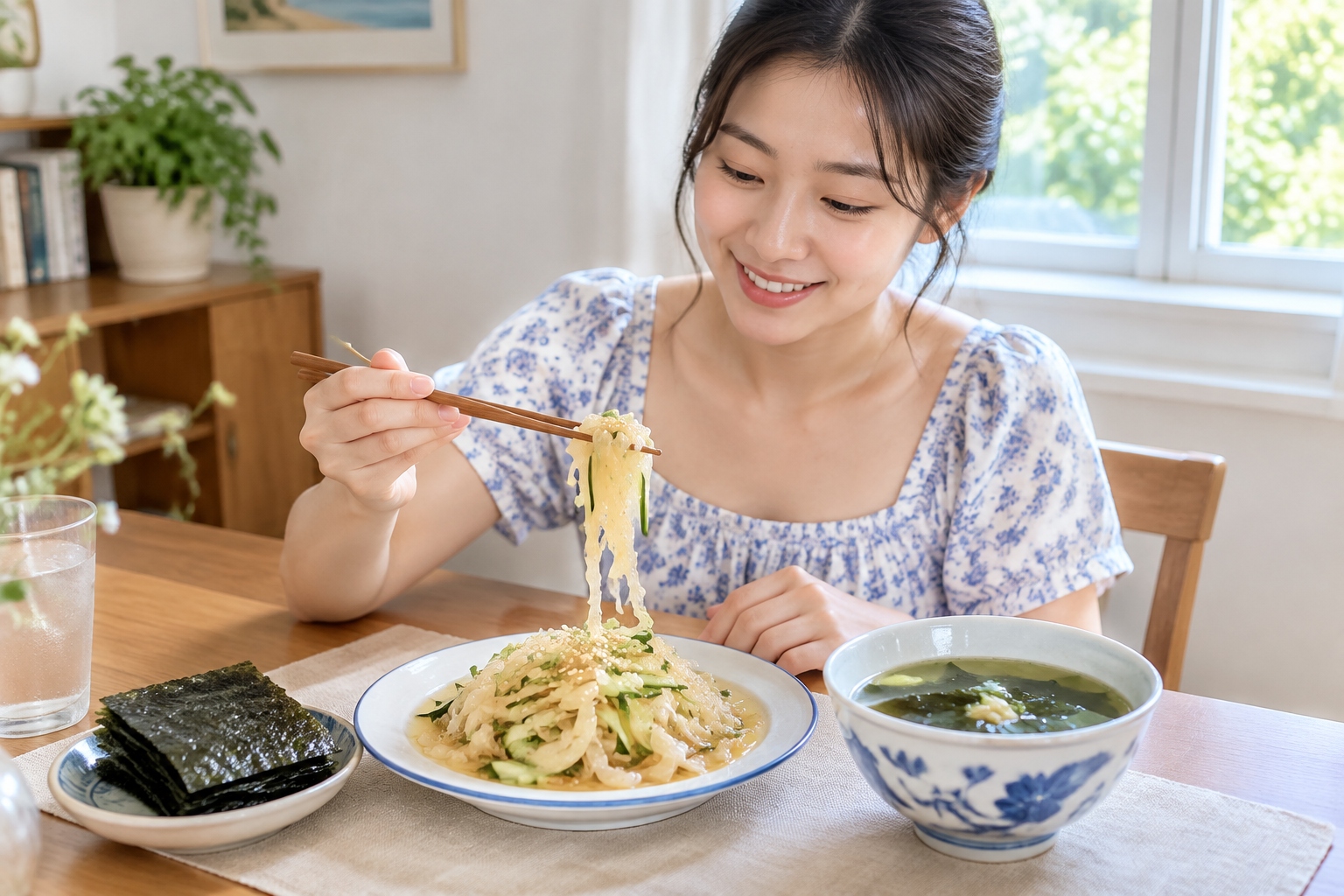
Walk into almost any casual restaurant in a Chinese coastal city on a hot afternoon, and one of the first dishes to land on the table is a glossy heap of shredded jellyfish, tossed with sesame oil, vinegar, slivers of cucumber, and a little garlic. For many foreign visitors, it’s a double surprise: first that people eat jellyfish at all, and second that it tastes of almost nothing—its entire appeal is the sound and feel of eating it.
That reaction captures something important about Chinese food culture. A large part of the cuisine is organized not around flavor alone, but around texture. Jellyfish is prized for a specific crunch, something between a crisp vegetable and soft cartilage. Kelp is valued for being slippery and chewy. Seaweed can be papery, gelatinous, or crackly depending on how it’s prepared. These are not fringe ingredients. They are ordinary, affordable, and sold in every supermarket.

What’s actually on the plate: a quick guide
Three groups of ocean ingredients show up again and again, and they’re easy to confuse if you didn’t grow up with them.
Kelp (haidai)
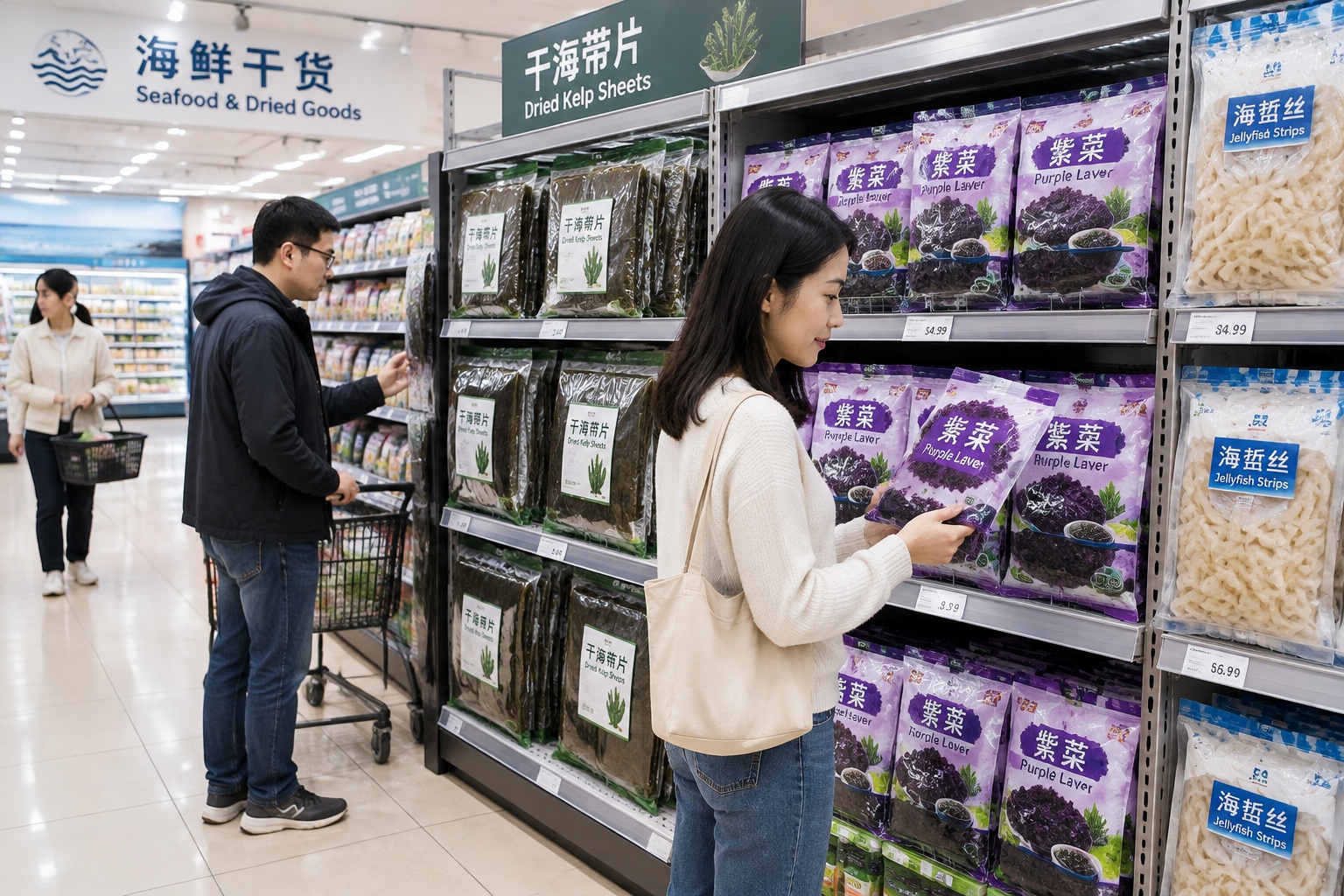
Kelp is the big one—literally. Dark brown-green and sold in long sheets, strips, or tied into knots, it’s one of the most common vegetables in northern China despite not being a vegetable at all. People simmer it in soups, braise it with pork, or blanch it and serve it cold with soy sauce and chili oil. It has a firm, chewy bite and a mild sea-salt taste. China is by far the world’s largest kelp producer, and the price reflects that: a bag of dried kelp costs less than a few dollars and lasts for weeks.
Seaweed and laver (zicai and haizao)
Thin purple-black laver—the same family of seaweed used for sushi wrappers—is dropped into egg-drop soup in dried sheets, where it unfurls into soft ribbons. Other seaweeds are sold fresh or salted and eaten as cold salads. Roasted, salted seaweed snacks, often imported from South Korea or Japan or made domestically, are standard lunchbox items for schoolchildren.
Jellyfish (haizhe)
Edible jellyfish is a different animal entirely, in every sense. It’s processed with salt and alum to firm it up, then sold in shredded or sheet form. Before cooking, it’s soaked to remove salt, then usually served cold. The texture is the whole point—a clean, resilient crunch with no fishiness when prepared well.
Why texture matters so much
Western cooking tends to treat texture as a supporting detail behind flavor. Chinese cooking often flips that. There’s even a dedicated vocabulary for mouthfeel: cui (crisp), nen (tender), qing (springy and chewy, like a good noodle), hu a (slippery smooth). Jellyfish and kelp are chosen precisely because they deliver sensations that meat and ordinary vegetables can’t.
This helps explain why these ingredients haven’t traveled as easily as, say, fried rice or dumplings. The flavors are mild and the preparation is simple, but the appeal depends on enjoying a texture that many non-Chinese diners have no prior reference for. Once you reframe jellyfish as “edible crunch” rather than “strange seafood,” it makes a lot more sense.
The health story people tell
Ask an older relative in China why they eat so much kelp, and you’ll rarely hear “because I like it.” You’ll hear reasons rooted in traditional nutrition logic. Kelp and seaweed are considered good sources of iodine and minerals, and are widely believed to support the thyroid and help “clear heat” from the body.
That last idea comes from traditional Chinese dietary thinking, which sorts foods into warming and cooling categories. Seaweed, jellyfish, and kelp are classified as cooling, which is why they’re especially popular in summer, served chilled as appetizers alongside cold beer. The science behind every specific claim varies, but the broad nutritional picture holds up: these foods are low in calories, high in fiber and minerals, and genuinely rich in iodine. In fact, China’s historical iodine-deficiency problems in inland regions were partly addressed through salt iodization, and coastal diets heavy in seaweed were long seen as naturally protective.
How it gets so cheap: the farming behind the food
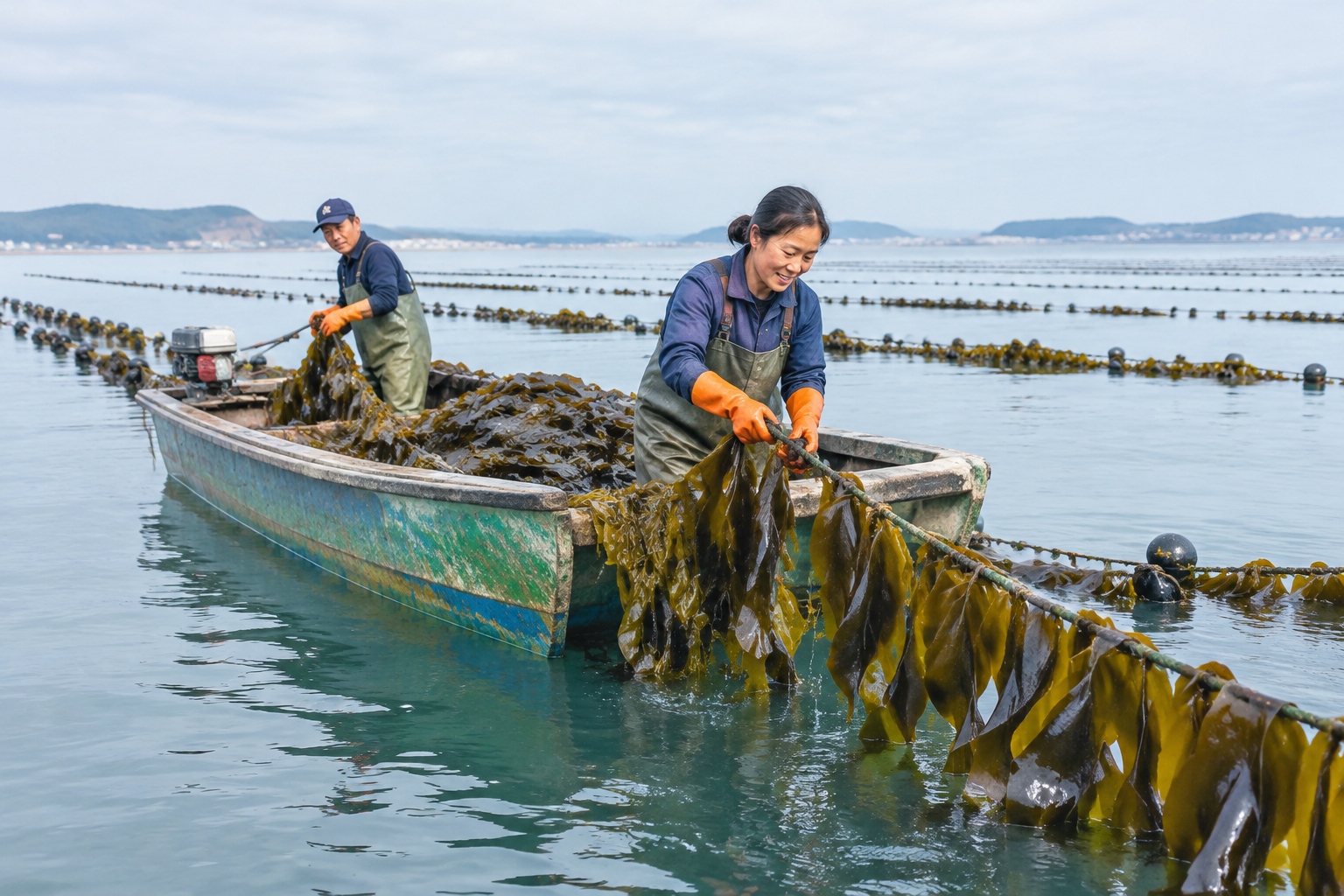
None of this would be everyday food without a massive, mostly invisible aquaculture industry. China produces the overwhelming majority of the world’s farmed seaweed, with kelp and laver grown on rope lines strung across coastal bays in provinces like Shandong, Fujian, and Liaoning.
The system is strikingly low-tech at its core. Farmers seed ropes with young kelp in autumn, let it grow through winter and spring in cold, nutrient-rich water, then harvest it in large flat-bottomed boats. The wet kelp is laid out to dry on racks and roadsides—a familiar sight along northern coastlines, where entire villages smell of drying seaweed in harvest season.
Jellyfish is partly wild-caught and partly farmed, processed quickly after capture because it degrades fast. Both industries employ large numbers of people in coastal towns and feed a domestic supply chain that keeps retail prices low. This is the practical backbone that turns an ocean resource into a one-dollar side dish.
A cuisine that treats the ocean as a garden
What strikes me most about this corner of Chinese food is how unremarkable it feels from the inside. Nobody thinks they’re doing anything unusual by eating jellyfish salad or kelp soup. It’s just food—cheap, cooling, a bit nutritious, pleasant to chew.
That ordinariness is the real story. Where many cuisines draw a hard line between “seafood” (fish, shellfish) and “vegetables,” Chinese cooking quietly expanded the garden to include the seabed. Kelp sits in the vegetable aisle. Seaweed goes in the soup pot like a herb. Jellyfish shows up as a starter the way a Western menu might offer a green salad.
For a country with a long coastline and a long history of making the most of available resources, it’s a practical kind of relationship with the sea—less about delicacy and spectacle, more about turning what the ocean offers into something you can eat on a Tuesday night without a second thought.
Start the discussion at forum.chinacomes.com