

Shaolin Gets the Buses. The Rest of Dengfeng Explains Why It Is There.
By eight in the morning, the road up to Shaolin Temple is a queue of tour buses. Vendors sell foam swords and plastic prayer beads. Boys in orange training suits pose for photos by the gate. A loudspeaker repeats the same three sentences in Mandarin and English, all day.
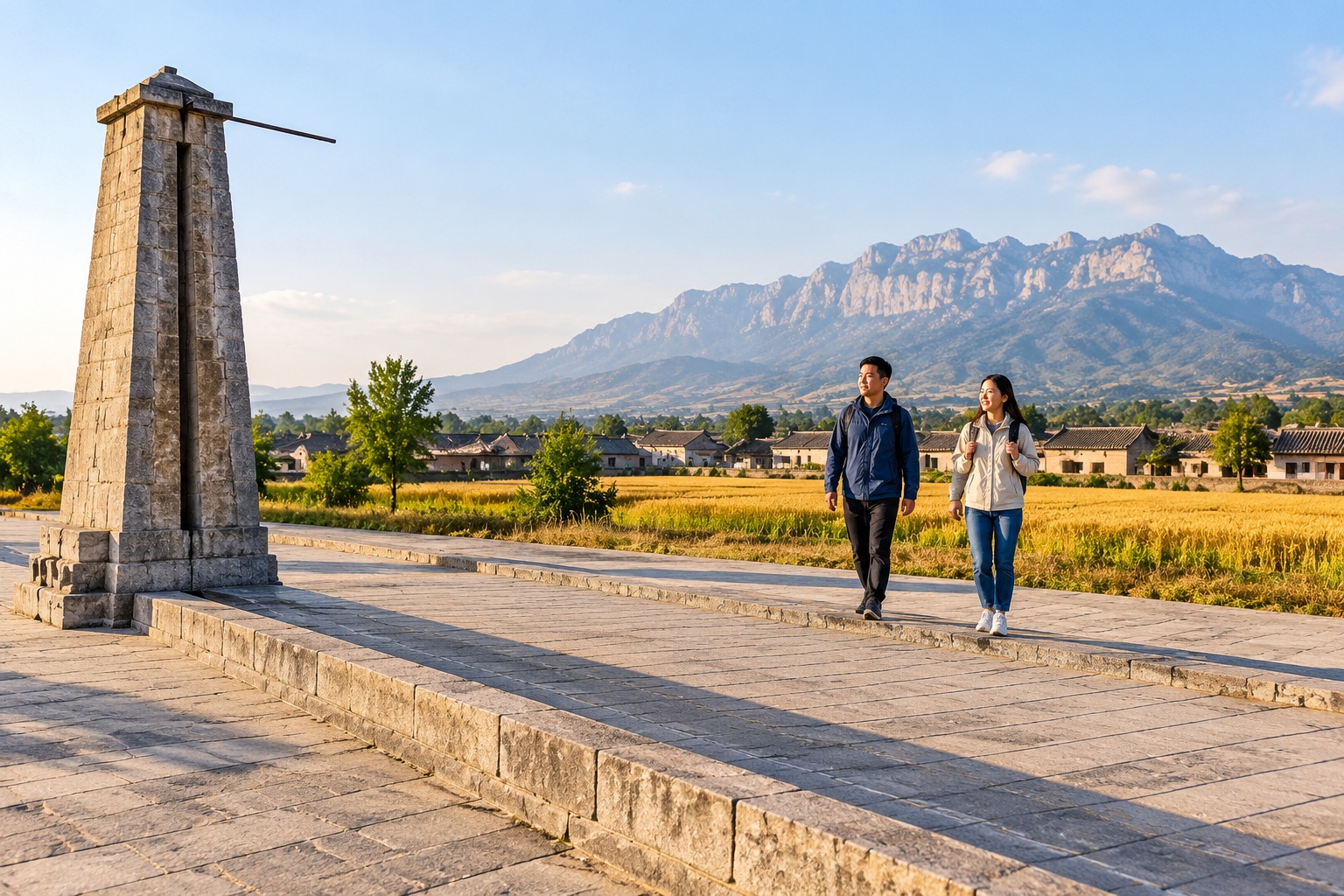
Half an hour’s drive southeast, in a village called Gaocheng, there is a stone wall about twelve metres tall with a long, flat, grooved slab running away from it. On most mornings, almost nobody is there.
Both places belong to the same UNESCO listing, inscribed in 2010 under the slightly clumsy name “Historic Monuments of Dengfeng in The Centre of Heaven and Earth.” Eight clusters of buildings. Eleven structures. Two thousand years of construction. Shaolin is the one everyone photographs. The others explain why anyone built a temple in this particular valley at all.
Why Dengfeng Was Considered the Centre of Heaven and Earth
Dengfeng is a county-level city of about 700,000 people in Henan province, at the foot of Mount Song, the central one of China’s Five Great Mountains. The Chinese word for China — Zhongguo — means “central country.”
This valley’s version of that claim was more specific, and astronomical.
Plenty of societies have decided they live at the middle of the world. The ancient Greeks placed an omphalos, a “navel of the world,” at Delphi. Medieval European mapmakers drew Jerusalem at the centre of their maps. What makes Dengfeng unusual is not the idea. It is that the Chinese turned the idea into a measurement problem, and then built instruments to check the answer.
The Duke of Zhou, a Shadow, and a Definition of “Centre”
The oldest text behind this is the Rites of Zhou, compiled roughly 2,000 years ago. One passage explains how to find the centre of the earth: set up a gnomon — a vertical post of standard height — and measure its shadow at noon on the summer solstice. If the shadow comes out at one foot and five inches, that spot is di zhong: the centre of the earth.
Why would anyone care? Because in a farming society, the calendar is not a convenience. It is the difference between a harvest and a famine. A ruler who could predict the seasons had a claim on legitimacy. Chinese political theory called it the Mandate of Heaven, and the mandate was read out of the sky.
So “centre” was not vanity. It meant: the place where the sun behaves correctly, where the calendar works.
Compare how the rest of the world settled a similar question. Every observatory needed a zero line for longitude, and for centuries they disagreed. In 1884, delegates from twenty-five nations met in Washington and voted to run the prime meridian through Greenwich, largely because Britain had the biggest merchant fleet. It was a political decision and everyone knew it. The Dengfeng claim was, in principle, derived from the sky rather than from a vote.
Gaocheng Observatory: Where an Idea Became an Instrument
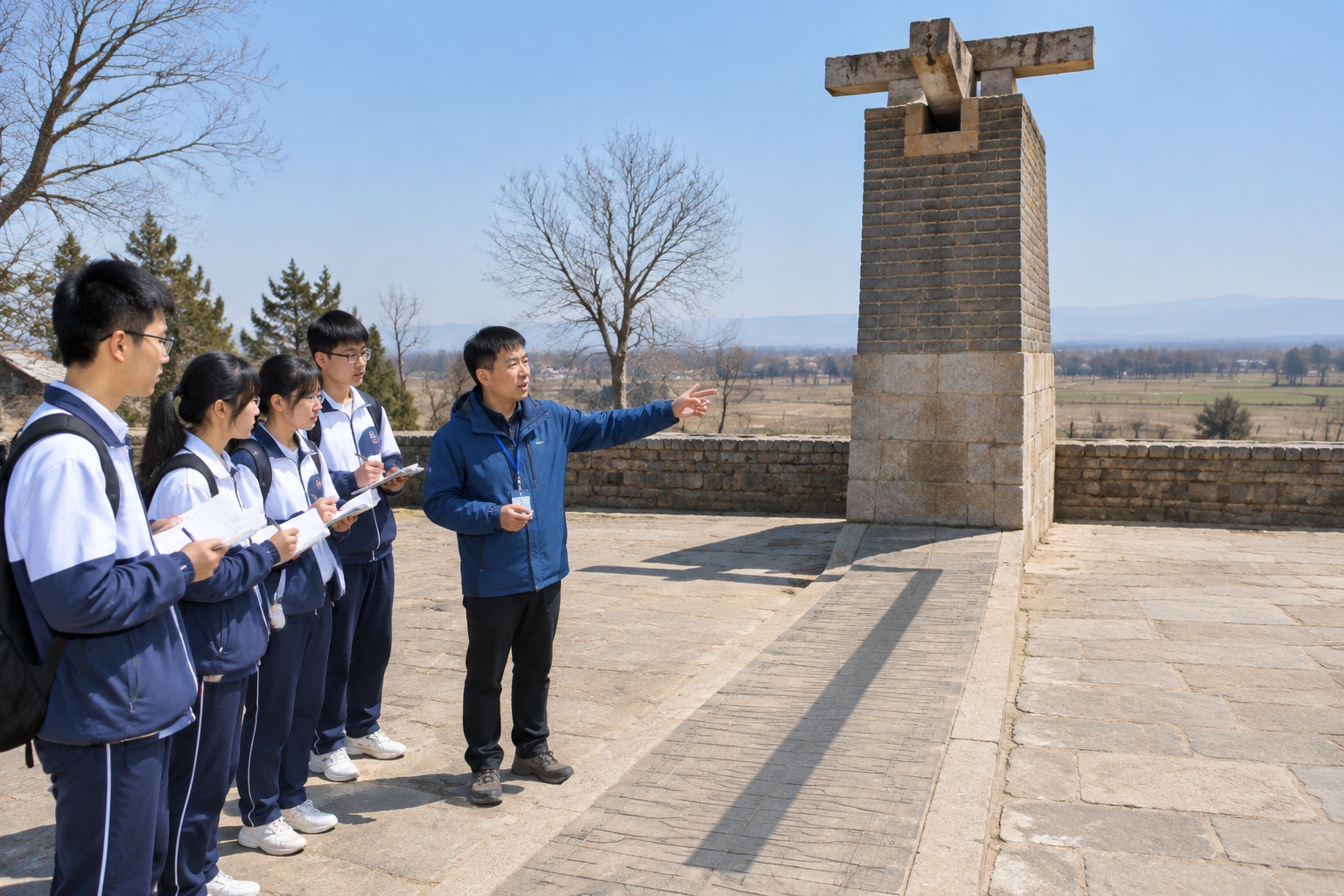
The stone structure in Gaocheng is what survives of a much bigger project. In 1276, Kublai Khan’s government put the astronomer Guo Shoujing and the mathematician Wang Xun in charge of fixing the calendar, which had drifted out of step with the seasons.
Their solution was to measure bigger. Traditional sundials used a gnomon about two metres tall; the shadow was short and its edge blurry. Guo’s team built a gnomon more than twelve metres high with a crossbar at the top, so the shadow fell further and could be read more precisely. They laid a stone scale — the liangtianchi, or “sky-measuring ruler” — 31 metres long to the north, with a water channel cut into both sides so it could be levelled perfectly.
The result, published in 1281 as the Shoushi Calendar, gave a tropical year of 365.2425 days — about 26 seconds off the modern figure, and the exact number the Gregorian calendar adopted three centuries later, in 1582. It stayed in use in China for more than 360 years.
Beside the Yuan observatory stands a much older, smaller stone sundial, put up in 723 during the Tang dynasty and inscribed with the name of the Duke of Zhou — a physical footnote to a legend about measuring the world.
Zhongyue Temple: Gods With Job Titles
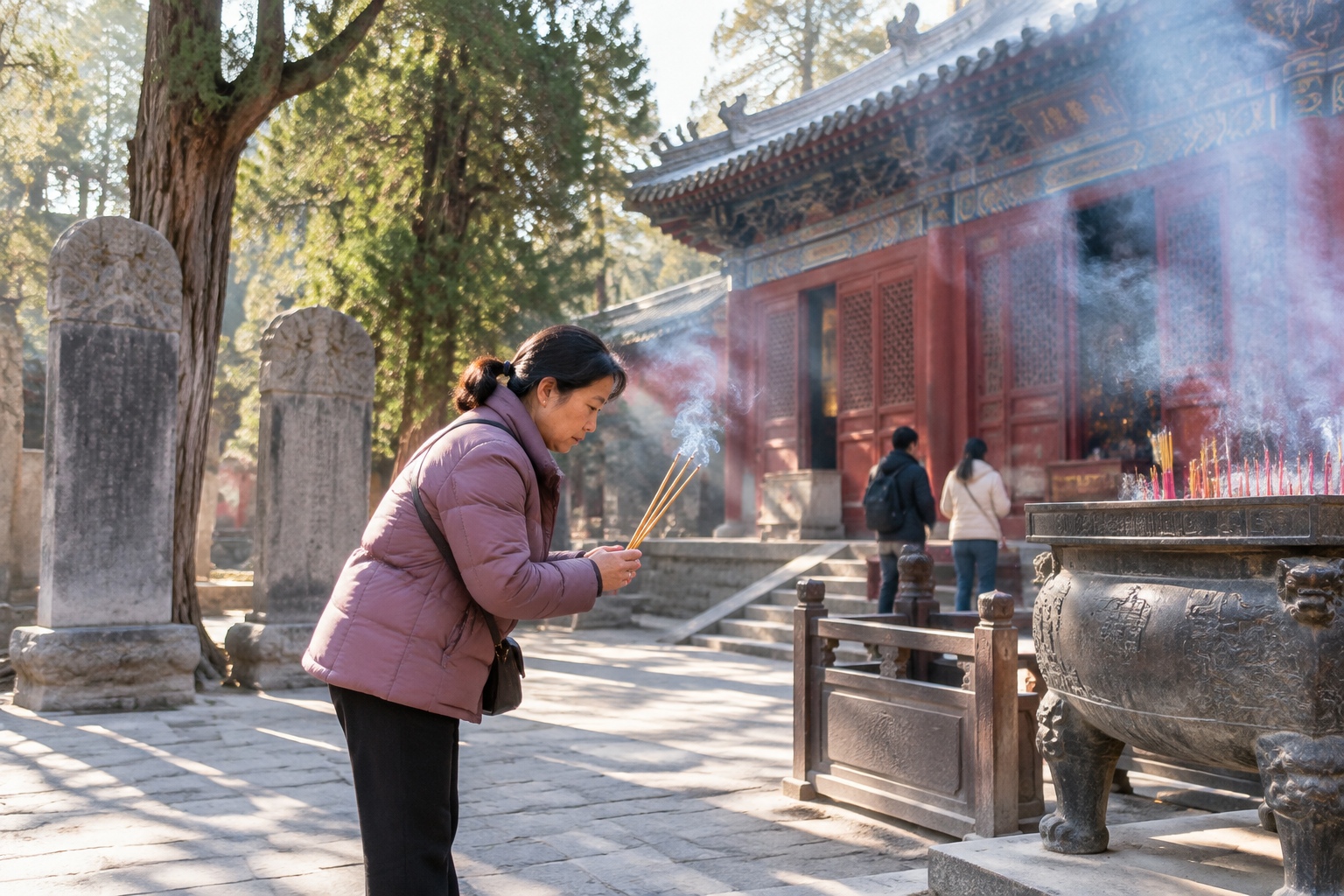
A short drive north of Dengfeng city sits Zhongyue Temple, the largest surviving complex of its kind in the region, built to honour the god of the Central Peak. Eleven courtyards, several hundred rooms, and a line of old cypresses running straight toward the mountain.
Near the main gate are four iron guardians, cast in 1064. Each is about three metres tall and weighs roughly three tonnes. Their knees are polished smooth from a thousand years of people touching them on the way past.
The interesting part is how the deity was imagined. Chinese mountain gods were not moody Olympians; they were officials. They held rank, received imperial titles, and were expected to manage a territory — rain, harvests, bandits. Emperors issued proclamations promoting or demoting them. Visiting was less like praying and more like filing a request, which then went up a chain of command.
In the Greek system you negotiated with gods who had personalities. Here you dealt with gods who had job titles. That difference shapes a great deal, including what a Chinese temple looks like: less a shrine, more a government office building.
Songyang Academy and a Valley of Three Answers
Within a few kilometres of each other, this valley holds a Chan Buddhist monastery, a Taoist temple, a Confucian academy, and an imperial observatory. That arrangement is worth pausing on.
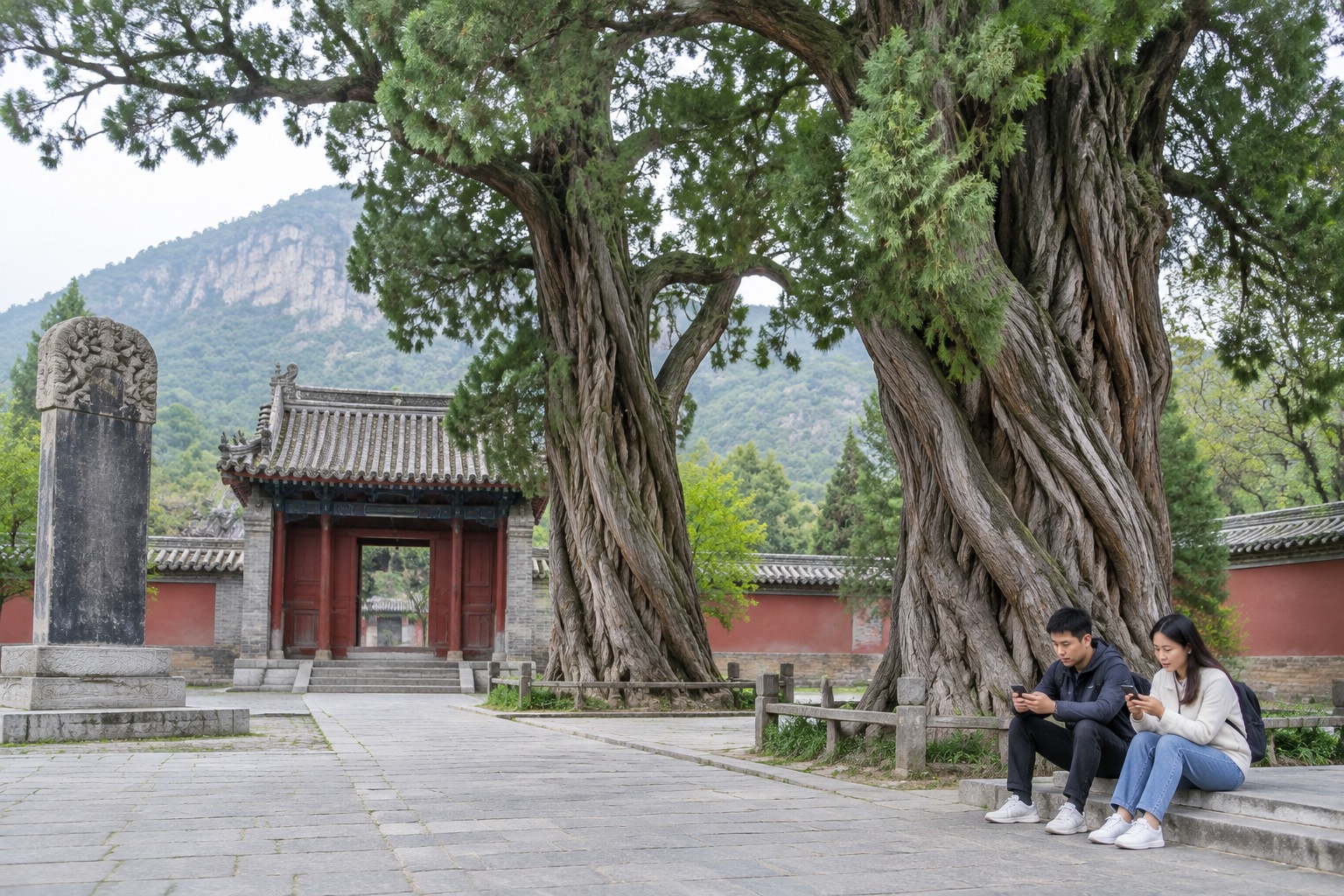
Songyang Academy, on the slope toward the main peak of Mount Song, was one of the four great academies of the Song dynasty. Its most famous residents are trees: a pair of cypresses that Emperor Wu of the Han is said to have named “General” and “Second General” around 110 BCE, and which are still standing. Estimates of their age run past 4,000 years. The historian Sima Guang and the philosophers Cheng Hao and Cheng Yi all taught or wrote here.
Coexistence was not always smooth. Emperor Wuzong’s persecution of Buddhism in the 840s stripped monasteries across the empire, including in this valley, and Confucian academies sometimes competed with Buddhist institutions for the same donors. Over the long run, though, the valley kept all three traditions, often along the same mountain path.
Europe’s equivalent centuries produced sharper, more zero-sum contests — a cathedral built to displace a mosque, a monastery dissolved by a king. Dengfeng offers a different pattern: coexistence without merger. Nobody had to agree. They just had to share a road.
Shaolin: The Part Everyone Knows, and What Has Changed
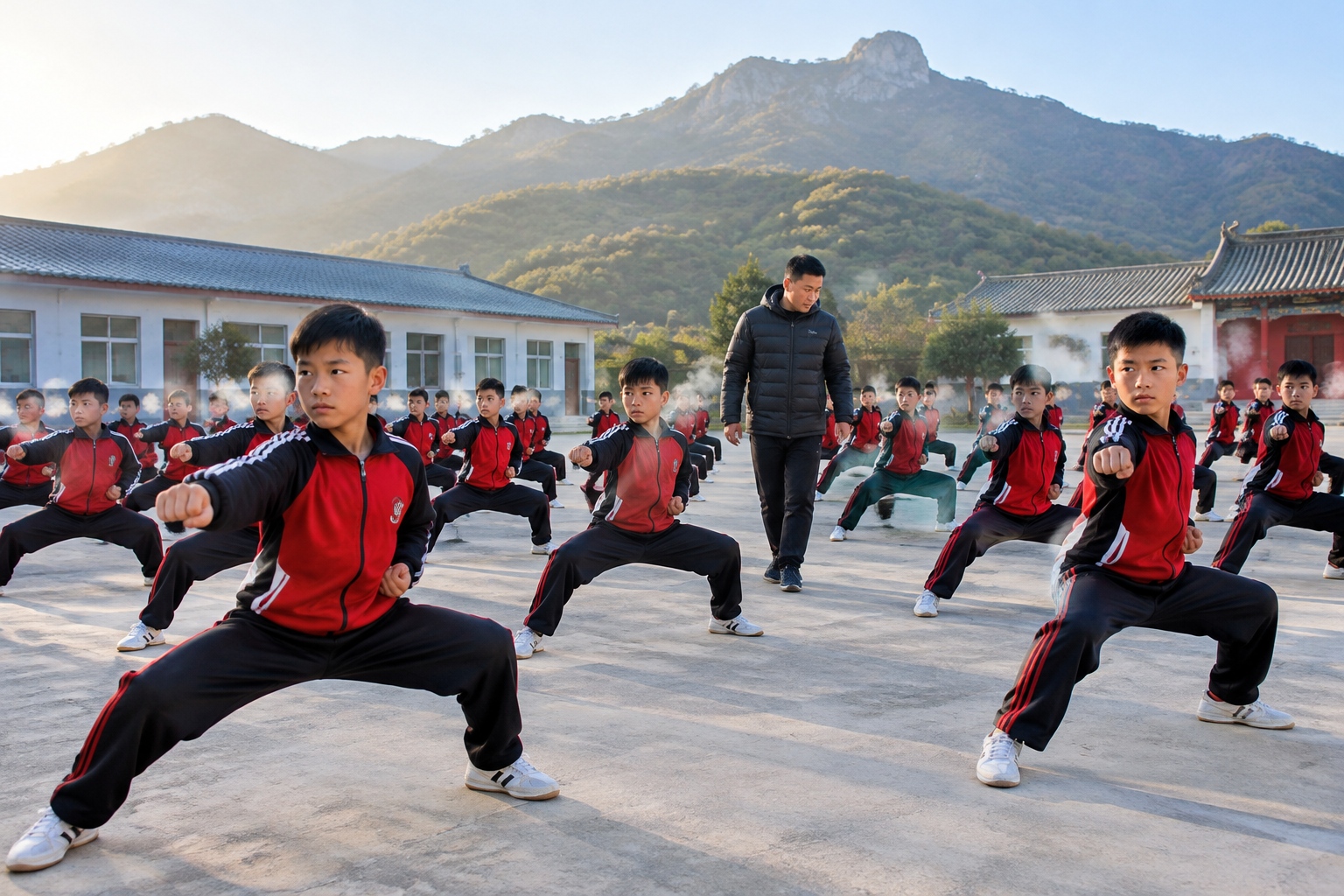
Shaolin was founded in 495 CE by order of Emperor Xiaowen of the Northern Wei, for an Indian monk named Batuo. Bodhidharma, the semi-legendary founder of Chan (Zen) Buddhism in China, arrived around 527 and is said to have meditated in a cave above the temple for nine years.
The martial arts came later, but the modern boom has a clear date. The 1982 film Shaolin Temple, starring a teenage Jet Li, is reported to have sold hundreds of millions of tickets in China. Within a few years the valley filled with martial arts schools.
They are still there, and they are not small. The largest, Tagou, opened in 1978 and now enrols tens of thousands of students, many from rural families. Training runs six to eight hours a day. Alumni perform in stage shows, work on film crews, teach abroad, and have appeared in the opening ceremonies of both the 2008 Beijing and 2022 Winter Olympics.
Behind the main temple, the Pagoda Forest holds more than 240 brick and stone pagodas built between the Tang and Qing dynasties, one for each notable abbot — the largest collection of its kind in China.
Shaolin has also become a case study in how religious sites should be run. Ticket revenue, brand licensing and proposed business partnerships have drawn years of criticism, and the argument over where devotion ends and commerce begins is unresolved. Visitors expecting a quiet monastery should know they are arriving at a major tourist attraction with a monastery inside it.
How to See Dengfeng’s Historic Monuments
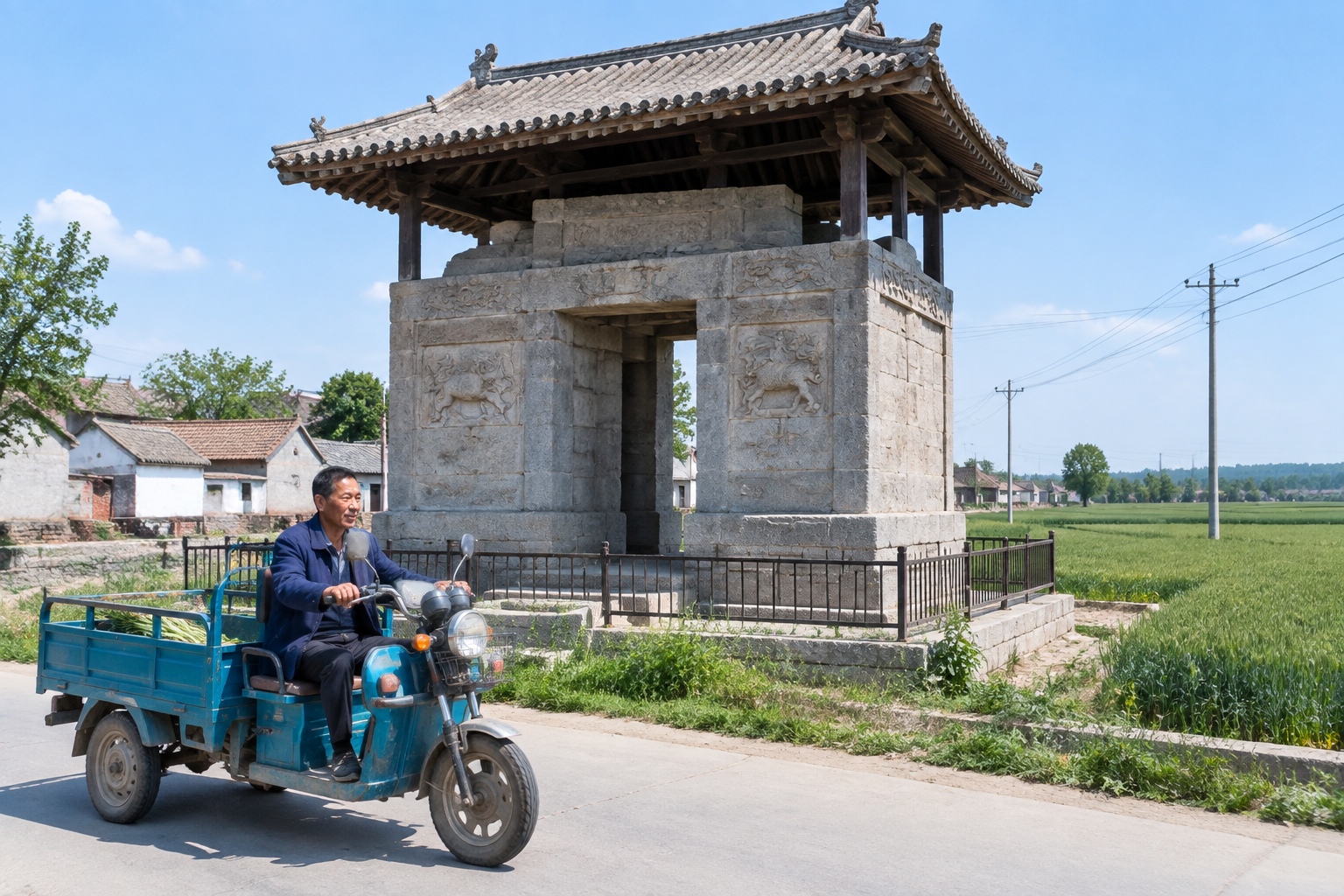
Most visitors give Dengfeng a morning. That covers Shaolin and the Pagoda Forest. Anything more needs a car and a day, and it is worth it — the sites are spread across roughly 20 kilometres, and public transport between them is thin.
The plan: base yourself in Dengfeng city. Give Shaolin half a day. Spend an afternoon on Zhongyue Temple and Songyang Academy, which sit on the road up toward Taishi Mountain. Drive southeast to Gaocheng for the observatory, and stop at the three Han dynasty stone gates — Taishi, Shaoshi and Qimu — which date to 118–123 CE and are the oldest structures in the whole listing. They now stand in villages and fields, easy to drive past without noticing.
Individual tickets are modest and change over time, so check current prices. A hired driver for a full day usually costs less than two separate taxi round trips.
Why an Ancient Obsession With “Centre” Still Matters
Two recent UNESCO inscriptions suggest the idea never really left. The 24 solar terms — the farming calendar that grew out of exactly this kind of sky-watching — joined the intangible heritage list in 2016. In 2024, so did the Central Axis of Beijing, the line running north from the Forbidden City through the Drum and Bell Towers, which organises the modern capital around a single spine.
Ordering space from a defined centre is an old habit here, and an unusually durable one.
Go back to the parking lot at Shaolin. Watch what people do: photo at the gate, kung fu show, back on the bus. The other half of the story is half an hour away and takes about an hour to walk around. It is a stone wall, a grooved slab, and a shadow.
It is also the reason the temple exists at all.
Start the discussion at forum.chinacomes.com