


7:45 AM, Saturday. The Traffic Jam That Feels Like a Vacation
The engine hums low as the sedan merges onto the G60 Expressway outside Shanghai. It’s not the chaotic gridlock of Monday morning rush hour. Instead, the cars move in a steady, rhythmic flow, headlights off, music playing softly inside. Inside this car sits Lin Wei, 32, a software engineer who spent his week debugging code in a glass-walled skyscraper in Pudong. Today, he’s not looking for a new office; he’s hunting for silence.
Lin represents millions of young Chinese workers who have stopped dreaming of ‘fleeing’ the megacities forever and started mastering the art of the ‘micro-escape.’ In China, the definition of travel has shifted. It is no longer about saving up for a two-week trip to Europe or Japan. It’s about finding a pocket of peace within 100 kilometers of home.
The Myth of Fleeing vs. The Reality of Recharging
For decades, the narrative was simple: work hard in Beijing, Shanghai, Guangzhou, and Shenzhen (the ‘Big Four’), then retire to a quieter life elsewhere. But that dream is evolving into something more immediate. The new trend isn’t permanent relocation; it’s weekly recharging.
This shift isn’t happening because people are lazy. It’s driven by the sheer density of urban life. When your commute is an hour and your apartment is 40 square meters, a two-hour drive to a nearby village feels like entering a different world. This is ‘micro-tourism’: short trips designed for mental reset rather than sightseeing.
Case Study: The Digital Nomad in Chengdu’s Backstreets

A young woman sits at an outdoor wooden table in a narrow alleyway of Chengdu, typing on a laptop with a steaming cup of tea beside her. Traditional brick walls contrast with modern tech equipment.
In the humid heat of late spring, Lin Wei isn’t driving to Chengdu for this story—let’s call him David instead. David works remotely from a co-working space in Wuhou District, Chengdu. He doesn’t own a house here; he rents a small loft and spends his weekends exploring.
His routine is specific: 8:00 AM starts with breakfast at a street stall serving spicy wonton soup. By 10:00 AM, he’s set up his laptop in a ‘digital nomad’ café where the Wi-Fi speed rivals Shanghai’s but the atmosphere smells of roasted peanuts and old wood. He works until noon, then walks to a nearby park.
‘In Beijing,’ David says, sipping his tea, ‘you walk fast because there is always someone rushing past you. Here, if I stop for five minutes, no one cares.’ The micro-trip here isn’t about the destination; it’s about the permission to slow down. Chengdu has become a hub not just for tech startups, but for those seeking a slower pace of life.
Case Study: Smart Hiking in Hangzhou
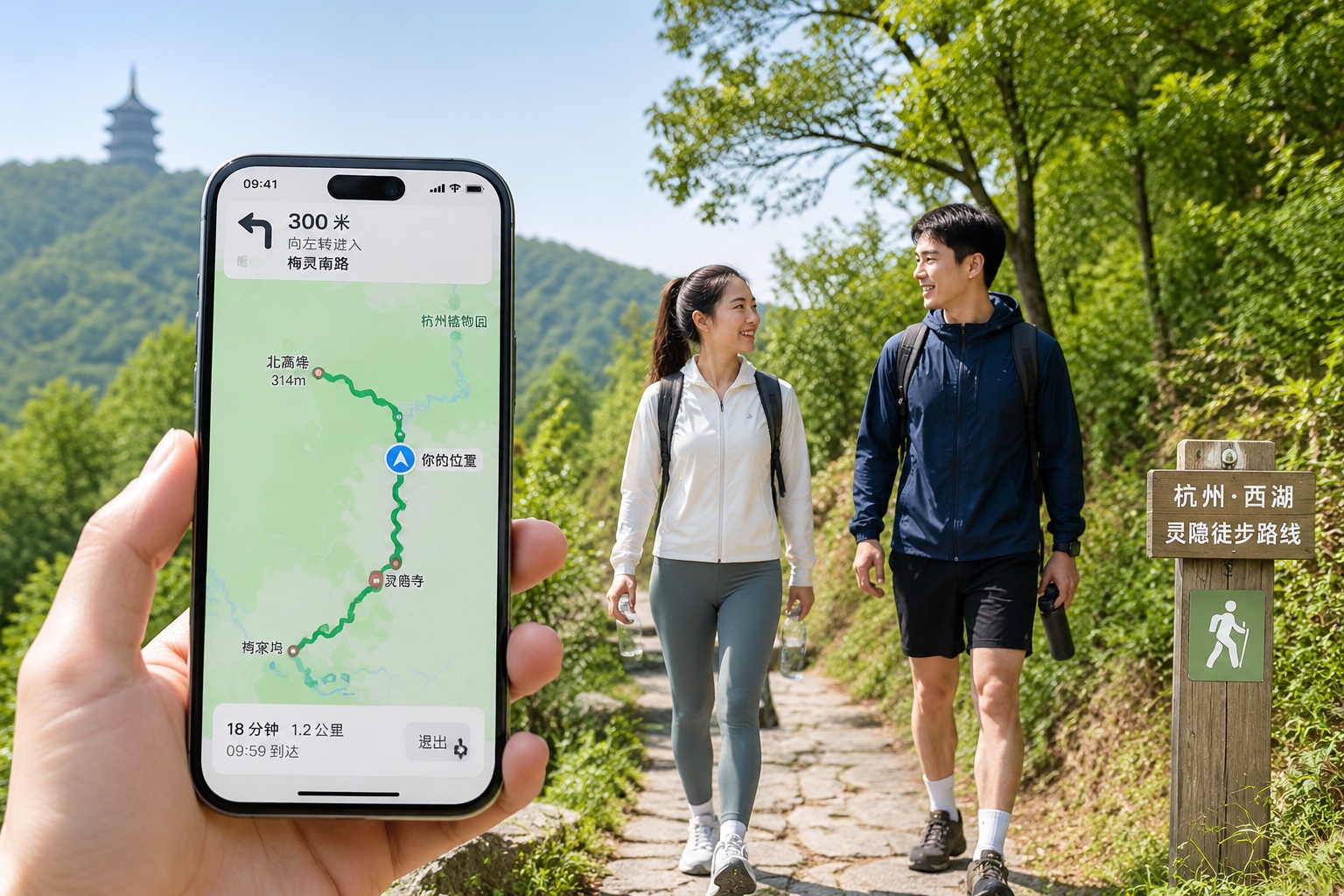
Smartphone screen showing a map app navigating a lush green mountain trail in Hangzhou, with hikers visible in the background carrying water bottles and wearing breathable sportswear.
In Hangzhou, the micro-trip takes on a different shape: it’s digital and physical. The city is famous for West Lake, but the real weekend escape happens on the trails of Tianmushan Mountain.
Here, ordinary workers use ‘Super Apps’ like WeChat or Alipay to navigate. They scan QR codes at trailheads to rent electric bikes or check crowd density in real-time. The infrastructure is surprisingly modern. Smart benches charge phones; digital signs warn of slippery paths during rain.
‘I don’t need a guidebook,’ says Sarah, a 28-year-old graphic designer from the city center. ‘My phone tells me exactly where the quietest trail is right now. If it’s too crowded, I drive ten minutes further.’ This integration of technology and nature allows for spontaneous travel without the anxiety of getting lost or missing out.
The Logistics of Ease: Why Spontaneity Works
What makes these micro-trips possible? It’s the seamless ecosystem of Chinese digital life. You don’t need cash, paper tickets, or a pre-booked itinerary. A single scan of a QR code can unlock a shared bike, pay for a meal at a roadside stall, and book a room in a rural homestay.
This frictionless experience changes the psychology of travel. For many Americans or Europeans, a weekend trip requires days of planning. In China, you can decide to leave on Friday night after dinner and be back Sunday evening with zero stress. The ‘logistics’ are invisible, buried under layers of convenient apps.
Public Spaces: Who Owns the Weekend?
The transformation extends beyond personal cars to public parks. In recent years, Chinese cities have radically reshaped their green spaces. Old industrial zones are now open-air museums. Abandoned railway lines have become cycling paths. Community centers offer free Wi-Fi and charging stations.
It is a visible shift in how the state views leisure. Parks are no longer just for morning exercises; they are vibrant hubs for music, markets, and family picnics. The weekend belongs to the public. You will find couples playing chess under banyan trees, groups of teenagers skateboarding near fountains, and elderly people practicing Tai Chi in silence.
From Speed to Quality
The rise of micro-tourism reflects a broader societal shift. After decades of breakneck growth focused on GDP and skyscrapers, China is now prioritizing ‘quality of life.’ It’s not about running faster; it’s about knowing when to stop.
For the ordinary person, this means more than just better apps or cleaner parks. It means reclaiming time. Whether it’s an hour in a Chengdu alleyway or a hike up Hangzhou’s mountains, these micro-trips are a quiet rebellion against the grind. They prove that you don’t need to leave your city to find peace—you just need to know where to look.
Start the discussion at forum.chinacomes.com