


The Paper Promise: Why the Contract Matters
Li Wei, a software engineer from Berlin, recently moved to Shanghai. His offer letter promised “competitive salary and great benefits.” But when he sat down to sign his employment contract, he found clauses that didn’t match the verbal promises. In China’s bustling tech hubs, this disconnect is common. Unlike in some Western jurisdictions where verbal agreements hold significant weight, Chinese labor law is strictly formalistic.
The most fundamental rule for any foreigner working in China is simple: you must have a written labor contract. According to the Labor Contract Law of the People’s Republic of China, employers are legally required to sign a written contract with employees within one month of starting work. Without it, your legal standing is fragile. If a dispute arises over unpaid wages or wrongful termination, having that signed document is your only shield. It transforms you from an “employee” into a party with enforceable rights.
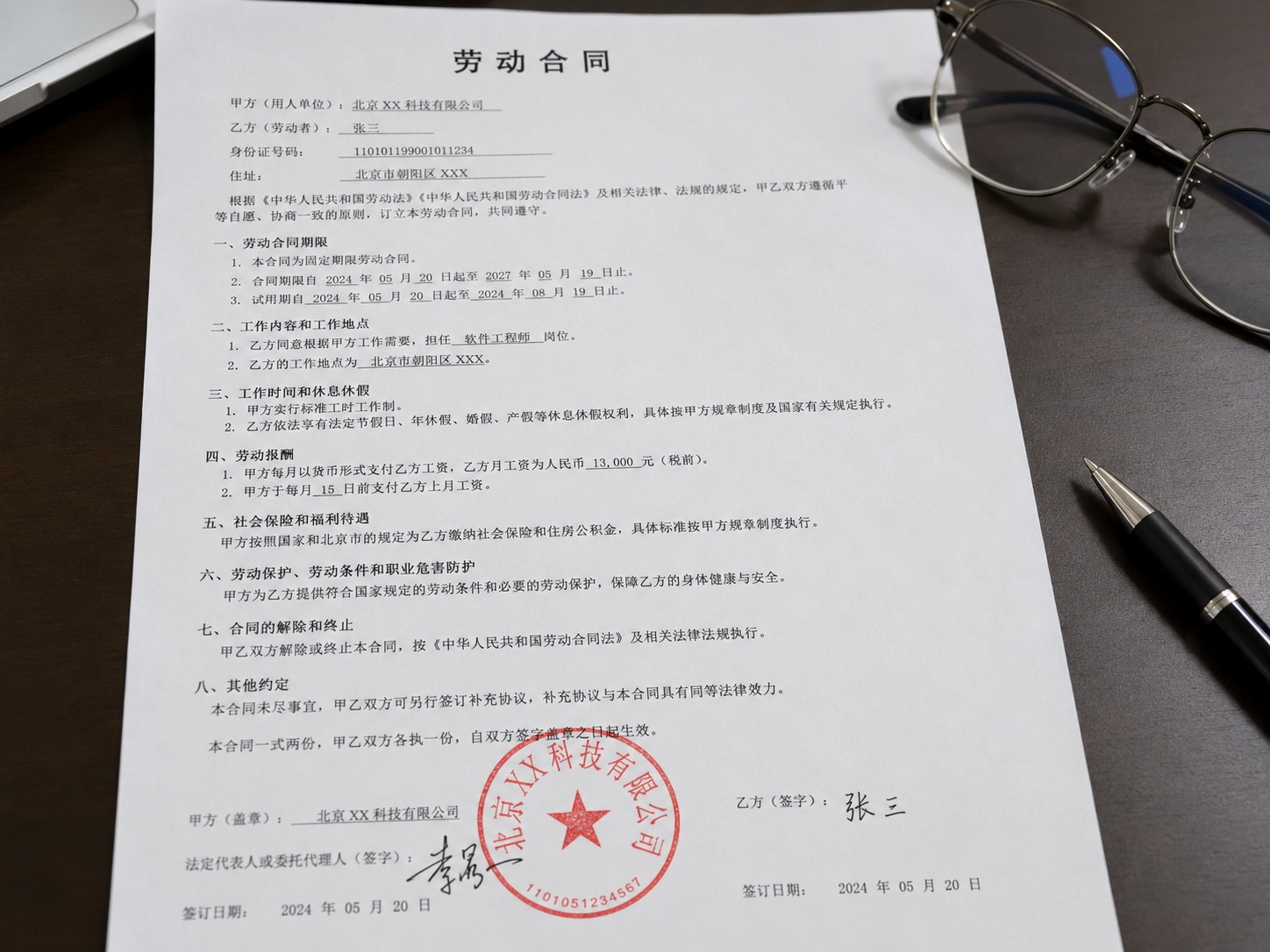
Decoding the Probation Period
The probation period (shi yong qi) is often where discrepancies appear. Many foreign candidates assume they are on a standard three-month trial, but Chinese law sets strict limits based on contract duration.
- Contracts between 3 months and 1 year: Probation cannot exceed one month.
- Contracts between 1 year and 3 years: Probation cannot exceed two months.
- Contracts of 3 years or more (or open-ended): Probation can be up to six months.
Crucially, you can only have one probation period per employer. If a company tries to renew your contract with another probation clause, it is illegal. Furthermore, during probation, your salary must not be less than 80% of the agreed full-time wage, nor can it be lower than the local minimum wage.

The “Five Insurances and One Fund”
When negotiating salary in China, you will often hear about Wu Xian Yi Jin (Five Insurances and One Fund). This is not just a bonus; it is a mandatory social security system. Foreigners employed by Chinese companies are generally required to participate in this system, though rules can vary slightly by city.
The “Five Insurances” include:
- Pension Insurance: A long-term savings plan for retirement. The contribution rate is significant, meaning a portion of your monthly salary goes directly into this account.
- Medical Insurance: Covers hospital visits and prescriptions. In major cities like Beijing or Shenzhen, having adequate medical coverage is essential due to the high cost of private healthcare.
- Unemployment Insurance: Provides temporary financial support if you are laid off without fault.
- Work-Related Injury Insurance: Covers accidents occurring at work. This is critical for any employee.
- Maternity Insurance: Now often merged with medical insurance, it covers maternity leave and related costs.
The “One Fund” is the Housing Provident Fund. Think of this as a forced savings account specifically for housing. Both you and your employer contribute to it. While it can be withdrawn when buying property or renting (depending on local rules), many foreigners view it as part of their total compensation package. A contract that omits these contributions is effectively lowering your take-home pay by 20-30%.
The Non-Compete Trap
For senior roles or those in tech and finance, you may encounter a non-compete clause (Jing Ye Xian Zhi). This clause prevents you from joining a competitor for a certain period after leaving the company. The law states this period cannot exceed two years.
However, there is a catch: If the company wants to enforce this clause after you leave, they must pay you compensation during that restriction period. Typically, this compensation is around 30% of your average monthly salary from the previous 12 months. If the contract says you are bound by non-compete rules but does not specify post-employment compensation, be cautious. In practice, some employers try to enforce these clauses without paying, leading to lengthy legal battles.
Pre-Signing Checklist for Foreigners

Before you sign your name on the dotted line, verify these points:
- Employer Identity: Ensure the contract is with the actual legal entity (the company stamp must match the business license), not a third-party agency unless you are being hired through them.
- Job Title and Location: Vague titles like “Other duties as assigned” can be exploited. Specificity protects you from sudden, unwanted transfers to other cities or departments.
- Working Hours: China has a standard 40-hour work week. Overtime should be compensated at 150% (weekdays), 200% (weekends), or 300% (holidays). Check if the contract acknowledges these rates.
- Tax and Social Security: Confirm that social security contributions are calculated based on your actual gross salary, not just the minimum base. Many companies try to minimize costs by paying insurance on a lower baseline.
Navigating Chinese labor contracts requires attention to detail. By understanding these clauses, you protect not just your rights, but your peace of mind in one of the world’s most dynamic markets.