

At 7 a.m. in a Cotton Field, the Loudest Thing Is a Machine
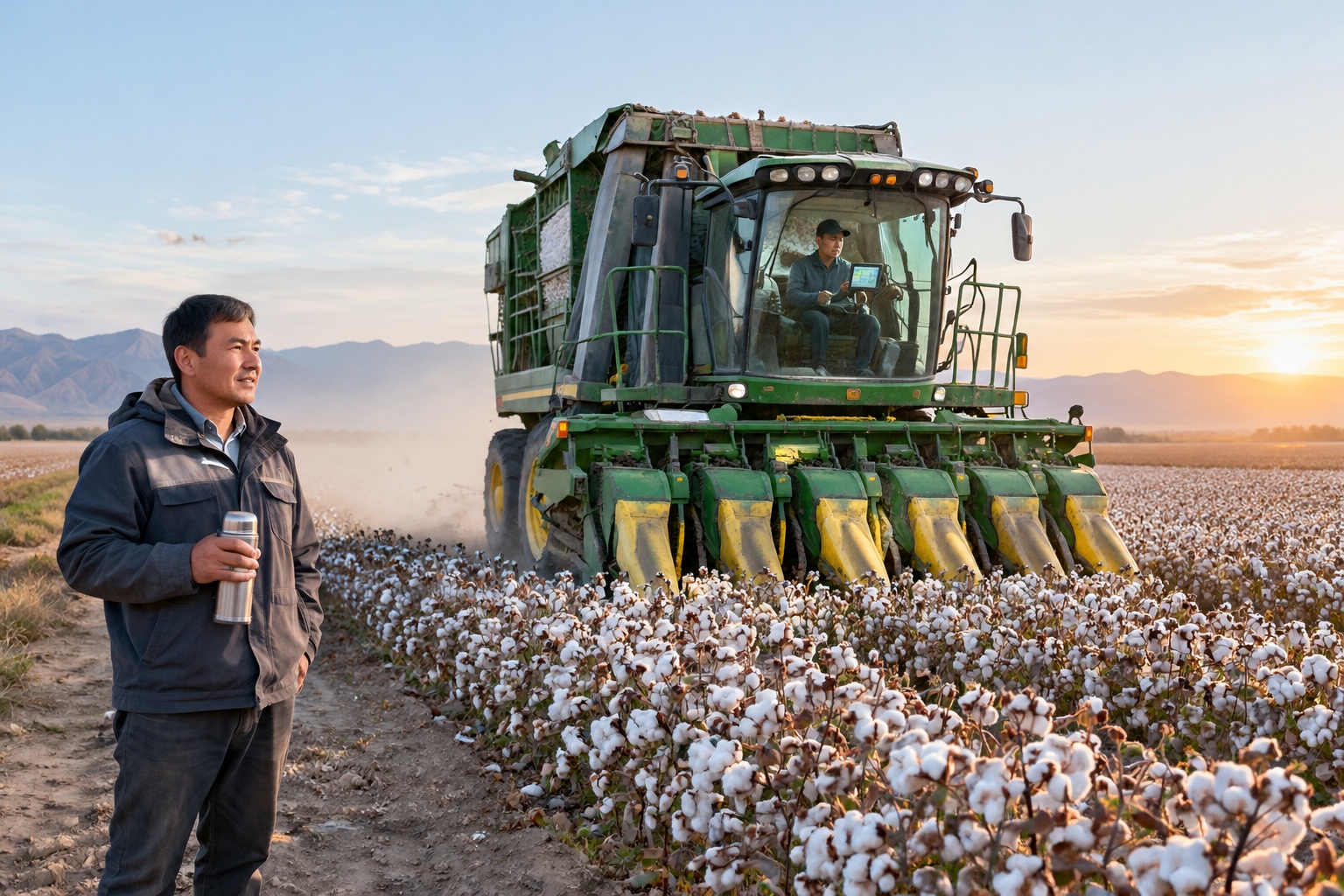
At 7 a.m. in Shaya County, southern Xinjiang, the air still holds the cool of the desert night. A thin line of light sits on the horizon. A worker in a blue jacket climbs into the cab of a six-row cotton picker, sets a plastic bottle of tea beside the joystick, and taps a screen. The GPS map wakes up: rows of green dots, a field boundary, a fuel gauge. The diesel engine coughs once, then settles into a low rumble.
Ten years ago, this same field would already be full of people. Pickers in wide hats, cotton sacks tied at the waist, hands moving from plant to sack. By noon, the edge of the field looked like a bus station: bicycles, motorbikes, watermelons, children. Today, the machine moves down the row, and the field behind it is almost empty. A few farmers stand at the headland, watching. Their phones buzz with WeChat messages from the cooperative. The loudest thing for most of the day is not conversation. It is the machine.
That is what people mean when they say Xinjiang’s farmland is getting quieter. It is not that farming has stopped. It is that the harvest, once a human crowd, has become a mechanical routine.
The Sound That Disappeared
For decades, the cotton harvest in Xinjiang was a mass migration. Each autumn, trains from Henan, Sichuan, Gansu and other provinces carried hundreds of thousands of seasonal workers westward. They picked by hand, paid by the kilogram. In villages, families rented out rooms, opened small canteens, sold gloves and hats. The peak season lasted from September to November. A skilled picker could collect 80 to 120 kilograms a day. A field of 500 mu—about 33 hectares—could absorb dozens of workers for weeks.
The work was hard, and the money mattered. For many rural households, two months of picking paid for winter expenses, school fees, or a new motorcycle. For cotton farmers, however, the cost was rising. By the early 2010s, hand-picking could cost 2.5 to 3 yuan per kilogram. With yields around 400 kilograms per mu, that was more than 1,000 yuan per mu in labor alone. If the weather turned bad or pickers were scarce, the crop could sit in the field.
What Changed in Ten Years
Mechanization did not arrive overnight. It came in pieces: better seed varieties that ripened evenly, defoliants that stripped leaves before harvest, drip irrigation that kept fields uniform, and machines that could handle Xinjiang’s dense cotton. The biggest shift was the cotton picker. In 2014, only about one-tenth of Xinjiang’s cotton was harvested by machine. By 2023, official figures put the machine-picking rate above 85 percent. The cotton area is around 2.5 million hectares, producing more than 5 million tons—about 90 percent of China’s cotton.
A six-row picker can harvest 300 to 500 mu a day. That is roughly the daily work of a thousand hand pickers. It also picks cleaner, faster, and in the dark if needed. The machine does not need a train ticket, a dormitory, or a lunch box. Its cost per mu is usually lower than hand-picking, though the upfront price of the machine, fuel, maintenance, and plastic wrap for the round modules are serious numbers for a small family farm.
That is why the quiet is uneven. On large cooperative fields in the north, the harvest can be almost fully mechanical. On small plots in the south, and on fields growing specialty cotton for seed or long-staple fiber, people still bend over the rows. Some farmers say hand-picking gives better quality and less trash. Others say they simply cannot get a machine into a tiny field surrounded by orchards.
Drones, Drip Lines, and a New Farming Calendar
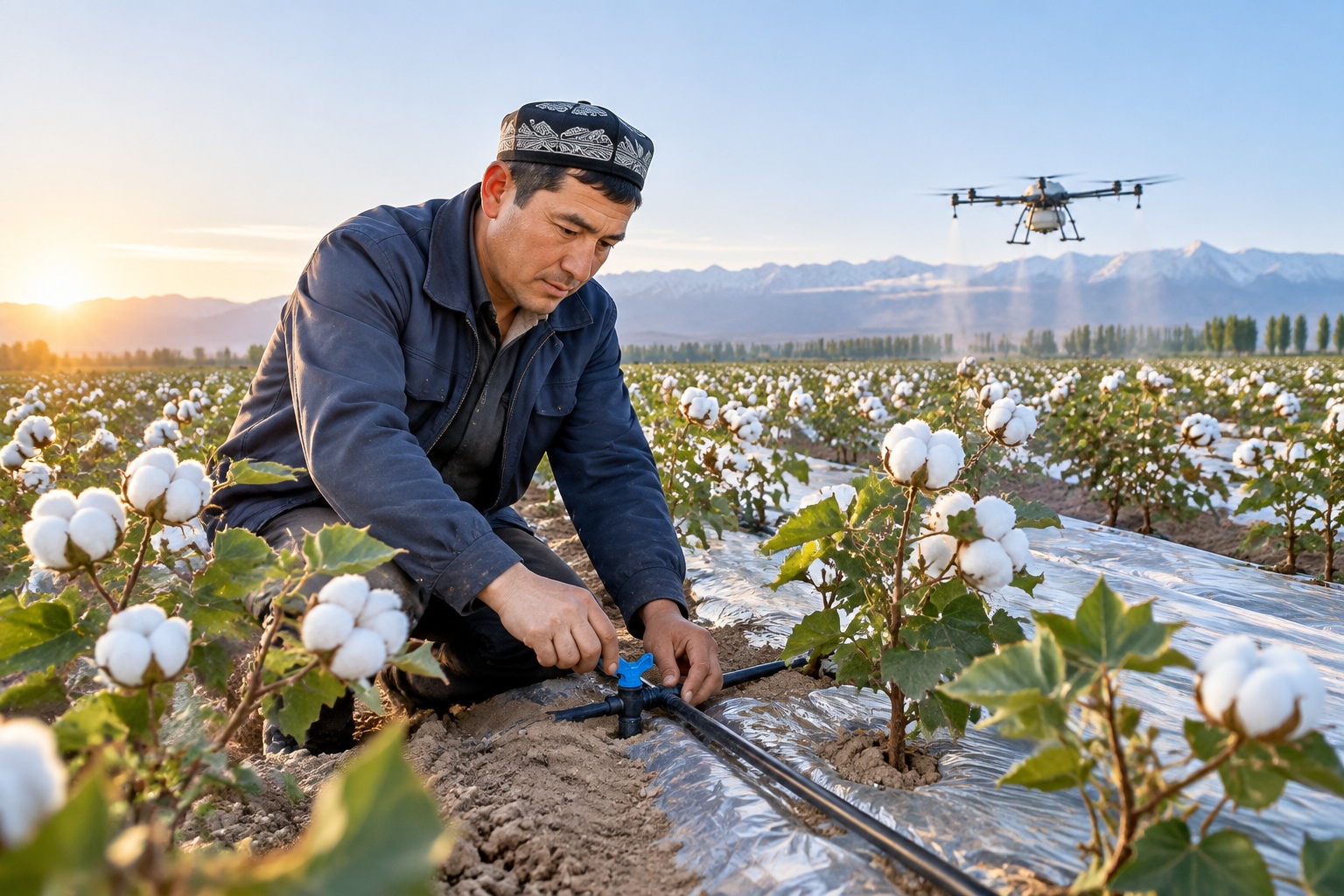
The cotton picker is only the most visible machine. The quieter revolution happens earlier in the season. In April, tractors with Beidou navigation roll across the fields, laying plastic film and drip tape in straight lines. The driver often does not touch the steering wheel. The system keeps the tractor within a few centimeters of the planned path. Under the film, water and fertilizer move through the drip tape directly to the roots. Farmers can check moisture on a phone app and open a valve from home.
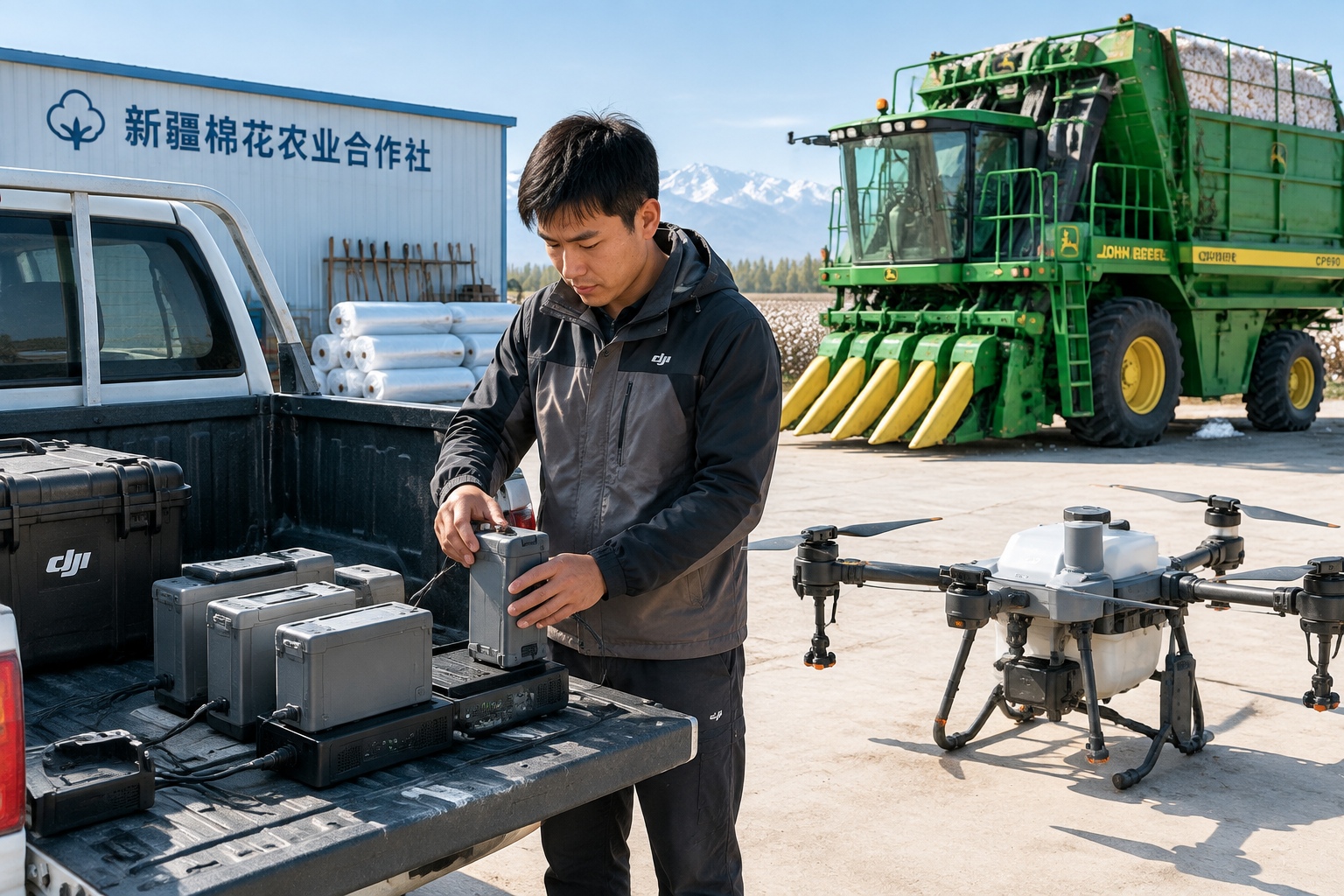
In July and August, drones take off. A pilot stands at the edge of the field, a control screen in hand. The drone sprays defoliant, pesticide, or foliar fertilizer. A single drone can cover hundreds of mu in a day. In Xinjiang, public reports say the number of plant-protection drones has passed 10,000. During the peak season, they work in teams, with pickup trucks carrying batteries, generators, and water tanks. The sky above the cotton has a new sound: a high, electric whine, like a large insect.
The Quiet Field Still Needs Hands
Machines have not removed people from farming. They have moved them. A cotton picker needs a driver, sometimes two. It needs mechanics, fuel trucks, GPS calibration, and someone to coordinate which field is ready. A drone needs a licensed pilot, a battery manager, and customers. A drip irrigation system needs someone to repair leaks, replace filters, and watch the pressure.
In many villages, the new farm jobs go to younger people who did not plan to farm. A former shop assistant becomes a drone pilot. A young man who once drove a taxi learns to operate a picker and earns 10,000 to 20,000 yuan in the harvest season. A woman who used to pick cotton by hand now runs a small parts shop for irrigation fittings. The work is still seasonal, but it is better paid and less back-breaking.
Not everyone benefits in the same way. Older farmers who rented out their land may receive a fixed rent—often several hundred to more than 1,000 yuan per mu, depending on location and water rights. They are no longer needed for the harvest. Some miss the busy season, when the village filled with relatives and noise. Others are glad to avoid the dust and the heat. The silence in the field is also a silence in the village: fewer temporary workers, fewer canteens, fewer evening markets.
The Trade-offs Behind the Silence
The economics are clear enough. If a machine can harvest a field for 200 to 300 yuan per mu and hand-picking costs 1,000 yuan or more, the machine usually wins. But the savings are not automatic. Cotton prices move. Fuel prices move. Machine payments must be made even in a bad year. A cooperative that buys a picker may need to travel thousands of kilometers to other provinces after the Xinjiang harvest to pay for it. The quiet field is connected to a busy highway: convoys of harvesters, trucks carrying modules, repair crews, insurance agents.
There are environmental questions too. Plastic film and drip tape must be collected and recycled. If not, they remain in the soil. Drones and tractors reduce fuel use per unit, but they also encourage larger fields and more intensive farming. Defoliants and pesticides must be managed carefully. Xinjiang’s dry climate and irrigation demands make water the hardest limit of all. Mechanization saves labor, but it does not save water by itself. Drip irrigation does, but only if the system is maintained and the water rights are clear.
For overseas readers, the temptation is to see this as a simple story of technology replacing people. In the villages, it looks more like a renegotiation. Families decide whether to rent out land, join a cooperative, or keep farming. Young people decide whether to stay for the harvest or work in a city. The machine changes the math, but people still do the math.
A Village That Sounds Different
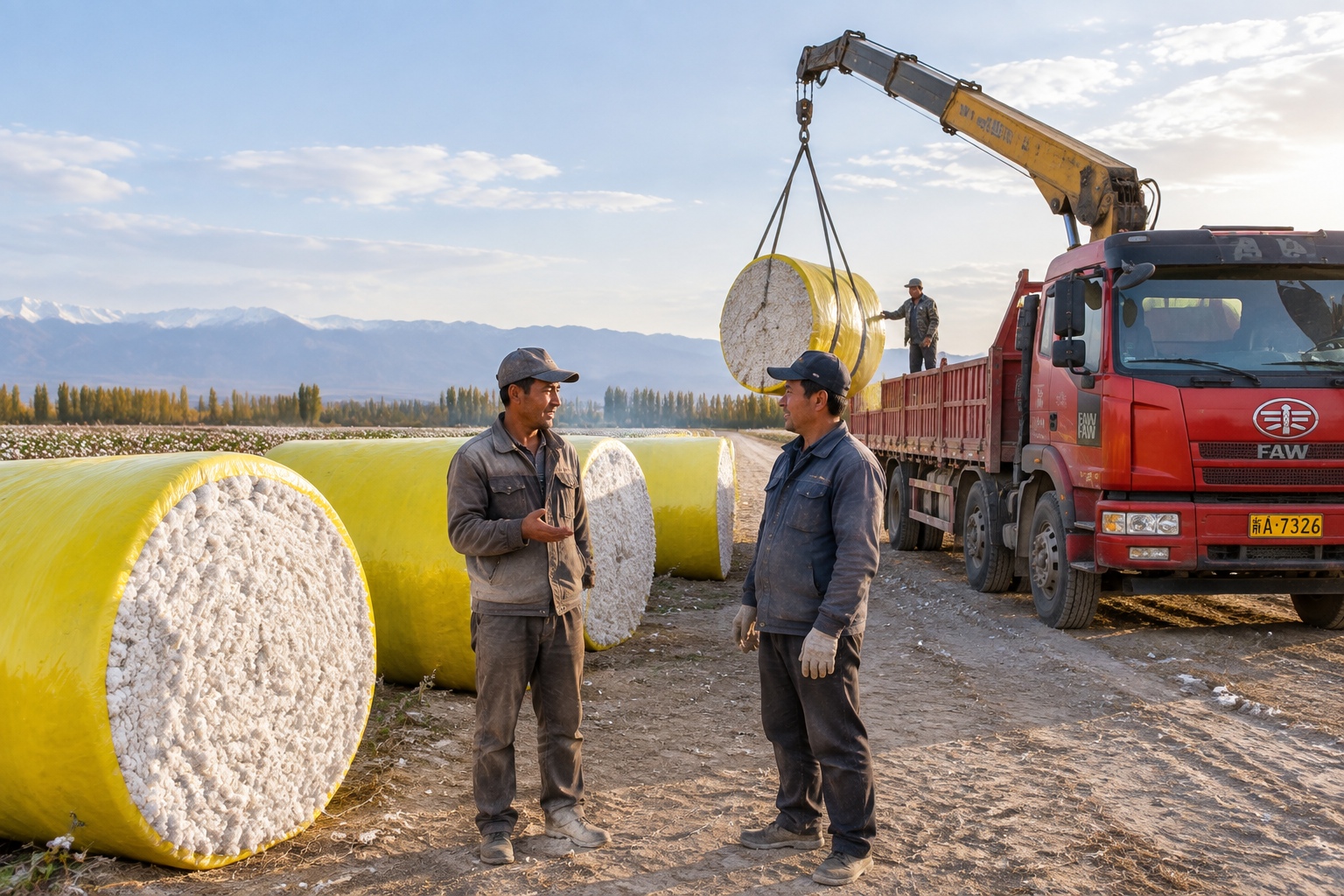
By late September, the rhythm is set. Before dawn, the cooperative yard is awake. Drivers check oil and filters. A woman hands out steamed buns and tea. The pickers roll out in convoy, headlights cutting through the dust. By mid-morning, the first round modules sit at the edge of the field like giant white pills. A truck with a crane lifts them onto a trailer. The driver marks the weight on a phone. By evening, the field is stubble and tracks. The picker moves to the next plot.
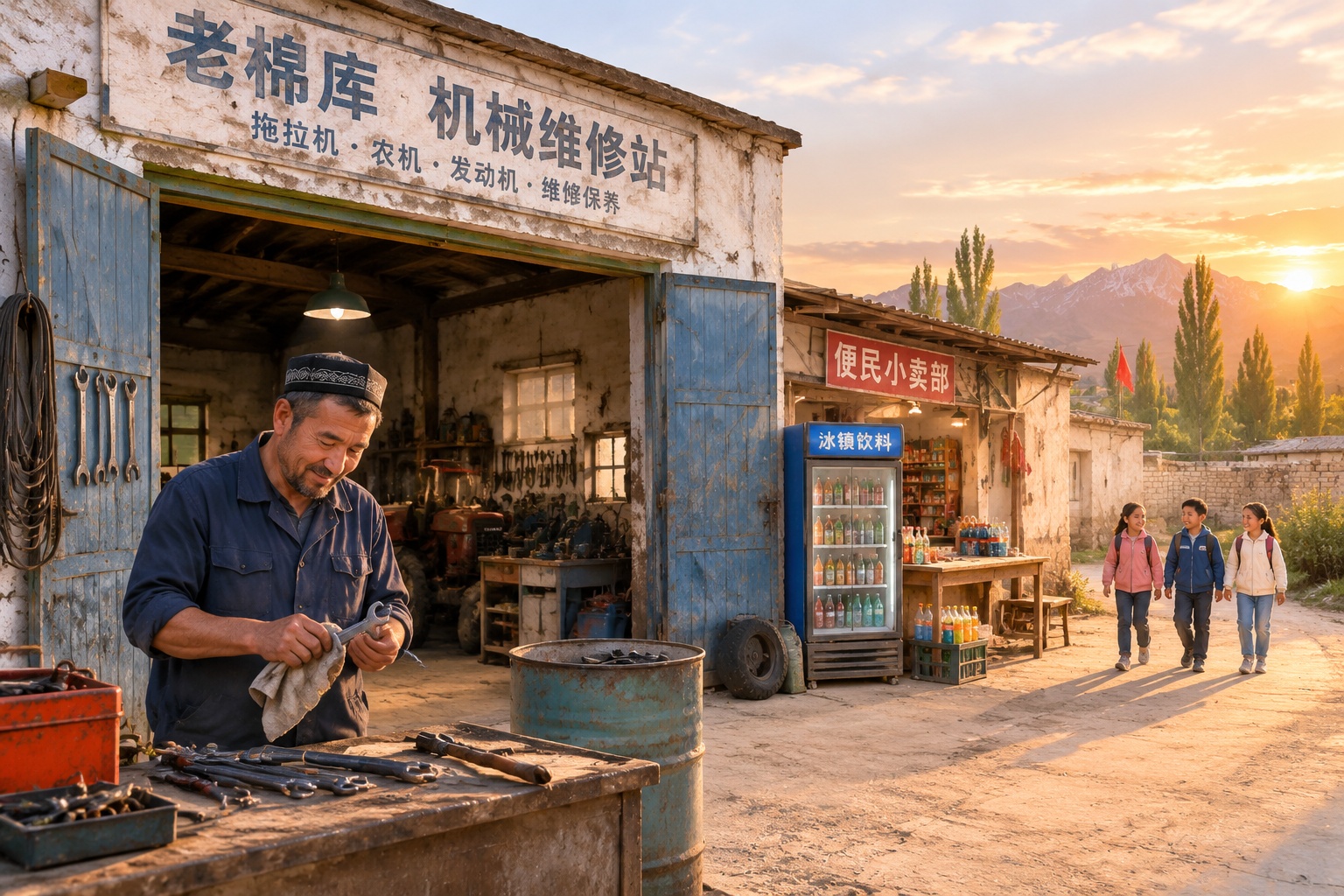
In the village, the day sounds different. The school bus still comes. The small shop still sells cold drinks. But the seasonal crowd is gone. The old cotton warehouse is now a machinery repair shed. The canteen that once served 50 pickers serves 10 drivers. At night, you can hear the drip lines ticking as water moves through the tape. It is not a romantic quiet. It is the quiet of a system that is working, or trying to.
What the Quiet Means
Xinjiang’s farmland is getting quieter because the harvest no longer needs as many hands. That is a real change, and for many farmers it has brought higher margins, less waste, and less dependence on a labor force that had to travel thousands of kilometers. It has also taken away a seasonal income that some families counted on. It has created new skills—drone pilot, machine operator, irrigation technician—and left others behind. The fields are not empty. They are differently occupied.
The next decade will test whether the quiet can last. Machines age. Water grows scarcer. Cotton prices rise and fall. Young people may or may not want to drive a picker at 2 a.m. But for now, at 7 a.m., the engine is already running. The GPS screen glows. The machine moves down the row, and the field behind it is silent.
Start the discussion at forum.chinacomes.com