

The Flowers Are Already Dead When the Machines Arrive
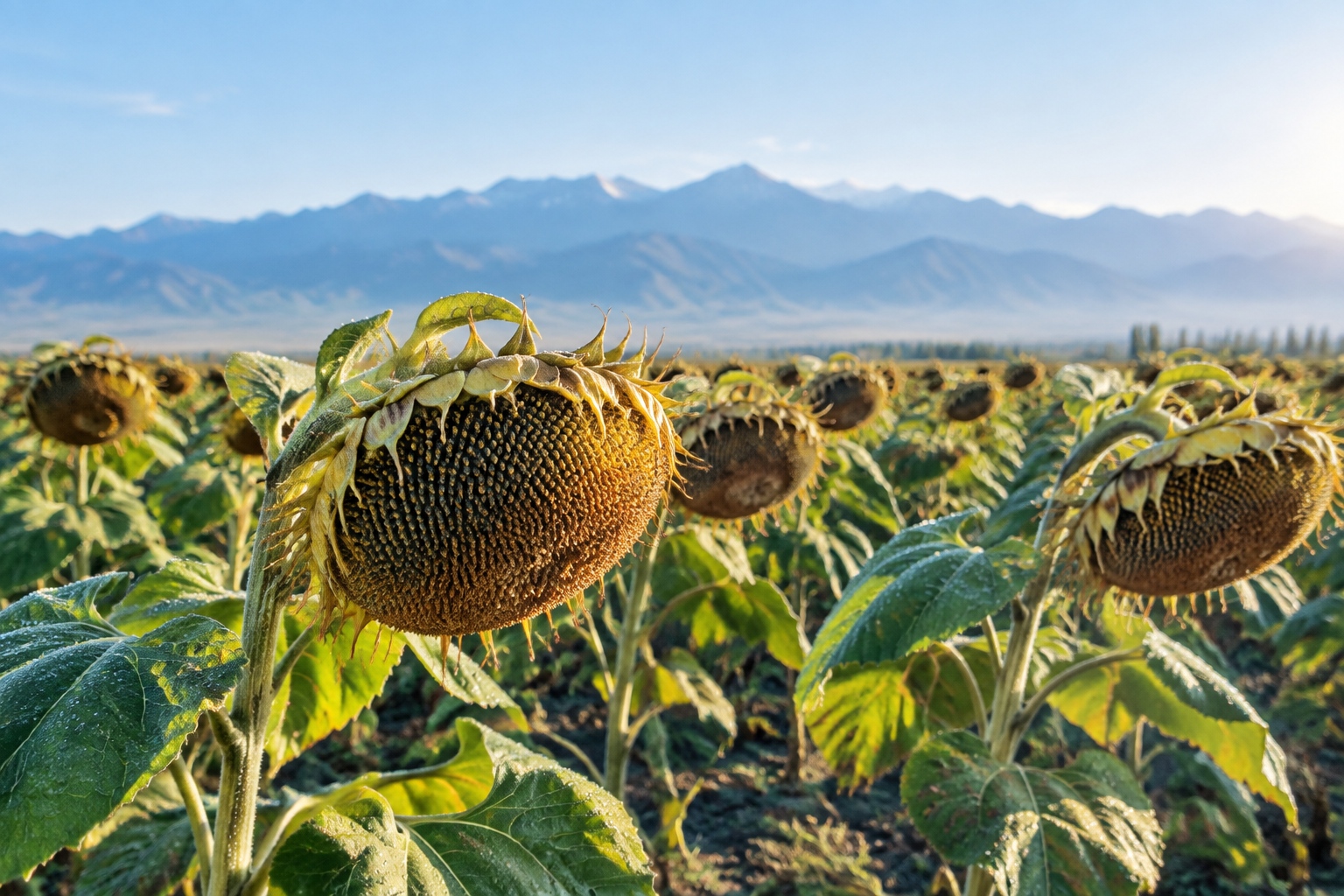
It is 8:15 in the morning and the sun has only just cleared the Tarbagatai range. The air is nine degrees Celsius. In Beijing, two and a half hours ahead on the same clock, office workers are on their second coffee. Here, a few kilometres outside a village in Emin County, northern Xinjiang, the day is barely starting — and the field in front of me is full of dead flowers.
Not wilted. Dead. Brown discs the size of dinner plates, bent hard at the neck, seeds showing in the middle where the yellow petals used to be. Six weeks ago this was the photograph everyone drives 600 kilometres from Urumqi to take: a yellow sea running flat to the horizon, a mountain wall behind it, a blue sky with nothing in it. Now the same field smells of dry tea, dust and diesel, and a low grinding noise is coming from the far end.
That noise is why I came.
A Machine That Eats a Field in Straight Lines
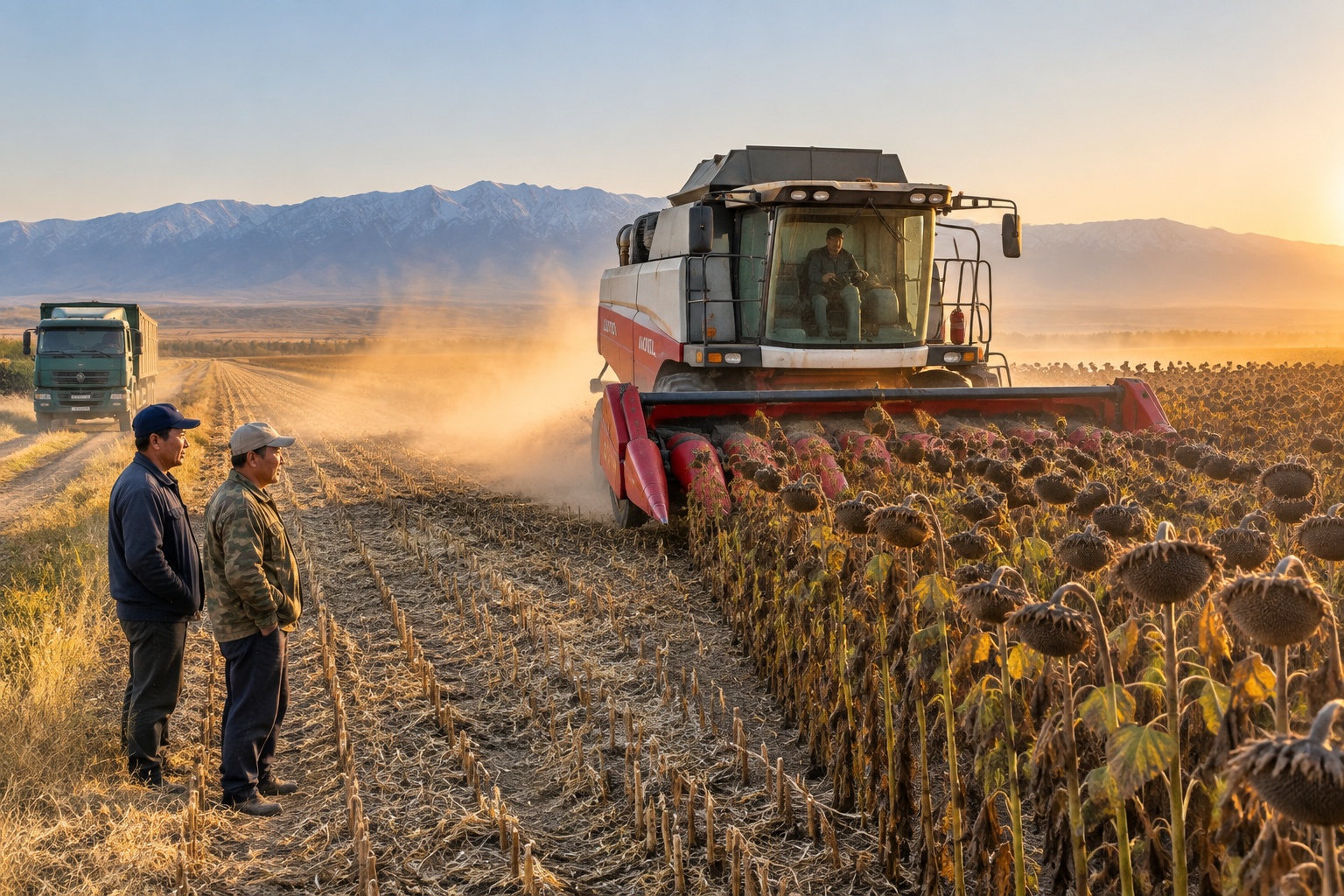
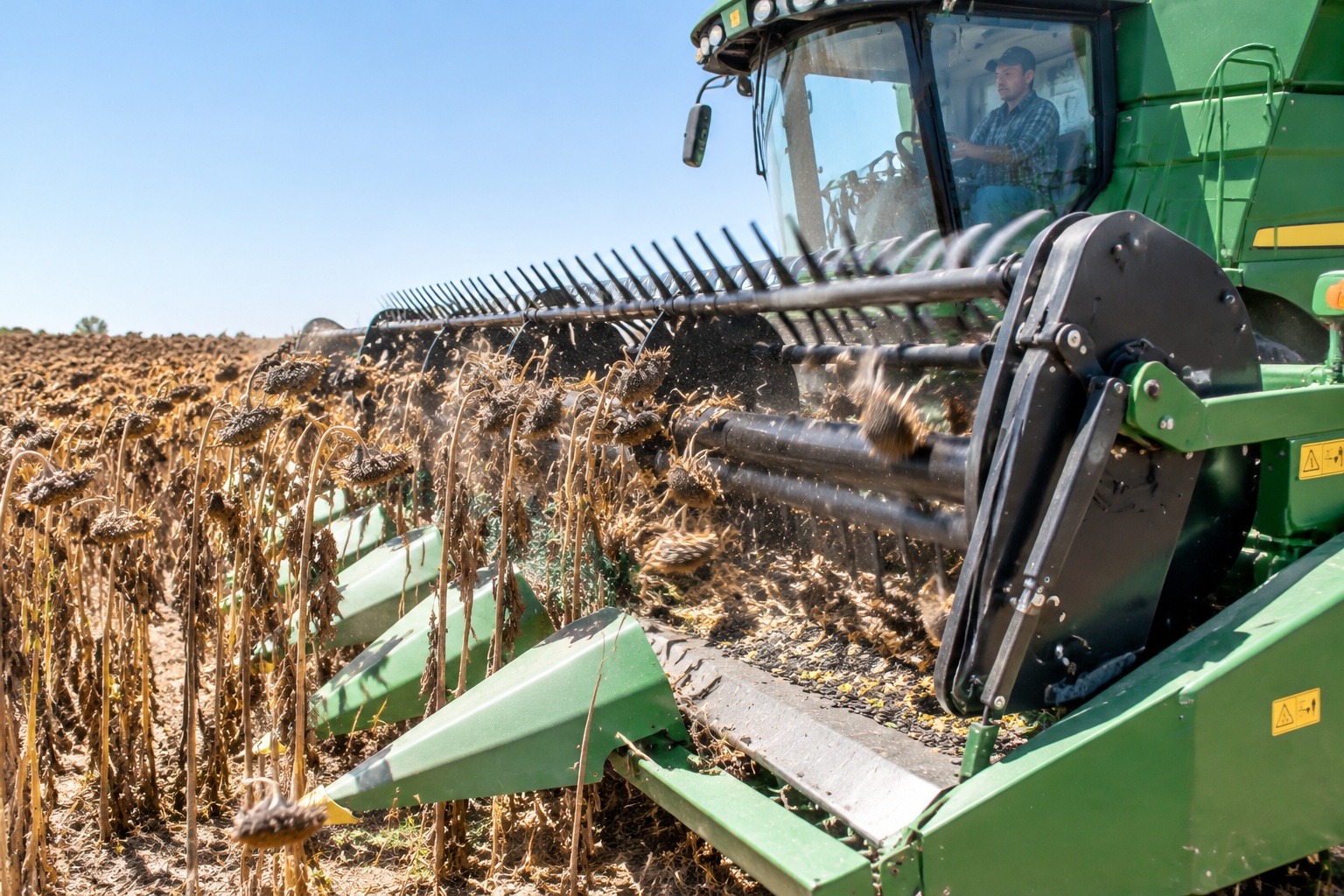
The combine appears first as a dust cloud, then as a shape: a red-and-grey machine with a wide header pushing through the stalks, eight rows at a time. It does not look like it is harvesting. It looks like it is swallowing. Stalks go in, the reel sweeps the heads down onto a pan, and behind the machine there is nothing but 20 centimetres of cut stem and a trail of chaff hanging in the air.
This is what people here call harvest season, and in northern Xinjiang it runs from late August to late September, depending on altitude and variety. A machine like this one covers 100 to 200 mu a day — a mu is one-fifteenth of a hectare, so roughly seven to thirteen hectares. Ten years ago, most of the sunflower in this region came off the field on human backs.
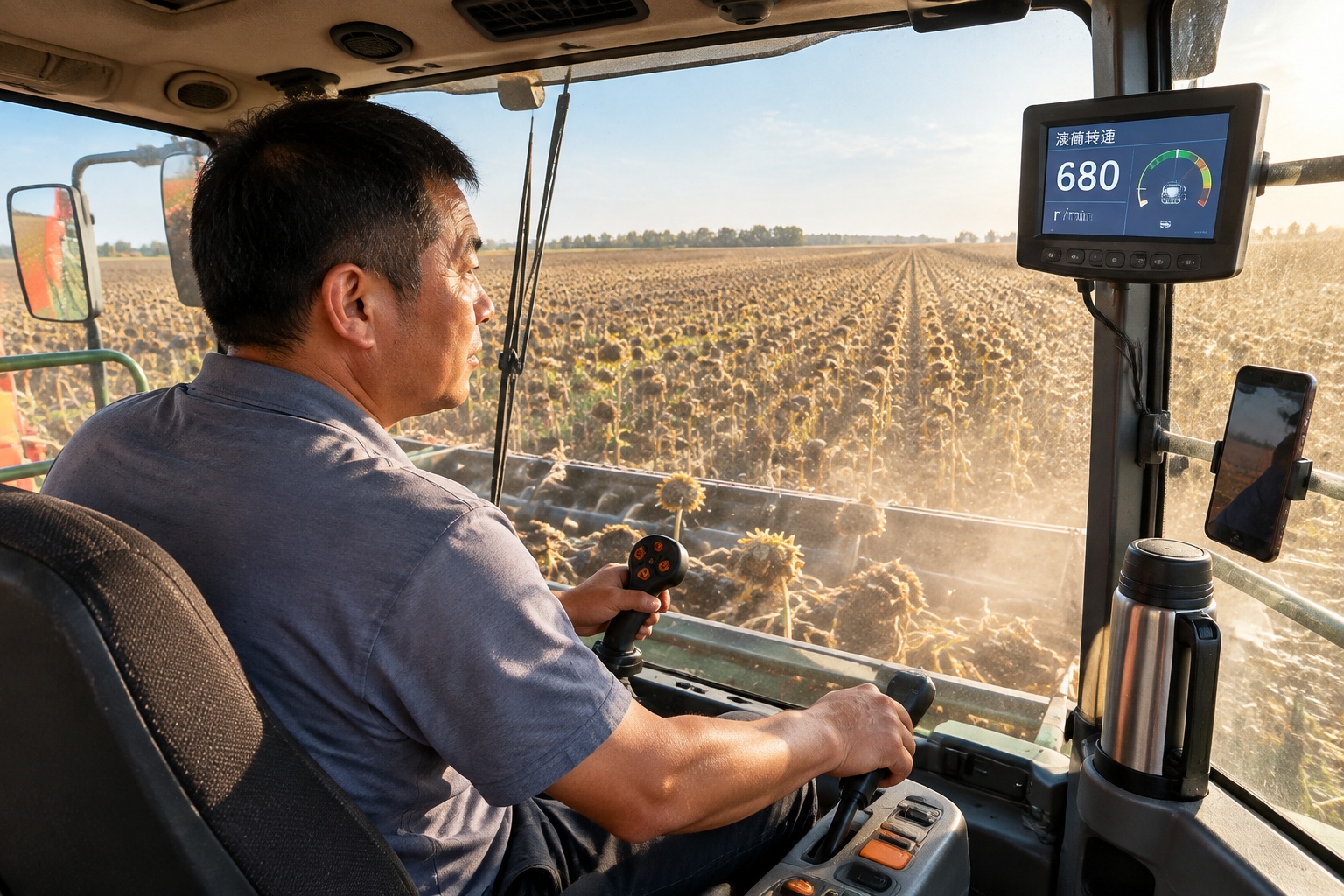
The driver, a man in his forties named Zhao, has been in the cab since nine. He sits in air conditioning with a thermos, a phone propped against the window, and a small screen showing drum speed. His hands move between two joysticks and a lever that lifts the header over rocks. Behind him, seed pours into a tank that fills in minutes, and a truck pulls alongside to take it away.
Why Northern Xinjiang Grows So Much Sunflower
Xinjiang and Inner Mongolia are China’s two largest sunflower regions, and the crop suits this landscape unusually well. The air is dry, so fungal disease is rare and the seed dries fast after harvest. Summer daylight runs long — in late June the sun is still up at 10 p.m. by the clock. Nights are cold even in August, which pushes oil content higher. And snowmelt from the mountains reaches the roots through drip lines laid under plastic film, the standard method across this region and the same reason it grows so much cotton.
Sunflower is also a rotation crop. Farmers here move it through a wheat-cotton-corn cycle to break disease and put nutrients back in the soil. It drinks less water than cotton, which matters more every year.
Where the Seeds Actually Go
Almost none of it leaves the country. The seed is pressed into cooking oil in plants around Tacheng, Altay and Changji; the leftover meal feeds cattle and sheep; the dry stalks are sometimes baled for fuel or bedding. Sunflower oil is a premium item in Chinese kitchens, and China still imports roughly two-thirds of the edible oil it consumes. That gap is why oilseed planting has been encouraged across the northwest, and why a field like this one is quietly part of a national supply argument, not just a pretty landscape.
The plastic film that saves water has a cost, too. It leaves residue in the soil if it is not pulled up, and Xinjiang has been running film-recovery programmes for years. Standing at the edge of a field, you can see both halves of the story at once: less water used, more plastic to collect.
The Man Who Used to Cut It by Hand
At the edge of the field, a 62-year-old farmer named Ma watches with his hands behind his back. He has farmed here his whole life. In the 1990s, he says, harvest meant five people in the field for three weeks: cutting each head off with a sickle, stacking them in rows to dry, then beating the seed out with sticks or driving a tractor back and forth over the pile. His hands still carry the scars. His back has not forgiven him.
“Now I stand here and wait for the truck,” he says. That is the whole job. He points at the stubble. “That is the part you cannot see. Twenty years ago, half the seed ended up on the ground.”
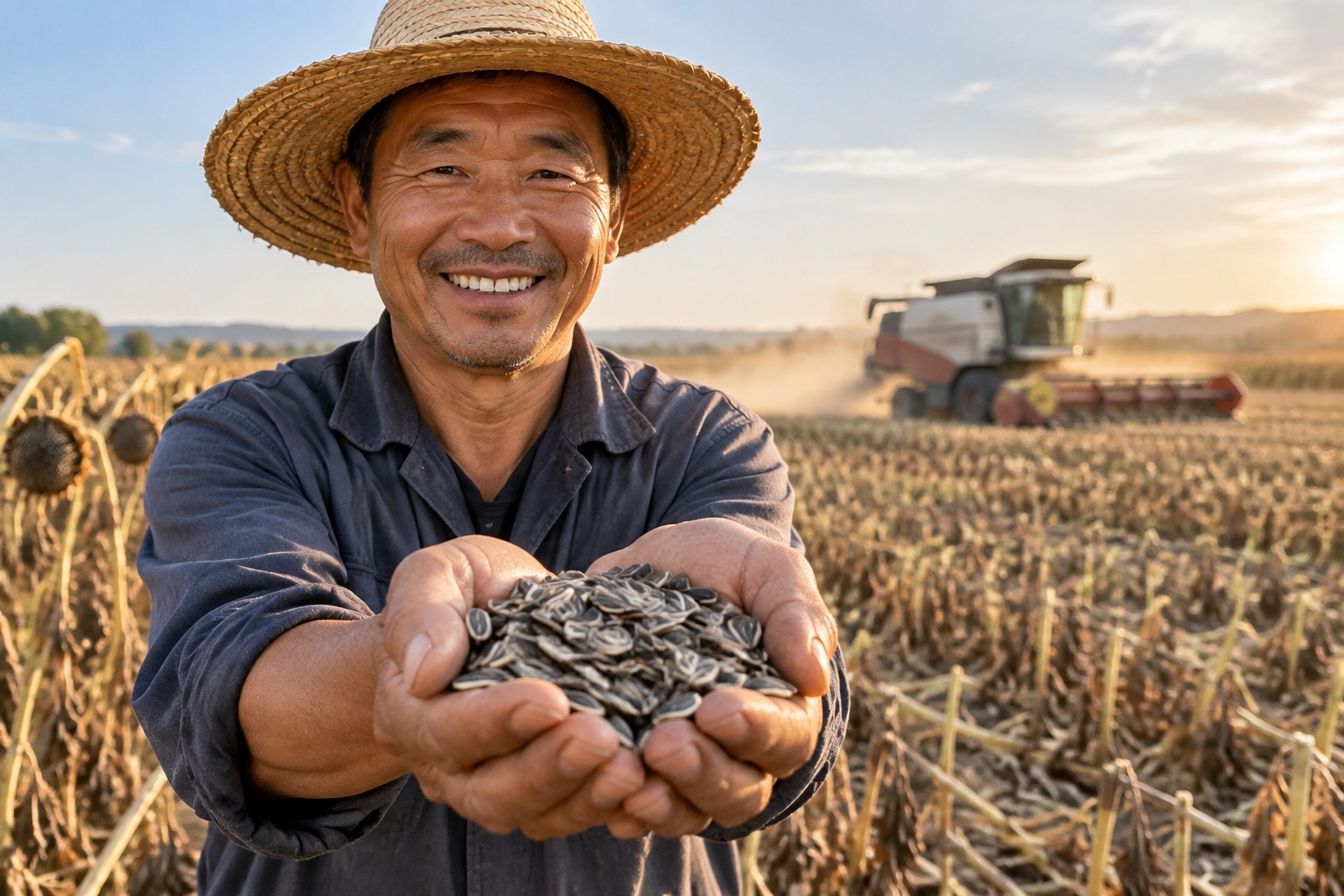
Machines in this region now advertise seed loss rates of three to five percent. At scale, that number is money: on a 300-mu field yielding 250 kilograms per mu, every percentage point of loss is 750 kilos of seed — around 7,000 yuan at recent prices.
What the Numbers Look Like
A good sunflower field here yields 200 to 300 kilograms per mu. Oil varieties sold for roughly 8 to 12 yuan a kilogram in recent seasons; confectionery seed, the big striped kind sold as snacks, fetches more. A 300-mu field — about 20 hectares, a realistic size for a family that has taken on extra land through the region’s land-transfer arrangements — produces 60 to 90 tonnes. Gross, that is somewhere between 600,000 and 900,000 yuan.
Costs eat a lot of it: seed, film, drip tape, fertiliser, water fees, fuel, and the machine. Hiring a combine usually runs 50 to 90 yuan per mu. Farmers will also tell you, unprompted, that prices move. Imported vegetable oil sets the ceiling, and a wet week during harvest can knock a grade off the seed. Mechanisation cuts the labour bill and the clock. It does not cut the risk.
The Tourism Problem
Every July, tour buses arrive. Local governments in Tacheng, Altay and the Ili Valley promote sunflower festivals, and photographers come for the yellow. By the time the combines show up, the buses are gone. There is no ticket booth, no viewing platform, no queue for selfies. You are standing in somebody’s workplace.
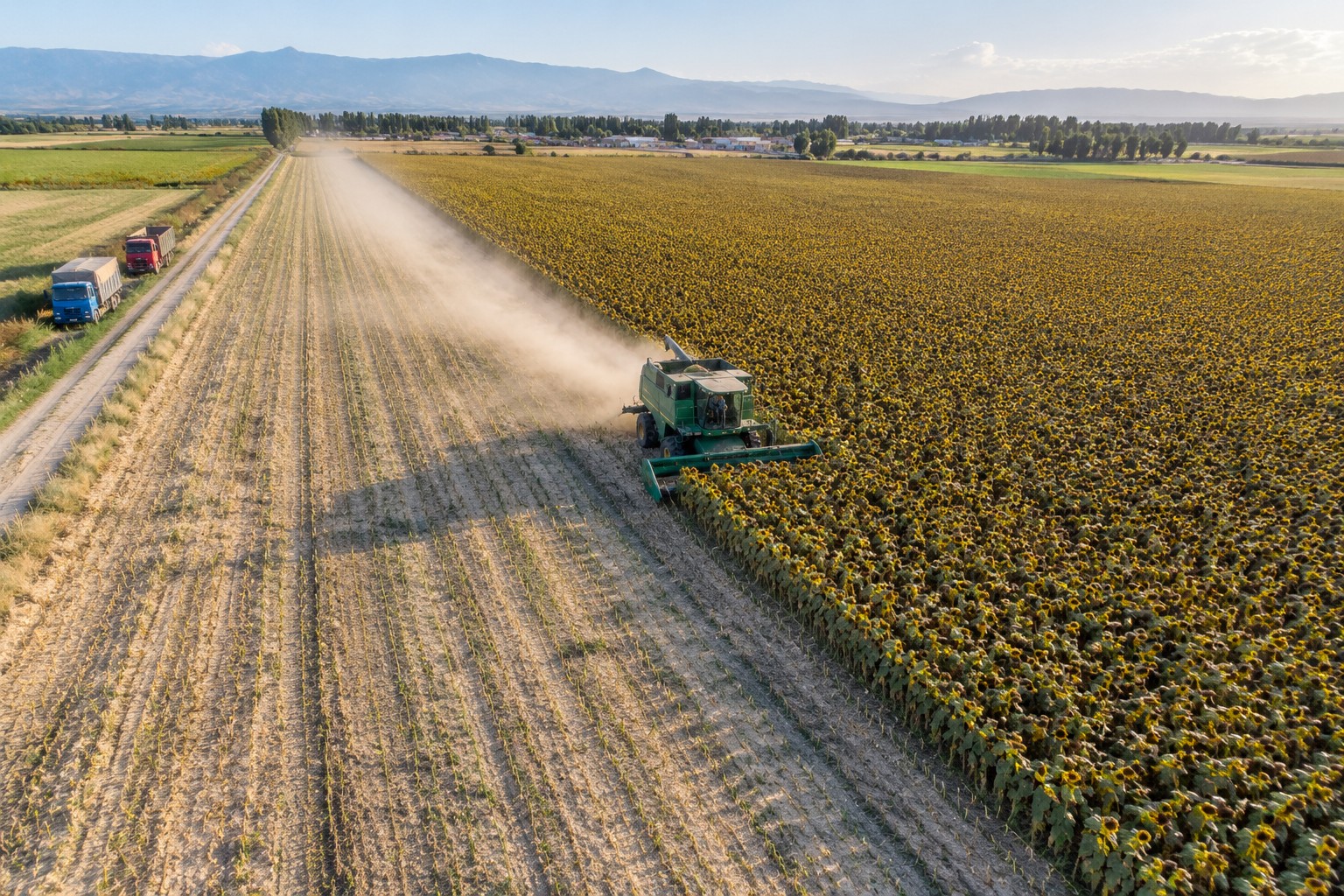
That is the better trip, if you do it right. Ask before you walk into a field — someone owns it, and the crop is money. Never stand behind a working combine: the header throws stones and stalks 15 metres back. In the evening the dust catches the light and looks wonderful on camera, and it will coat your lungs and your lens in ten minutes. Bring a mask.
What This Looks Like at Nine in the Evening
By evening the field is half gone. Where there was yellow there is now a flat grey-brown carpet of stubble, and the machine is working the last strip with its lights on. Sunset here in late August comes around nine: the clock says Beijing, but the sun keeps solar time, two and a half hours behind. A truck pulls up and seed pours out of the auger in a solid golden ribbon, and the smell coming off it is warm and nutty, like a bakery at closing time. Zhao climbs down, stretches, and says he will start again at nine tomorrow.
Going There: A Short Practical Guide
Where
Northern Xinjiang. Emin, Yumin and Toli counties in Tacheng Prefecture; Burqin and Fuhai in Altay; Zhaosu and Xinyuan in the Ili Valley. Ili sits higher and later — bloom can run into August and harvest into October.
When
Bloom: mid-July to mid-August. Harvest: late August to late September. Ask at a hotel or a restaurant; nobody posts a harvest schedule online, and it shifts by a week or two every year.
Getting There
Fly to Urumqi (URC) and drive, or fly to Tacheng (TCG) for the closest fields. Distances are enormous — 600 kilometres from Urumqi to Tacheng — and fuel stations can be far apart. A car with a driver for the day typically runs several hundred yuan; arrange it through your hotel.
Practical Notes
Xinjiang runs on Beijing time, so in late August sunrise is around 8 a.m. and sunset around 9 p.m. Good light for photographs is roughly 7:30 to 9 p.m. Bring a dust mask, closed shoes, water and sunscreen; the UV at this latitude and altitude is not gentle. Flying a drone over working machinery needs the operator’s permission, and in some areas the local agriculture bureau’s as well. Do not walk into stubble in sandals.
And if you go, remember what you are actually watching: not a postcard, but a machine doing in one afternoon what a family used to do in a month. That part of the future has already arrived here — quietly, at 8:15 in the morning, under a sky with nothing in it.
Start the discussion at forum.chinacomes.com