
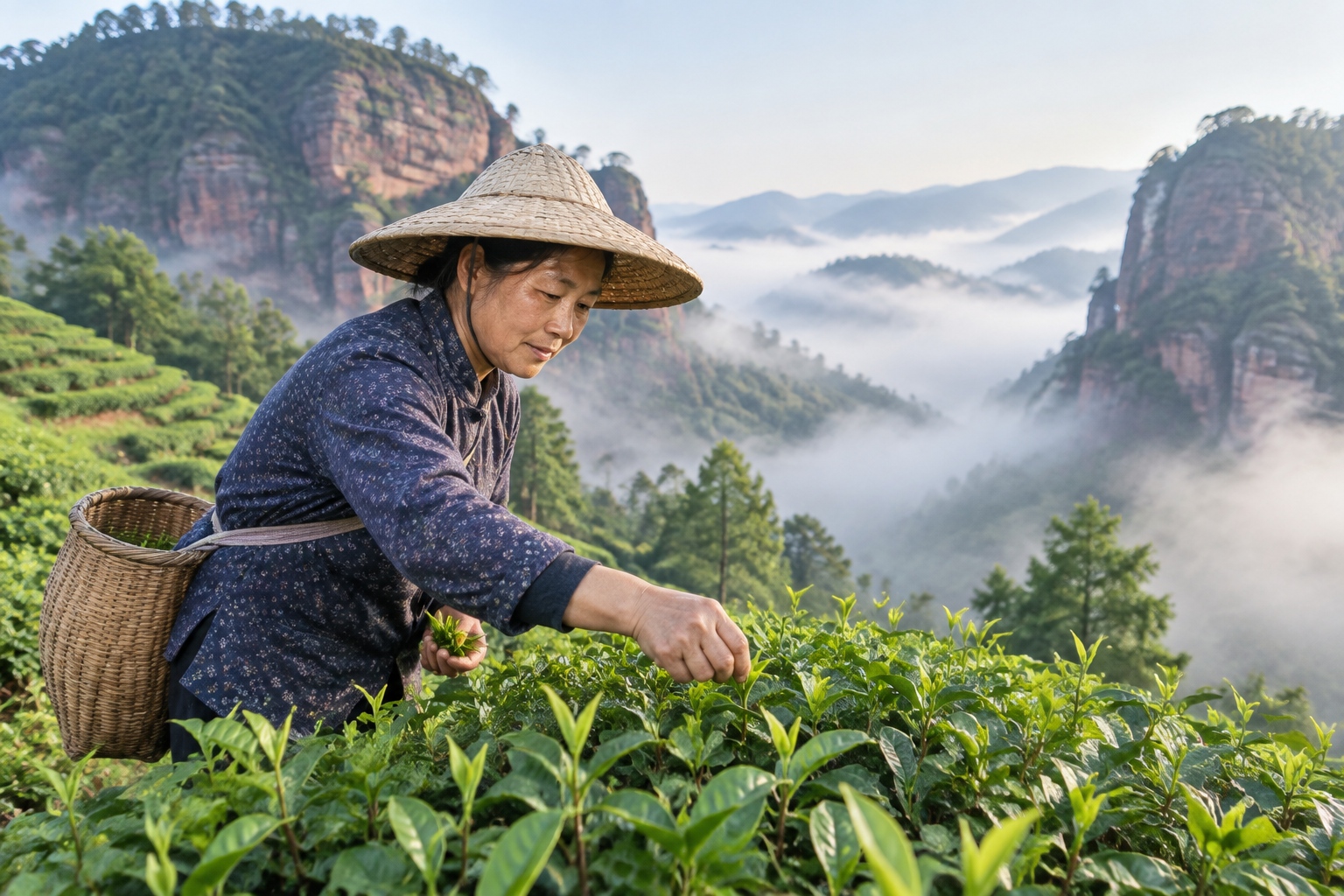

Before the Fog Lifts in Wuyishan
The first thing Mr. Chen handed me was a bamboo basket. It was 5:40 in the morning, dark enough that I could really only see his hands: nails cut short, knuckles wide, fingertips stained a yellow-brown that soap doesn’t fix. “Come on,” he said. “The leaves won’t wait.”
We walked uphill for forty minutes behind Tianxin village, in the far north of Fujian province, close to the Jiangxi border. The path was paved for the first ten minutes, for tourists, and then it wasn’t. By the time we reached his plot, fog was peeling off the rock walls in strips, and I could see why this place is called Wuyishan — “the mountain of martial peaks.” Thirty-six near-vertical cliffs of red sandstone, with tea bushes wedged into every pocket of soil between them.
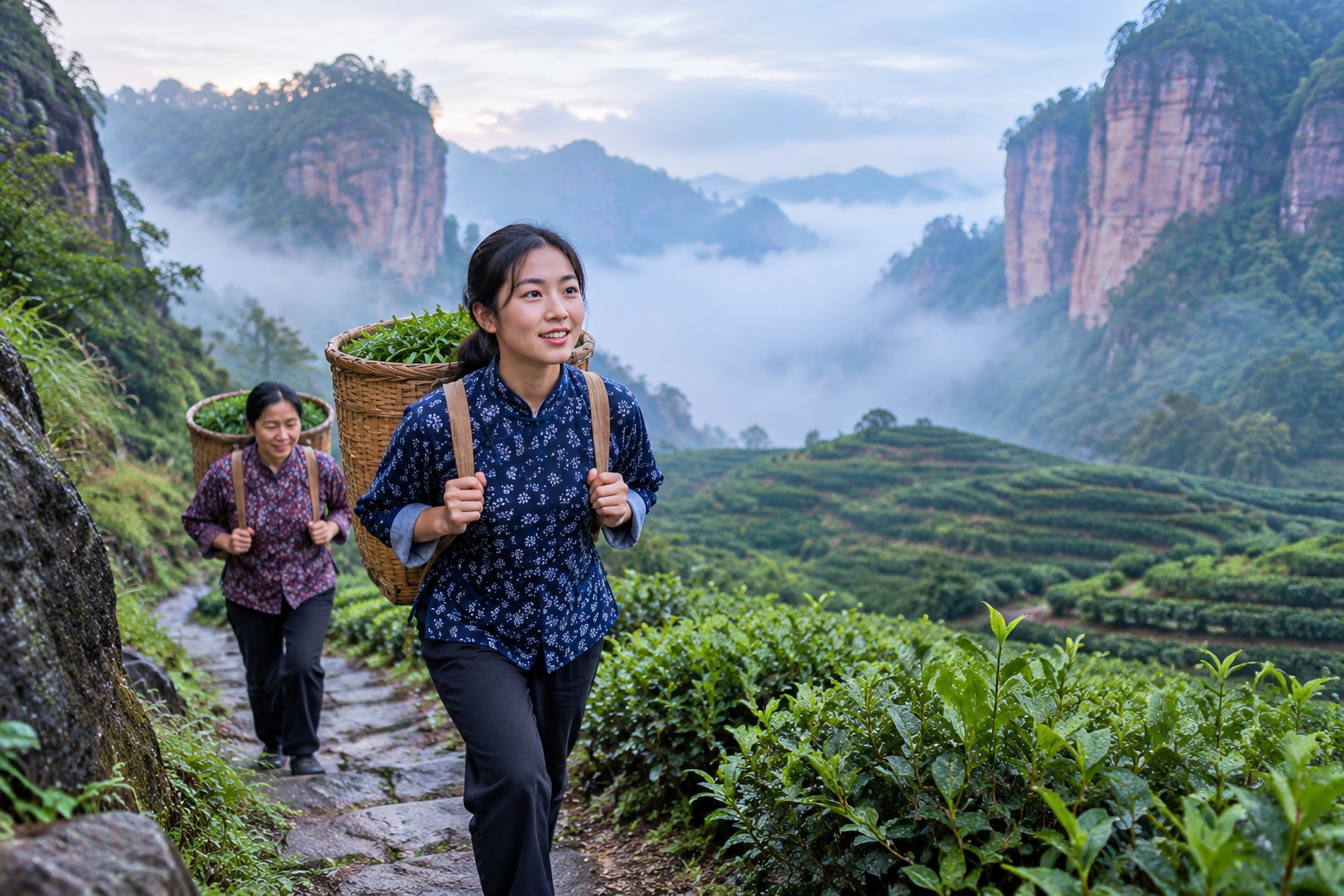
Mr. Chen is 56 and has been making tea since he was fifteen. He asked me not to use his full name, which is normal here; plenty of tea families are vague about exactly which slope their leaves come from.
What “Da Hong Pao” Actually Means
Da Hong Pao — “Big Red Robe” — is an oolong, and specifically a rock tea, yancha in Chinese. It’s heavily roasted, dark, expensive, and probably the most famous Chinese tea that most foreigners have never tasted.
The legend involves six bushes growing on a cliff at a gorge called Jiulongke, and a scholar (or an emperor, depending on who’s telling it) who draped them in a red robe after a cure. What matters now is more practical. In 2005, a 20-gram lot of tea from those six mother bushes reportedly sold at auction for 208,000 yuan — more than $25,000 at the time. Commercial picking stopped the following year. The bushes are fenced and watched, and the tea from them is given as gifts rather than sold in shops.
So almost every Da Hong Pao you can actually buy comes from cuttings taken from those bushes, or from other Wuyi cultivars such as Rou Gui (“cinnamon”) and Shui Xian (“narcissus”), often blended together. In November 2022, UNESCO added China’s traditional tea processing techniques to its intangible cultural heritage list, and Wuyi rock tea was one of the traditions named. That matters less for marketing than for the fact that the methods here are old, specific, and hard to fake.
One Bud, Three Leaves, and a Slope That Hates Your Calves
Mr. Chen’s plot covers maybe two mu — a bit over a quarter of an acre — spread across a slope I’d guess runs at 35 degrees. You don’t really walk on it. You wedge your feet sideways and hope.
He showed me what to pick: one bud with three leaves below it, snapped cleanly with the thumbnail, never crushed. Take more leaves and the tea turns coarse. Take fewer and the yield drops. “Pick too early and the tea is thin,” he said. “Too late, it’s bitter and the aroma is gone.” The window is roughly two to three weeks, from late April into mid-May. Miss it, and the whole year’s income changes shape.
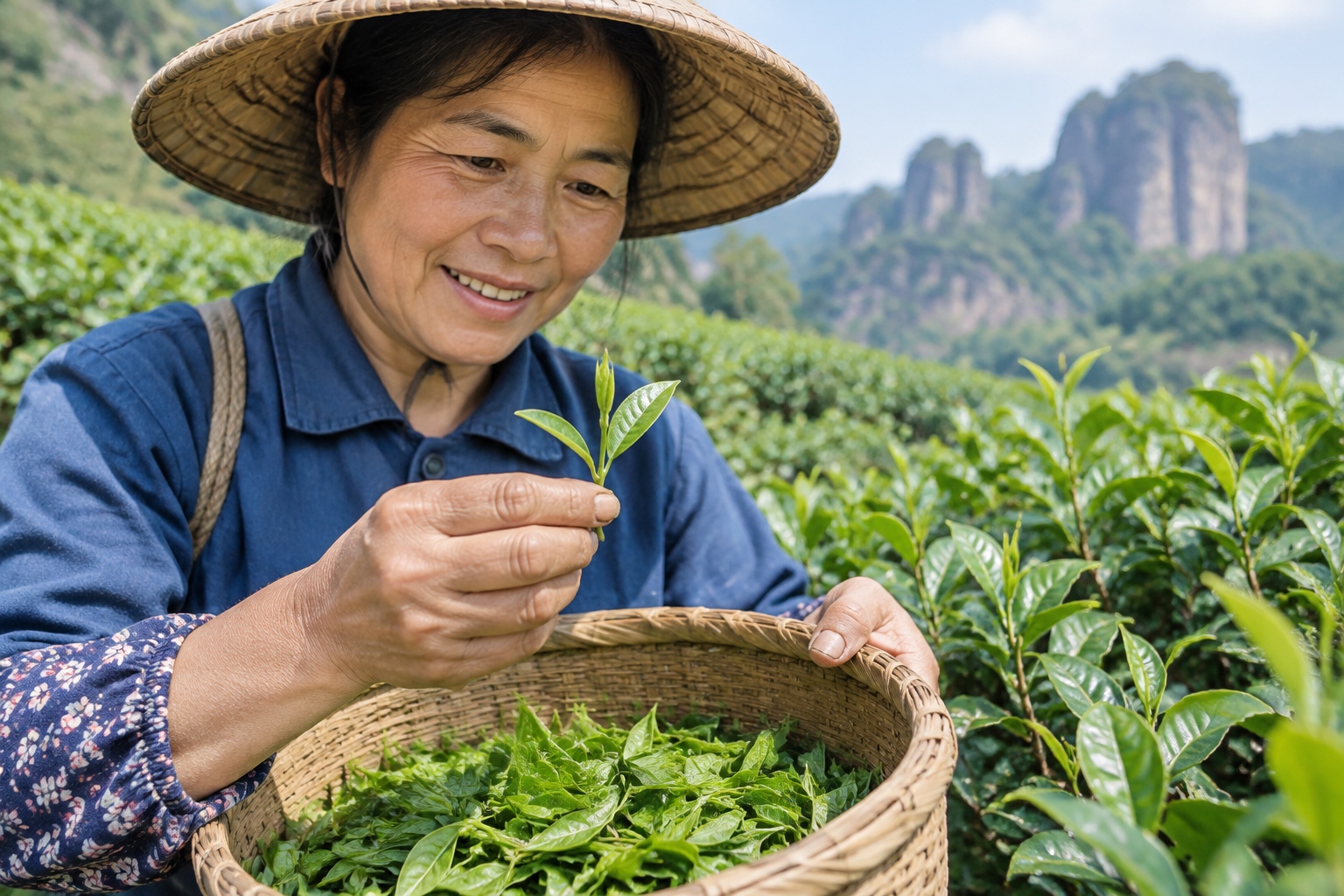
I picked for three hours and filled maybe a third of a basket. The crew around me — four women in long sleeves with cloth wraps over their faces, and two men — filled theirs by mid-morning. They’re paid by weight, a few hundred yuan a day for a fast pair of hands. One of them, Auntie Zhou, has picked this slope for more than twenty years. She told me the job is easier than it used to be because the mountain road is better now, and harder because the sun feels stronger than when she started. I can’t tell whether that’s climate change or memory. Both are real.
The Night Is When the Tea Is Actually Made
Picking is the photogenic part. The part that decides whether the tea is worth anything happens after dark, and it runs on adrenaline, cigarettes and instant coffee.
By 4 p.m. the leaves were spread on bamboo racks outside, wilting in the last of the sun — shaiqing, “sun withering.” Then they moved indoors to cool and lose more moisture. Then the long night began.
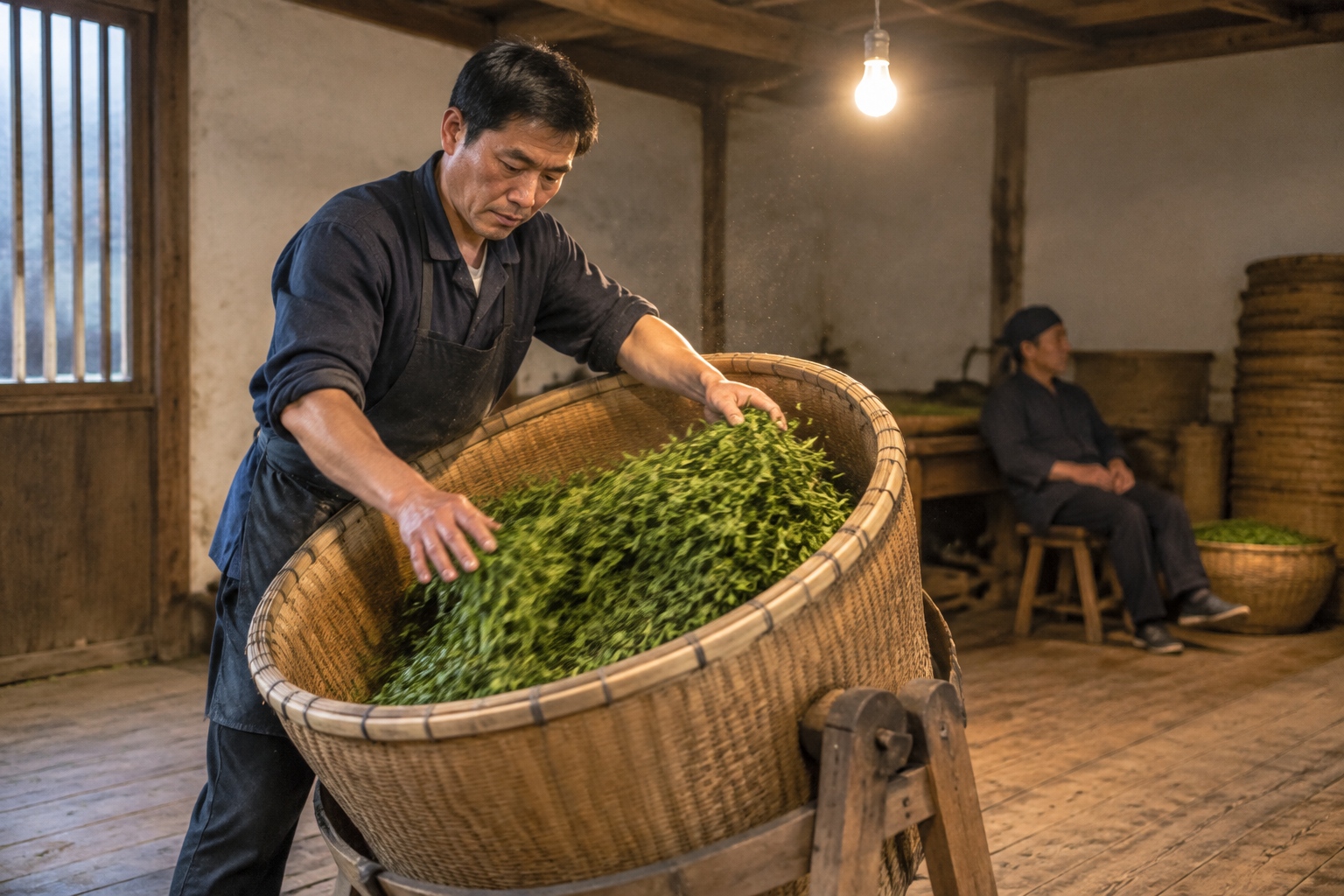
This is yaoging, the shaking. The leaves go into a woven bamboo drum, and Mr. Chen turns it by hand, a few minutes at a time, then lets them rest, then shakes again. Every hour or so, all night. The shaking bruises the edges of the leaf. Oxidation starts along those bruises, and the smell in the room shifts as the hours pass — first cut grass, then gardenia, then something closer to ripe peach. Around midnight I stopped being able to tell whether it was getting better or I was just getting tired.
Some time after 3 a.m., the leaves are “killed” — sha qing — dumped into a heated drum so that heat stops the oxidation, then rolled and twisted into the dark strips you’d recognise in a shop, then dried. The first light was coming up over the cliffs when they finished. Nobody in Wuyishan sleeps much in May.
Charcoal, Ash, and a Roast That Takes Months
Here’s the part that separates rock tea from almost everything else: it goes back over fire.
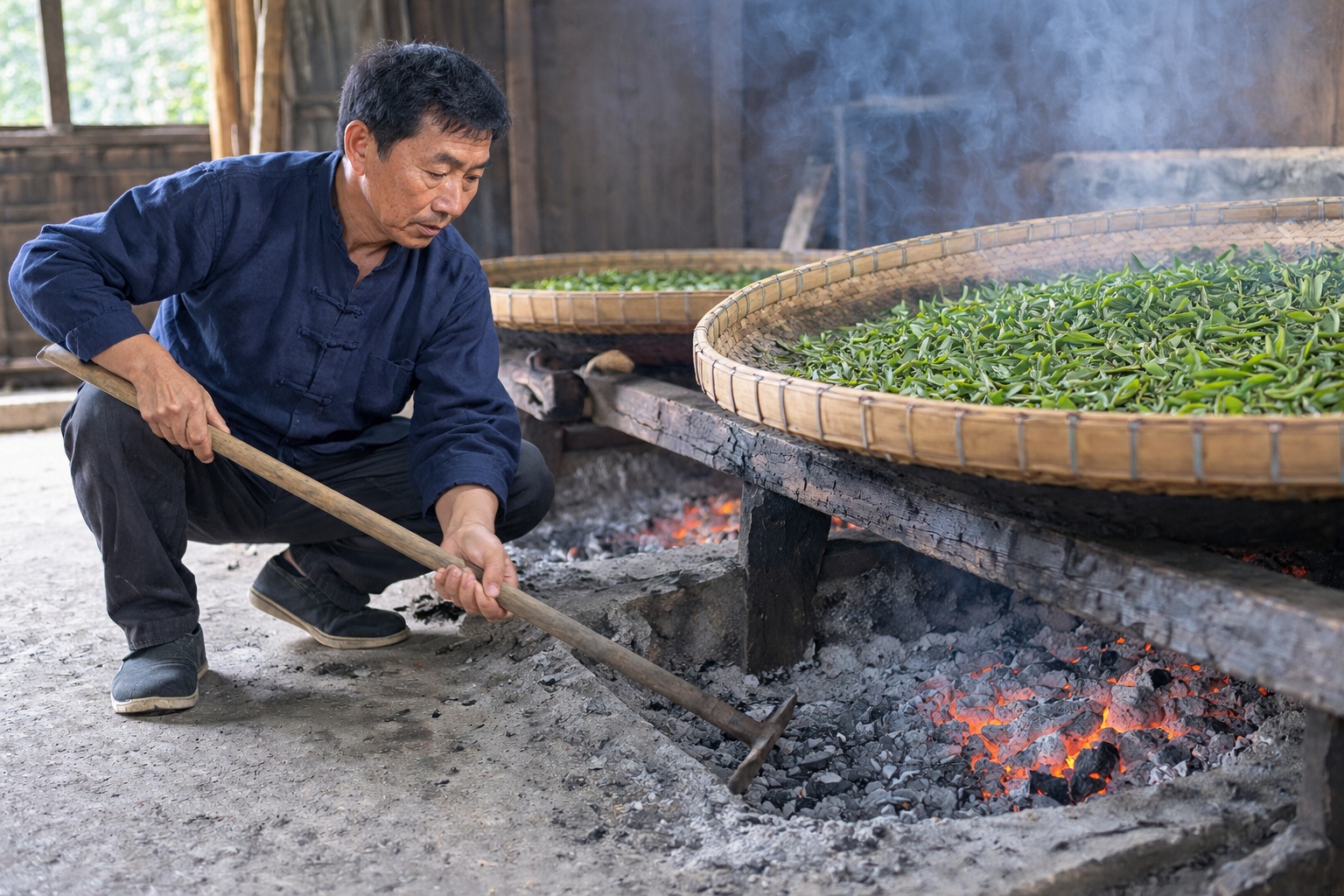
In a shed behind the house, bamboo baskets sit on racks above shallow pits of charcoal — traditionally lychee wood charcoal, trucked up from the south of the province. The pits are covered with a layer of ash, and the roaster controls the temperature by raking ash aside or piling it on. Too hot and the tea scorches, tasting like an ashtray. Too cool and it stays green and sour. A single roast runs eight to twelve hours, usually at night, when the air is cool and the heat is easier to hold steady.
Then the tea rests. Weeks. Then it’s roasted again. Most good rock tea goes through three rounds, and the last one, dunhuo — “slow stewing” — is low and long. Across the whole process, five to seven jin of fresh leaves become one jin of finished tea, and the charcoal takes another chunk of that weight with it. Mr. Chen’s tea won’t be at its best for months. Some of it will sit for years. In a country that moves as fast as China does, there’s something stubborn about a product that improves mainly by being left alone.
Who Actually Gets Paid for This Leaf
Not all Wuyishan tea is equal, and everyone here knows the map. Zhengyan — “true rock” — means tea grown inside the protected scenic area, on the thin, fast-draining soil between the cliffs. Banyan is half-rock, from the edges. Zhou cha comes from the flat river land and doesn’t taste like rock at all. A jin of decent zhengyan, 500 grams, might retail for 1,000 to 5,000 yuan, and famous plots go far higher. Meanwhile, a lot of what’s sold as Da Hong Pao online and in supermarkets comes from outside Wuyishan entirely.
The city has tried to protect the name: geographical indication certification, anti-counterfeiting labels, inspections. It helps. It doesn’t fully work. That isn’t a China-specific problem; it’s how famous agricultural products behave everywhere.
What surprised me most was who does the selling. Mr. Chen’s daughter, 28, came back from Xiamen three years ago. She runs the family’s online shop, films the roasting nights on her phone, and streams to buyers in Shanghai, Guangzhou, and overseas Chinese communities in Singapore and Malaysia. She told me one evening of livestreaming sells more than the shop downstairs sells in a week — and that the hardest part is convincing people the cheap stuff isn’t the real thing.
Millions of tourists pass through Wuyishan each year, and the resort strip near the entrance is wall-to-wall tea shops and tasting rooms. Tea money rebuilt this town: new houses, new cars, daughters who came home. It also made May crowded and pushed prices on the good slopes into numbers that sound like jokes.
Drinking the Day’s Work
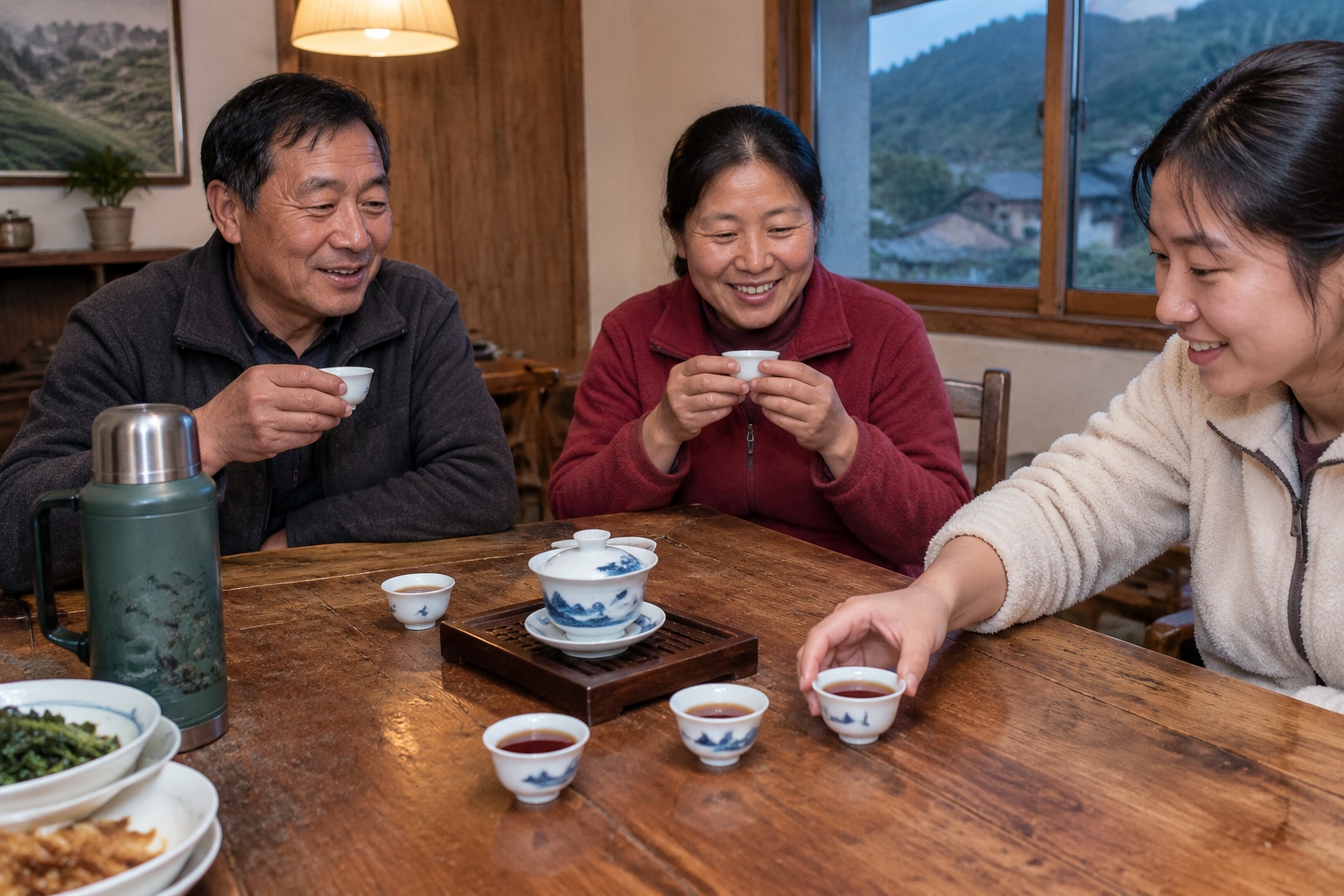
That night, we finally drank. Mr. Chen rinsed a gaiwan, measured in about eight grams, poured boiling water over the leaves, then emptied it fast into cups so small I could cover one with my thumb.
The first two infusions are mostly roast — dark, almost cocoa, a little smoky, with a dryness on the tongue. The third and fourth are what people mean by rock tea: orchid, stone, a mineral coolness that sits in the throat long after you swallow. Chinese calls it yanyun, “rock rhyme,” and I’ve never seen a translation that works. It’s less a flavour than the feeling of something staying behind.
Mr. Chen doesn’t talk much while drinking. Neither did his father, judging by the photo on the wall. We ate rice, stewed chicken and greens, drank a little home-brewed rice wine, and by nine he was yawning, because tomorrow starts at five again.
What stays with me is the mismatch. This tea is sold live, by phone, to Singapore, by a 28-year-old woman who checks her notifications between pours. It is also made by shaking leaves by hand at two in the morning and then roasting them over ash for three months, more or less the way it was done a century ago. Both of those are today’s China. Not one or the other.
Start the discussion at forum.chinacomes.com