
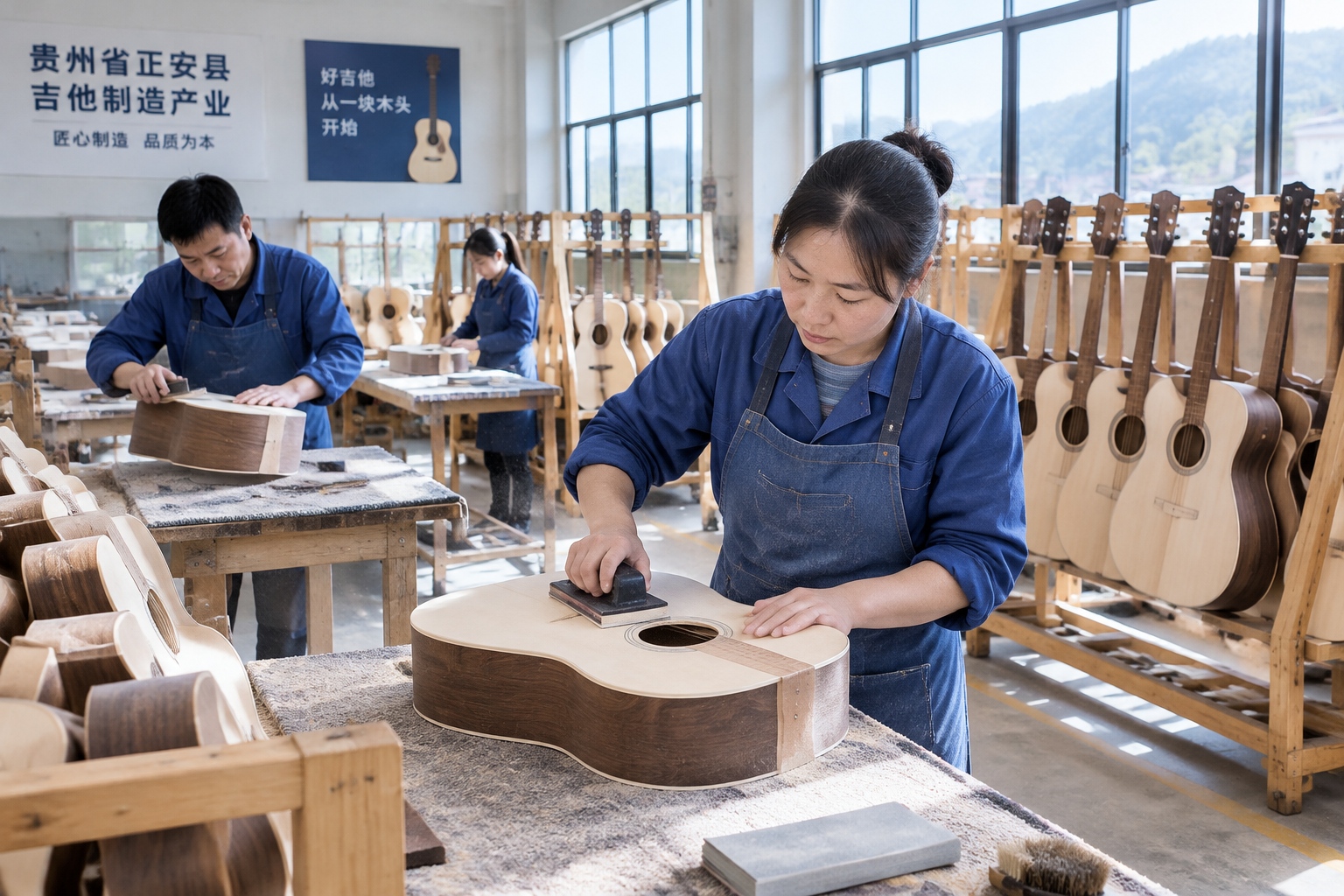

A guitar factory at 8:40 in the morning
At 8:40 on a cool morning in Zheng’an, the sanding room is already humming. A woman in a blue apron holds the body of an acoustic guitar against a spinning belt, turning it a few degrees at a time until the spruce top catches the light and goes smooth. Fine wood dust drifts in the slanted sunlight. Down the aisle, a man clamps a freshly glued neck into a jig and sets a timer. The air smells of lacquer and warm wood.
None of this looks like what outsiders expect from rural Guizhou, a mountainous province in southwest China long associated with steep terrain, terraced farms, and poverty. Yet the finished instruments stacked by the loading door carry labels bound for the United States, Brazil, Japan, and the Gulf. Zheng’an County, population around 650,000, now makes somewhere close to six million guitars a year—by most estimates, about one in five guitars produced anywhere in the world.
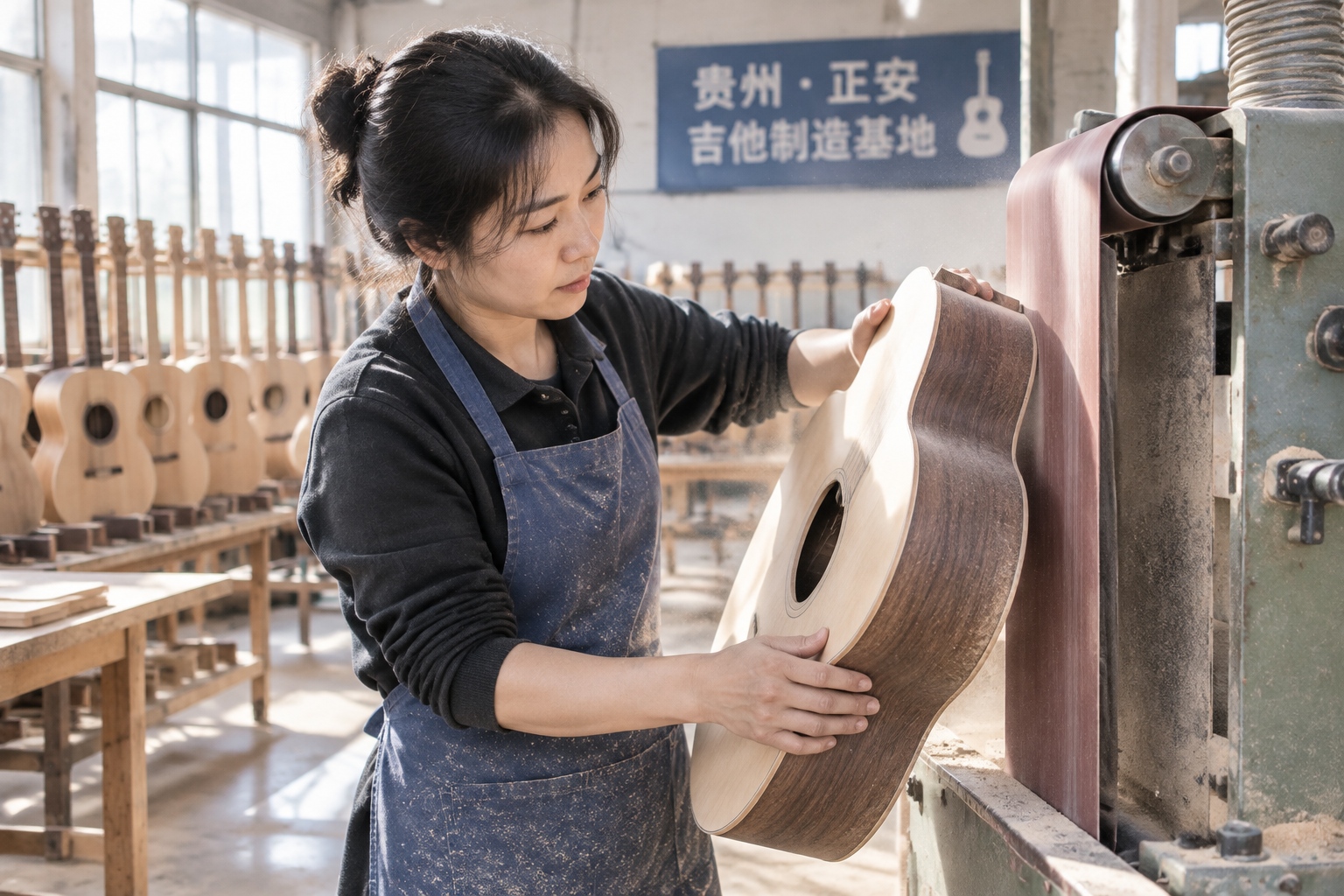
From a poverty county to “China’s guitar town”
To understand why this is surprising, you need the background. Until 2020, Zheng’an was on China’s official list of national-level poverty counties. There was little industry and not enough farmland to go around. For decades its main export was people: hundreds of thousands of young workers who boarded buses and trains for the Pearl River Delta in Guangdong, the manufacturing belt near Hong Kong, to work on assembly lines.
Some of them, as it happened, ended up in guitar factories around the city of Guangzhou. They learned to bend wood, cut frets, mix finishes, and run the machines. A few became line managers. A few started dreaming about running the whole thing themselves.
In 2013 the local government made them an offer. It built a guitar industrial park on the edge of town, waved rent and tax incentives, and sent people to Guangdong with a simple pitch: come home and build here, where your workers already live. The first entrepreneurs who returned were betting that an entire supply chain could be rebuilt in a place most of the world had never heard of.
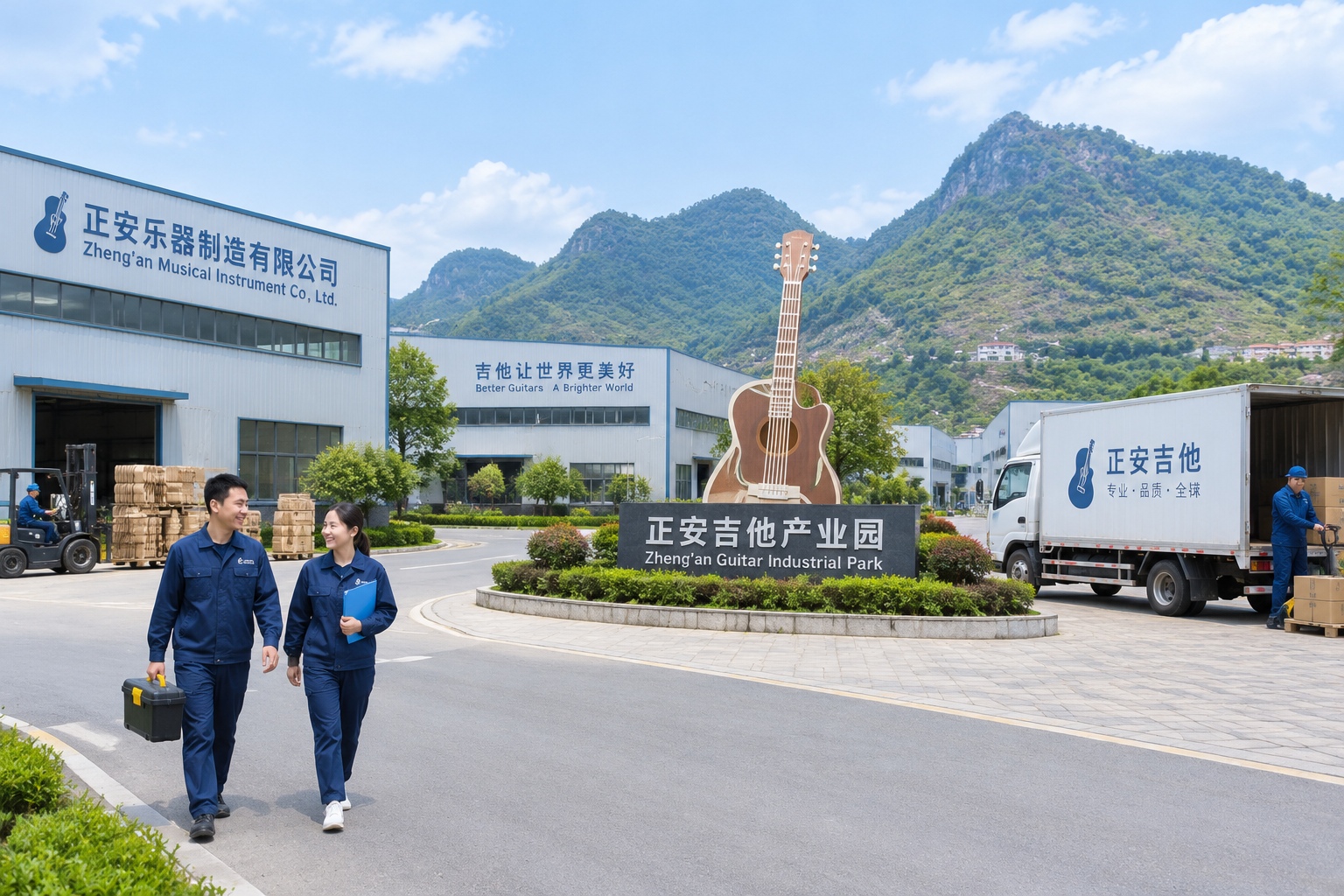
Inside the workshop: hands and machines
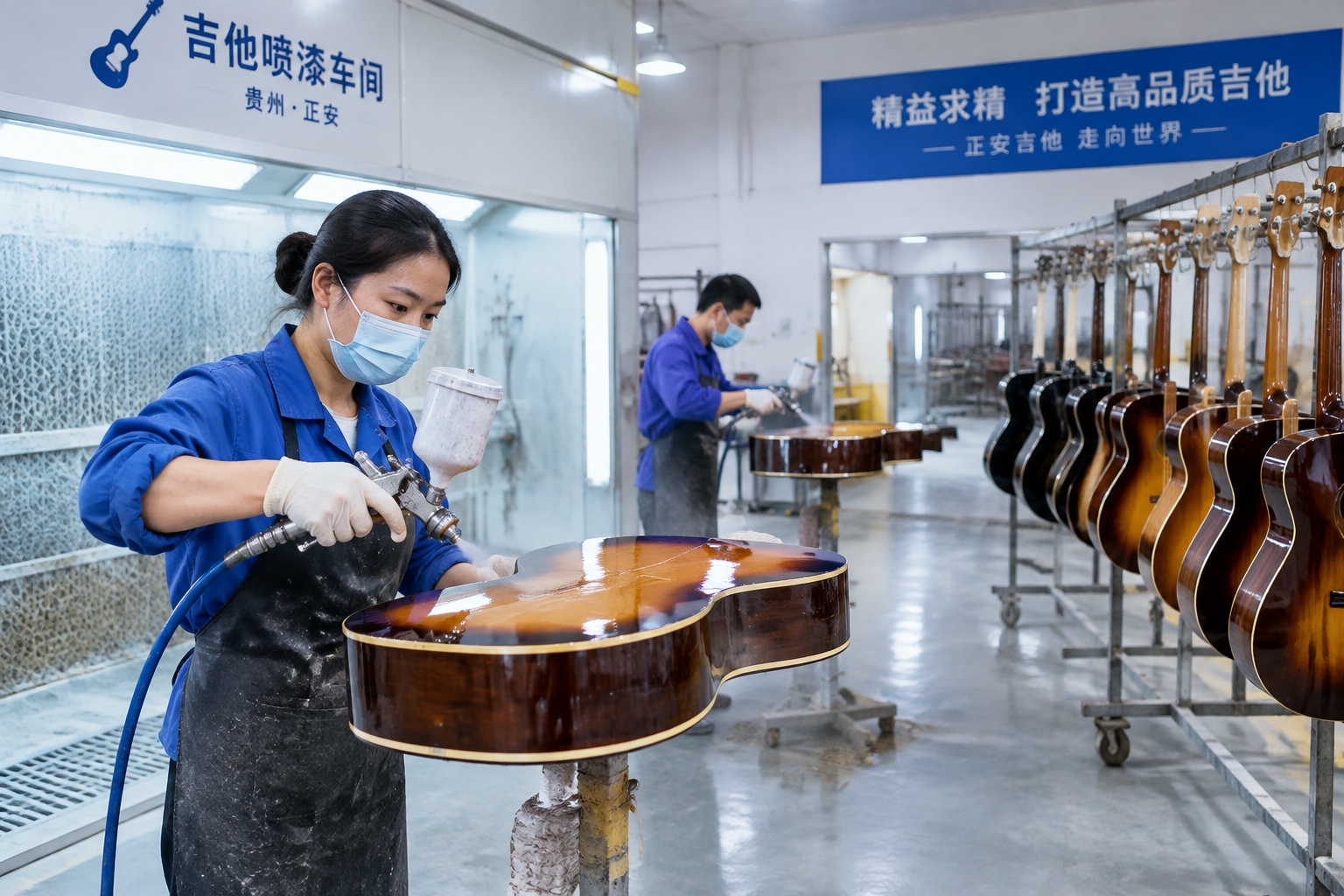
Walk the floor of one of the larger factories and you see why guitars are still a craft as much as a product. Making one involves well over a hundred steps, and the two things that matter most—the shape of the wood and the quality of the finish—resist full automation.
It begins with timber. Spruce, mahogany, maple and rosewood arrive in planks, get cut to thickness, and are left to dry so the wood won’t warp after it’s sold. Machines handle the rough cutting and the repetitive routing. But the bending of the sides, the fitting of the neck, the leveling of the frets, and the final setup—adjusting the strings so the instrument plays in tune and feels right under the fingers—are done by people who have done it thousands of times.
The spray room is its own world. Workers in masks lay down coat after coat of lacquer, then sand between coats until the surface turns to glass. A single high-gloss finish can take days. Further along, a young technician plucks each string of a completed guitar, listening, tightening a tuning peg, listening again. Quality control here is still largely an ear and a pair of hands.
The people who make them
Chen, who asked to be identified only by her surname, spent eight years on guitar lines in Guangdong before moving back. Now she does final inspection, the last person to touch an instrument before it’s boxed. She earns, she says, roughly what she made down south—but she sleeps in her own home, and her two children live with her instead of with grandparents hundreds of miles away. That last part, more than the wage, is the sentence you hear again and again.
This is the quiet revolution of the place. For a generation, families in counties like Zheng’an were split by distance: parents working in coastal factories, children raised by the elderly, reunions limited to the Lunar New Year. The guitar park didn’t just create jobs; it created jobs where people’s families already were. By official counts the industry now employs well over ten thousand local residents, and the county estimates that tens of thousands of former migrants have returned.
There’s pride in the work, too, though it’s understated. A line worker will tell you, without much drama, that an instrument he helped build is probably being played in a music store in São Paulo or a bedroom in Texas. Many of these guitars sell abroad for a modest price—entry-level and mid-range instruments are the bread and butter here—which is exactly the point. Zheng’an competes on the vast middle of the market, where price and consistency win.
Why it works: a whole supply chain in one town
The reason Zheng’an can offer competitive prices isn’t cheap labor alone—coastal China figured out guitars long ago, and wages here are no longer rock-bottom. The advantage is clustering. When more than a hundred guitar companies sit within a few square kilometers, the ecosystem fills in: suppliers for strings, tuning machines, cases, wood, finishes, and packaging all set up shop nearby. A factory can order a missing part and have it the same afternoon instead of trucking it in from another province.
This is a pattern China has repeated across its county economies—one town for socks, another for ties, another for Christmas ornaments. Economists call it industrial agglomeration; on the ground it just means that everything you need is next door, which cuts cost and time at every step. Zheng’an added its own twist: a workforce that already knew the trade before the first factory opened its doors.
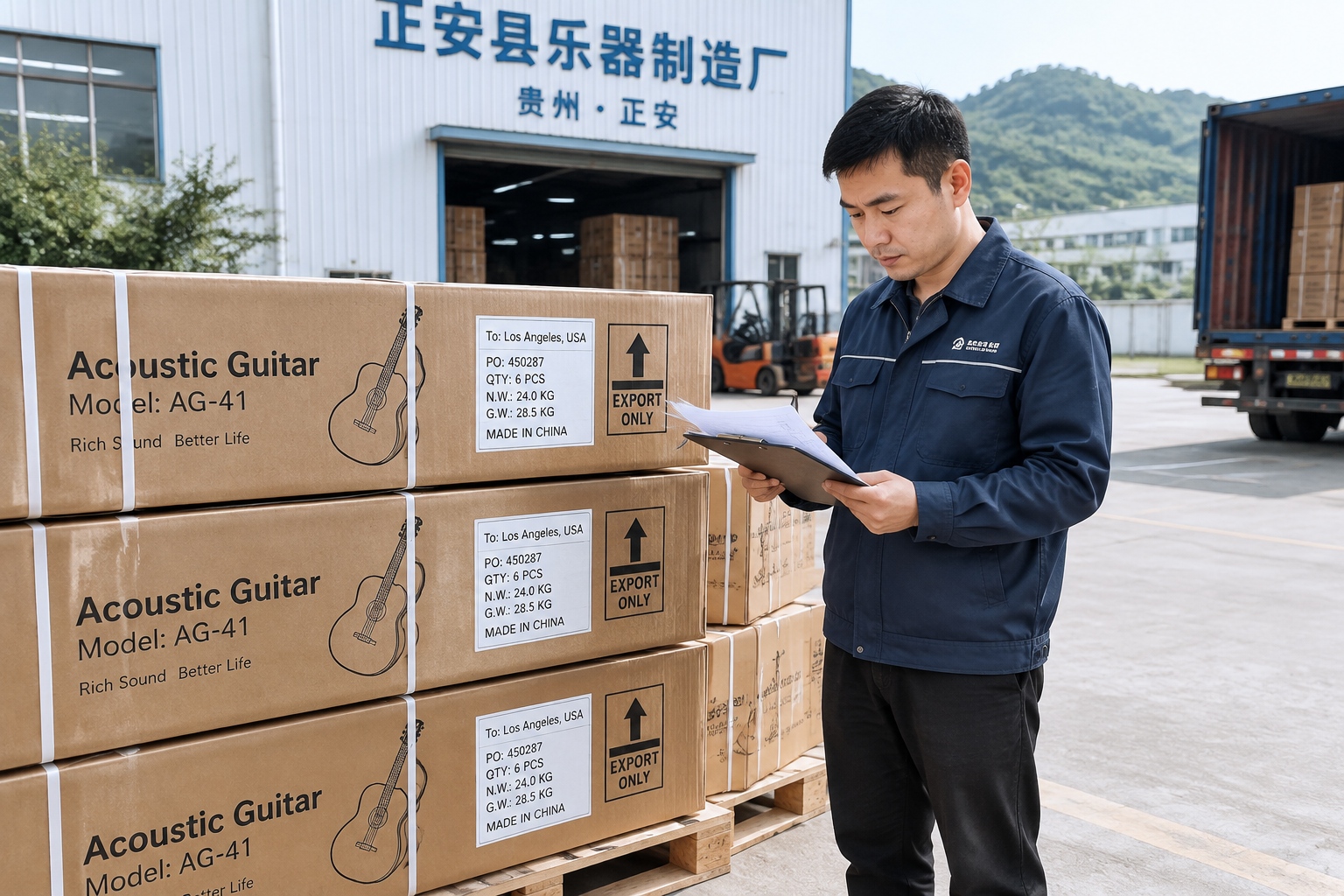
What a county full of guitars actually changes
The effects ripple past the factory gates. New apartment blocks and schools have gone up to serve returning families. There’s now a guitar culture layered on top of the industry—a guitar-shaped plaza, classes for local kids, buskers who learned on instruments made a few miles away. The county has leaned into the identity, branding itself as a music town to draw visitors.
It isn’t a fairy tale. The business runs on export orders, which means it feels every shift in global demand, shipping costs, and currency rates. Much of the output remains lower-margin, and moving up to higher-value, better-known brands is slow, uncertain work. Some returnees have gone back to the coast when orders dipped. The people here know their prosperity is tied to buyers they will never meet.
Still, stand in that sanding room at 8:40 in the morning, watch the spruce catch the light, and the larger story is hard to miss. A county that once exported its young people now ships guitars to forty-odd countries, and the children of former migrant workers are growing up at home. In the arithmetic of modern China, that counts as a lot.
Start the discussion at forum.chinacomes.com