

The First Few Minutes: Safety Over Everything
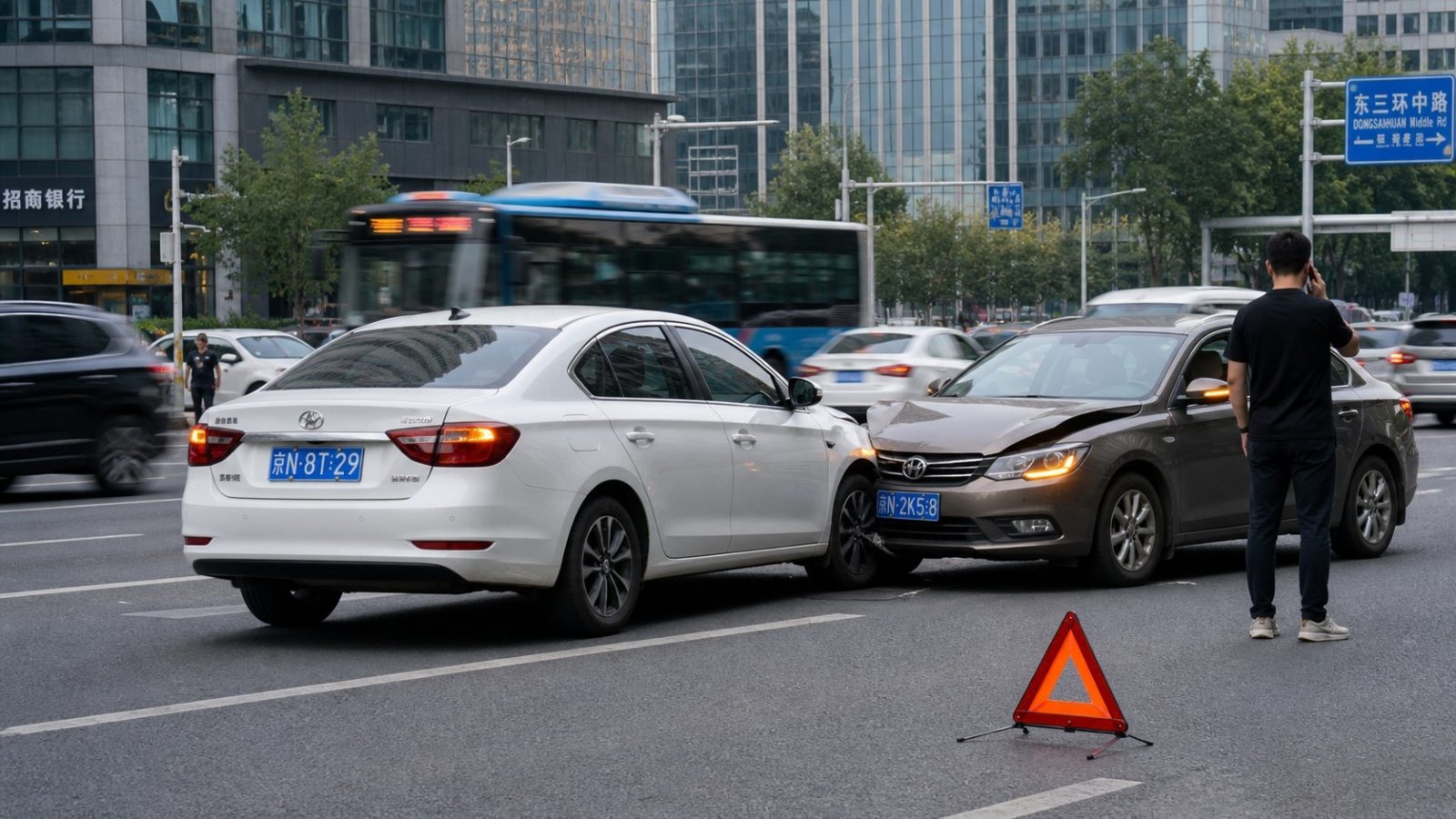
If you are driving or riding in China and suddenly hear the screech of tires, your first instinct will likely be panic. But before checking for injuries or arguing about who is at fault, there is a strict sequence of actions that determines your safety and legal standing.
The golden rule in China, as everywhere else, is: People First, Property Second. If anyone is injured, call 120 (ambulance) immediately. Then, turn on your hazard lights (double flashers). In China, if the accident is minor and involves no injuries, traffic police often require you to move the vehicles out of the main lane within 30 minutes to avoid blocking traffic—a common cause of secondary accidents.
Next, place the warning triangle. Unlike in some European countries where you might find one already installed, Chinese law requires drivers to carry a reflective triangle. Place it at least 50 meters behind your car on regular roads, or 150 meters on highways. Step back to the guardrail and wait.
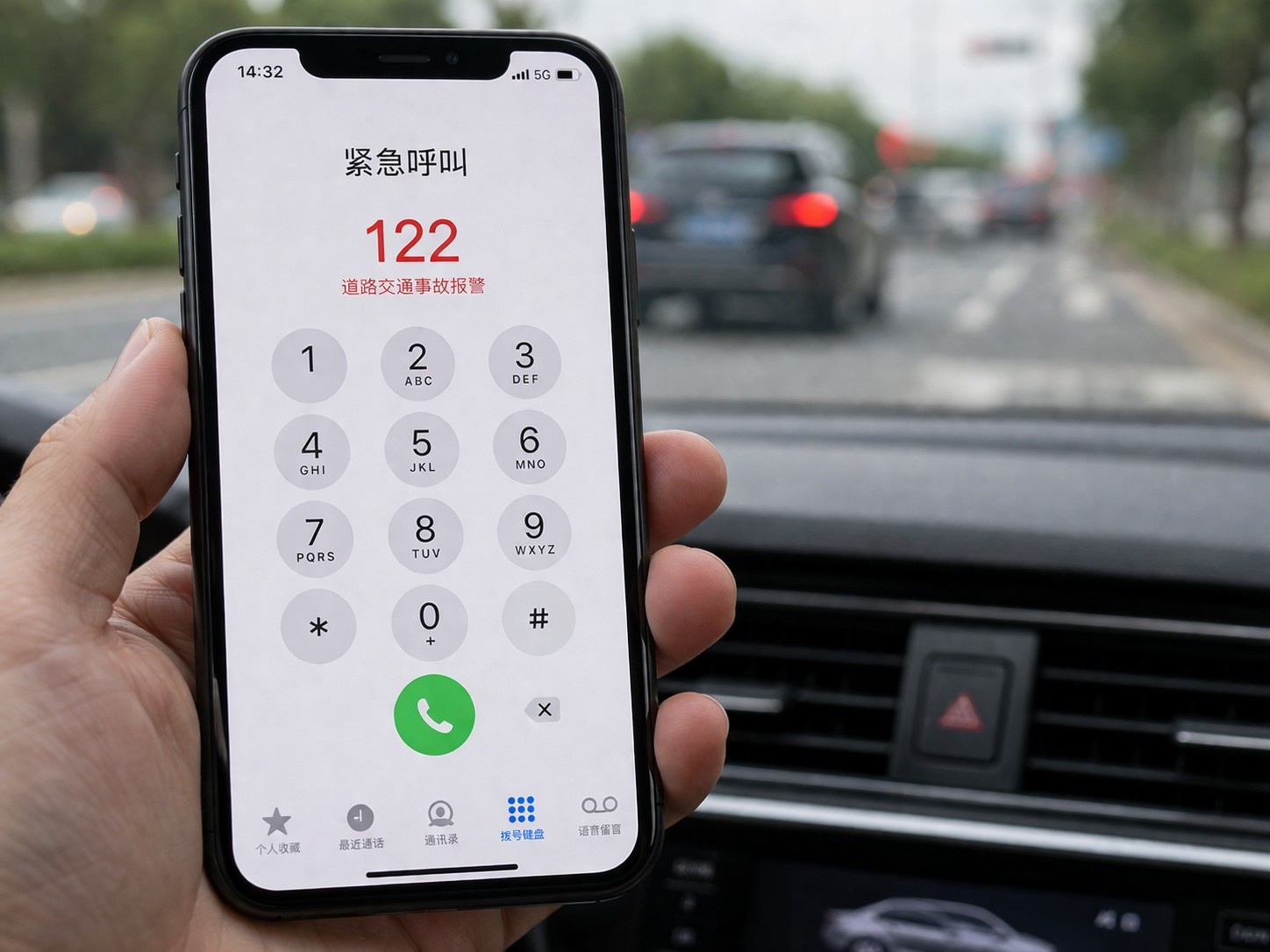
Call 122: The Traffic Police Hotline
In China, you do not call 110 (general police) for standard traffic accidents; you call 122. This is a dedicated hotline for traffic management. Operators are accustomed to handling cases in both Mandarin and often English in major cities like Beijing, Shanghai, or Shenzhen.
Gathering Evidence: The “Photo Checklist”
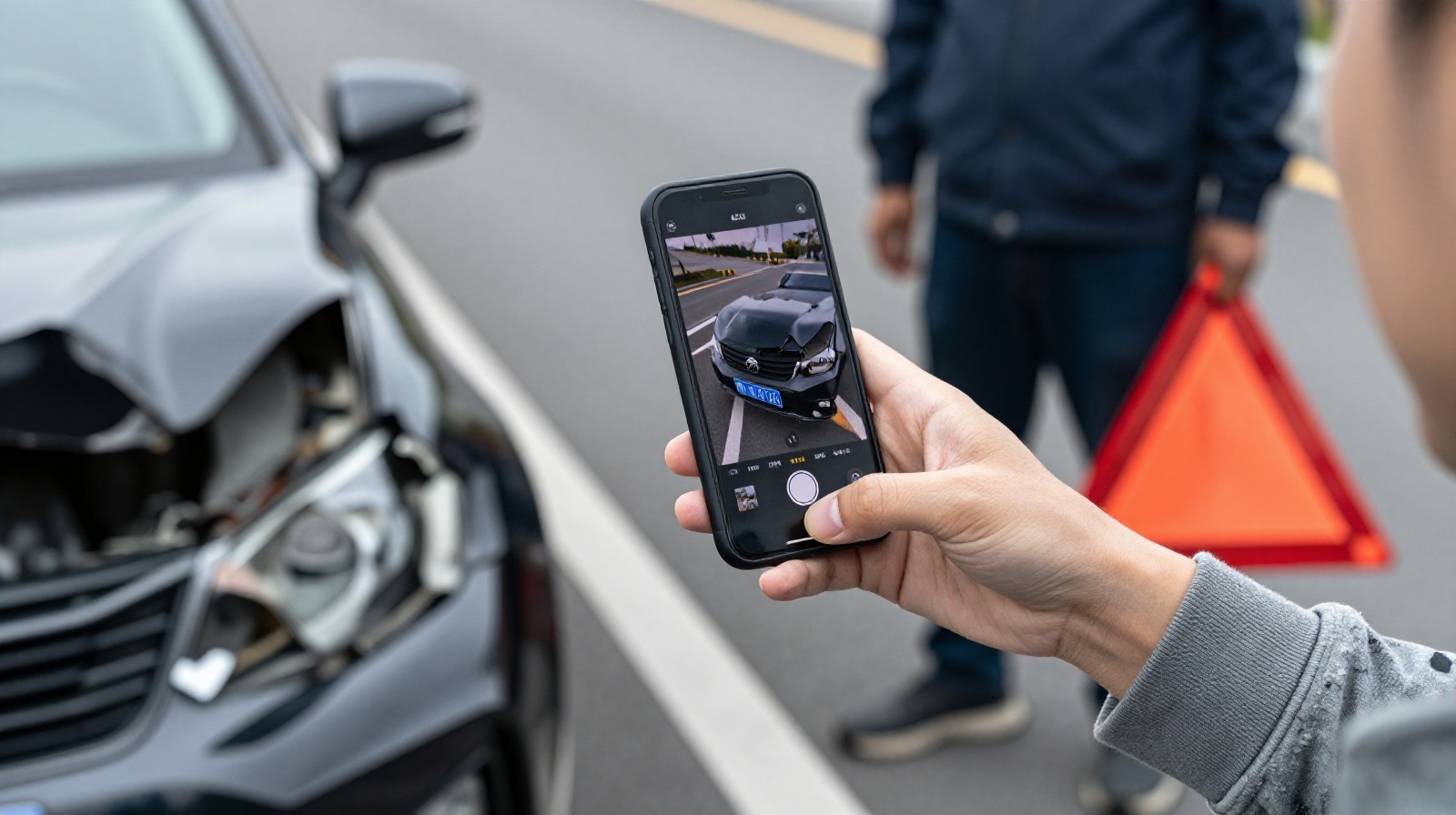
Before you move anything, your phone camera is your most important tool. Chinese traffic police rely heavily on visual evidence to determine liability quickly. If you are involved in a minor scrape, taking the right photos can resolve the issue in 15 minutes.
Take at least four photos from these angles:
- The Front View: Show both cars, their license plates clearly, and the road markings (lane lines or stop signs).
- The Rear View: Similar to the front, showing the rear of both vehicles.
- The Collision Point: A close-up of where the cars hit each other. Show the damage in detail.
- The Context: Photos of nearby road signs, intersections, or landmarks that help identify the exact location.
If there are dashcam videos, save them immediately. Many drivers in China now use AI-assisted dashcams that automatically upload footage to the cloud upon impact—check your device settings if you have one.
Private Settlement vs. Official Report
You will often hear locals talk about “Si Liao” (private settlement) versus “Gong Liao” (official report). Knowing when to use each saves hours of frustration.
When to Choose Private Settlement (Si Liao):
- The damage is minimal (e.g., a small scratch or dent).
- No one is injured.
- Both parties clearly agree on who is at fault.
- You have verified the other driver’s license, registration, and insurance status.
If you settle privately, always take a photo of both drivers’ licenses and exchange WeChat IDs for digital records. Never hand over cash without a written or digital confirmation.
When You MUST Call 122:
- The other driver has no license plate or insurance.
- They appear to be under the influence of alcohol.
- There is any dispute about who caused the accident.
- Injuries are involved, even minor ones.
Navigating Insurance and Police Reports
If you must go through the official channel, do not worry about language barriers. Most insurance companies in China have English-speaking support lines, especially those with international branches (like AIG or Allianz). For local insurers, having a bilingual friend or using a translation app is usually sufficient.
The “Fast Claim” System
China has one of the most efficient insurance claim systems in the world for minor accidents. In cities like Hangzhou, Shenzhen, and Chengdu, you can often resolve claims entirely through mobile apps (such as Alipay or WeChat mini-programs) linked to your insurance provider. The police may issue a digital liability determination letter within minutes.
Communication Tips for Foreigners
If English is not spoken by the other party or the responding officer, keep it simple and non-confrontational. Aggression can complicate matters in Chinese culture, where “saving face” is important.
Useful Phrases:
- Nǐ hǎo, wǒ bù huì shuō Zhōngwén. Kěyǐ bāngzhàng ma? (Hello, I don’t speak Chinese. Can you help?)
- Xièxiè. (Thank you.)
Show the police or the other driver a pre-written note on your phone: “I have insurance. Please call my insurance company.” This shifts the burden of communication to professionals, reducing stress for everyone involved.
Final Checklist for Drivers in China
- [ ] Turn on hazard lights and place warning triangle.
- [ ] Check for injuries; call 120 if needed.
- [ ] Call 122 (Traffic Police) or use the local traffic app.
- [ ] Take 4+ photos of the scene before moving cars.
- [ ] Exchange contact info and verify licenses/insurance.
- [ ] Do not admit fault verbally; let the police decide liability.