

A New Skyline on a Coal Base
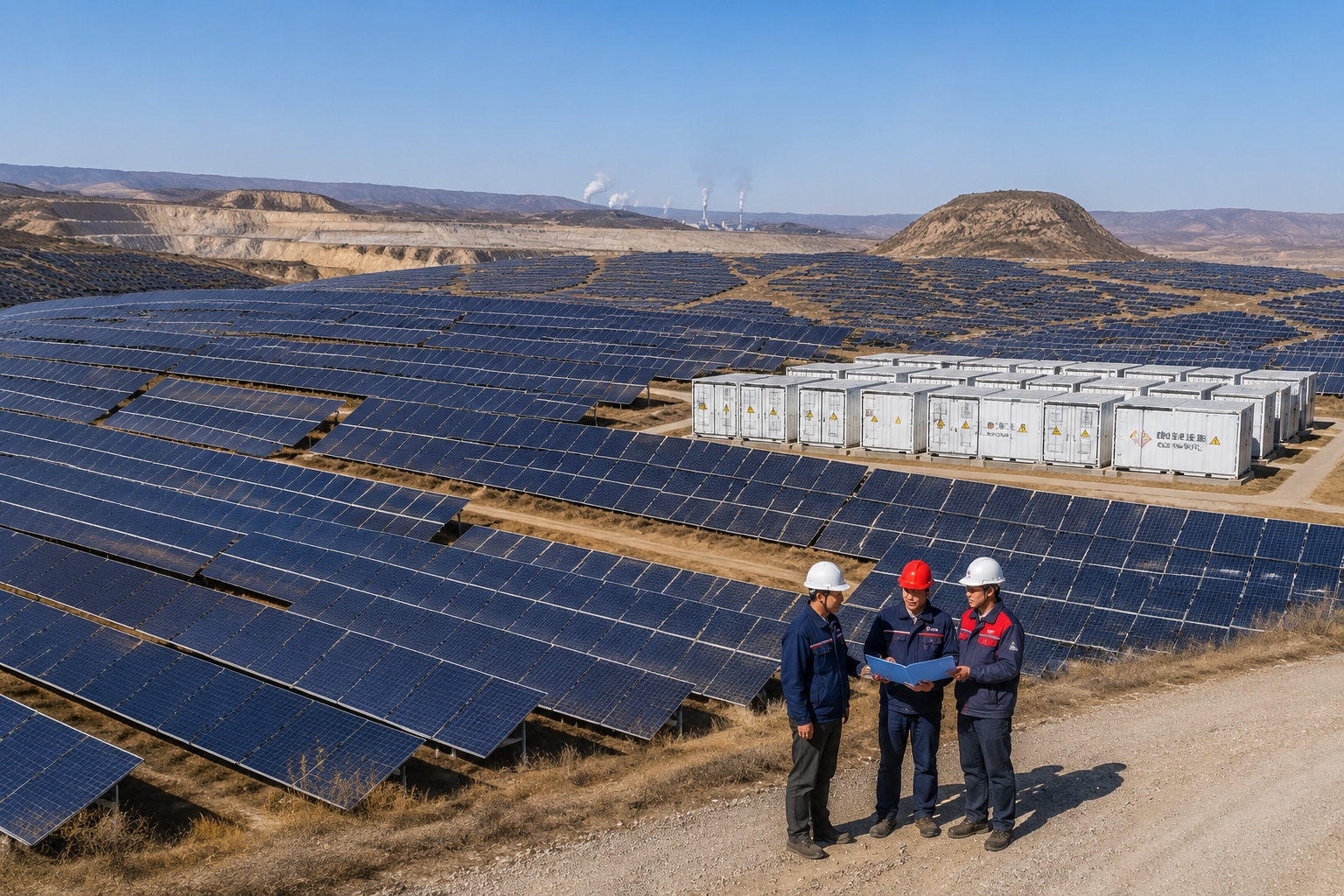
Driving out of downtown Datong in northern China’s Shanxi province, the first thing that catches your eye is not a smokestack but a blue horizon. Row after row of solar panels stretch across rolling land that looks oddly shaped — some areas are sunken, as if the ground has settled unevenly. On a nearby flat plot, dozens of white containers, each about the size of a shipping container, sit in neat rows. Overhead, the sky is clear, but occasionally a truck loaded with coal rumbles past, kicking up dust from the same ground that now holds solar arrays.
This is not a futuristic city. It is a former coal mining area, now part of a pilot project that combines photovoltaic power generation with large-scale battery storage. For a city that once supplied coal to much of China, it’s a surprising sight — and a hint at how deeply the country’s energy landscape is changing.
A Century Built on Coal
Datong’s history is written in coal. Located on the Datong coalfield, one of China’s largest, the city has been digging since the early 20th century, with intense extraction starting in the 1950s. At its peak, Datong’s mines produced tens of millions of tonnes of coal every year. That coal powered steel mills, power plants and railways across northern China. The city grew around mining; generations of families worked underground, and entire districts were built to house miners.
But extraction came with a heavy cost. As coal seams were stripped away, the ground above them subsided. Over the decades, large areas of land around Datong sank gradually. Roads cracked, houses tilted, drainage broke, farmland became unusable. According to local government reports, the area of subsidence within the mining zone is substantial — several hundred square kilometres. This land was too unstable to build on, too damaged to farm, and often left abandoned.
That legacy made Datong an unlikely candidate for a clean-energy transition. Yet it also created an opportunity: vast, flat, open areas with strong sunlight and no competing uses.
Solar Panels on Broken Ground
In the mid-2010s, the Chinese central government launched a “Top Runner” programme to encourage advanced photovoltaic technology. Central Shanxi, including the Datong area, was chosen as the site for the first large-scale demonstration. Developers were invited to build solar plants on subsidence zones, with the promise of guaranteed grid access and favourable tariffs.
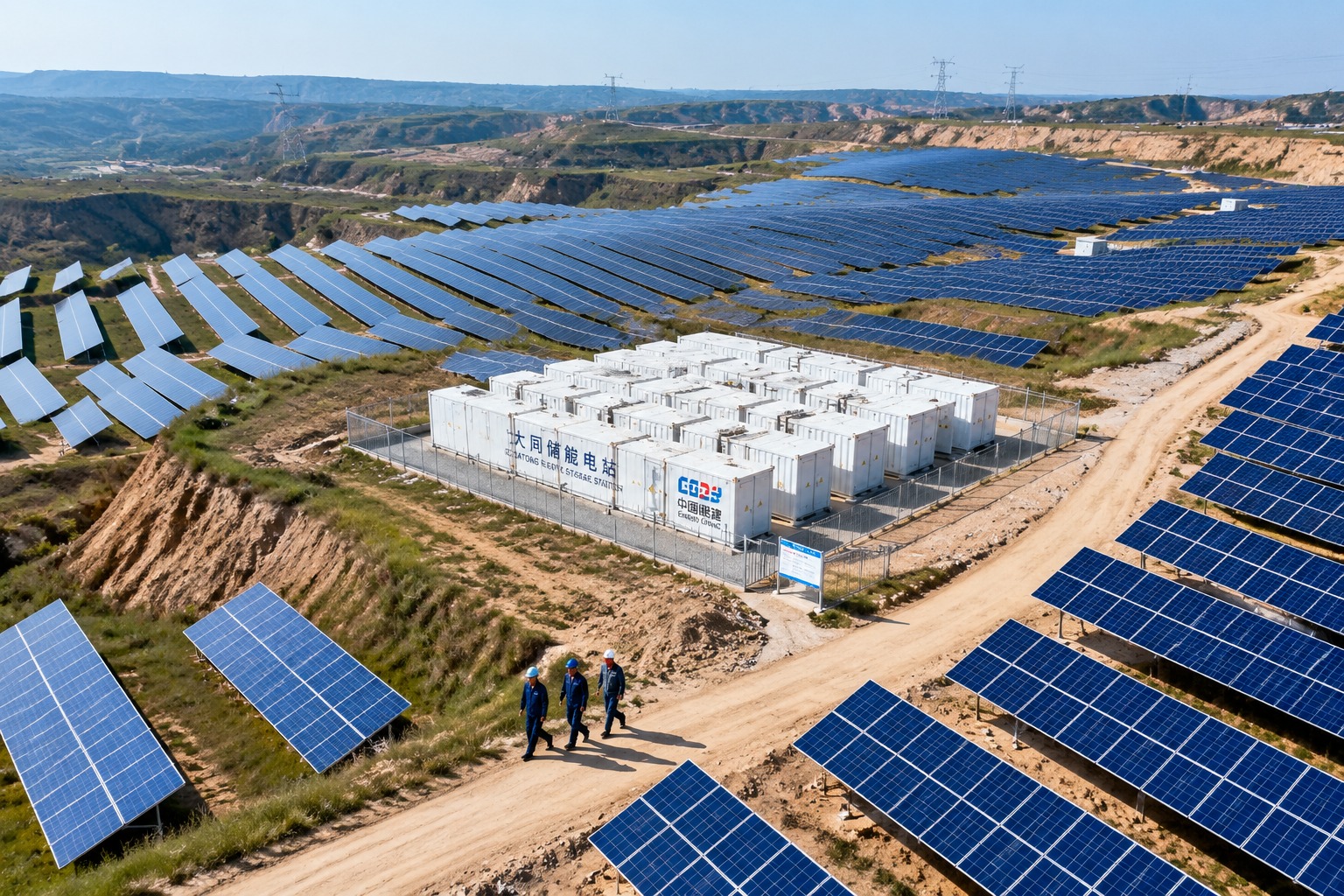
What followed was an extraordinary transformation. Between 2015 and 2017, more than a million solar panels were installed across the scarred landscape. Today, the Datong base has a total capacity of over one gigawatt, enough to power roughly half a million homes. The panels are mounted on adjustable frames to follow the sun, and the ground below is often left for grass or crops.
Energy storage was added later, as the response to the growing share of solar on the grid. A typical storage station inside the base is made of dozens of large battery containers, each housing hundreds of lithium-ion cells. Together, they store enough electricity to power tens of thousands of homes for a few hours — a buffer that smooths the ups and downs of solar generation.
Why Storage Matters
Solar power has an obvious weakness: it only produces while the sun shines. Electricity demand, however, peaks in the evening when solar output drops toward zero. Without storage, grid operators have to rely on coal or gas plants to ramp up quickly, which is both expensive and carbon-heavy. Batteries solve this that by charging in sunny afternoons and discharging in the evening rush.
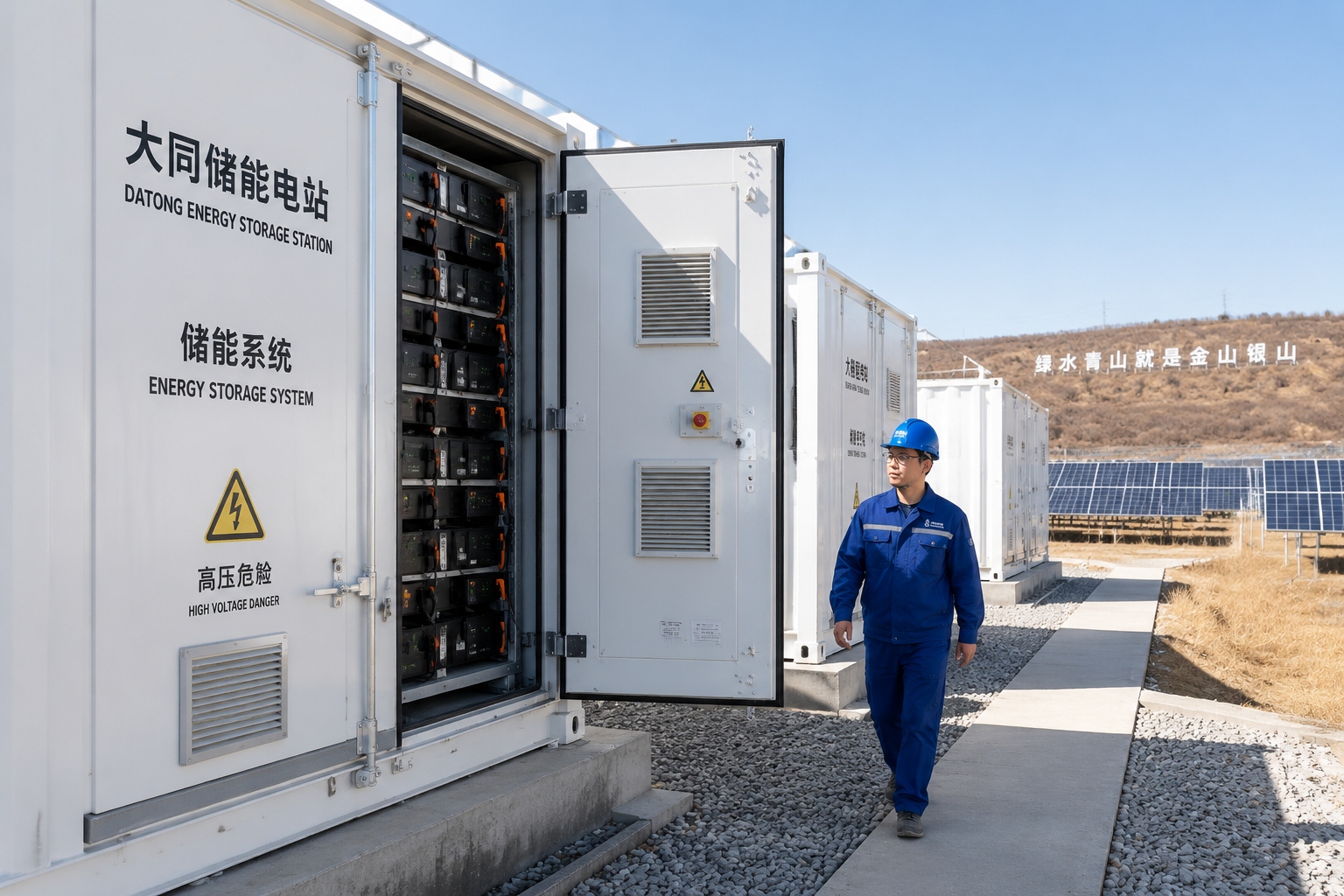
The containers work like gigantic power banks. Each one is a dense pack of battery cells, a heating and cooling system, and safety sensors. When the sun is strong, the solar plant feeds electricity to the grid and also charges the batteries. When the sun sets, the batteries take over and release electricity smoothly. They can react within milliseconds, helping stabilise voltage and frequency. This makes the entire plant much more reliable, and it makes the grid operator’s job easier.
Beyond the physical hardware, this “solar plus storage” model is becoming a standard in China’s new energy landscape. The National Energy Administration has pushed provinces to build additional storage capacity alongside new PV plants. Datong is not alone; similar projects are sprouting from the deserts of Qinghai to coastal Jiangsu. But Datong’s location gives it a special meaning — it is proof that even a coal heartland can host next-generation clean energy infrastructure.
The View From the Villages
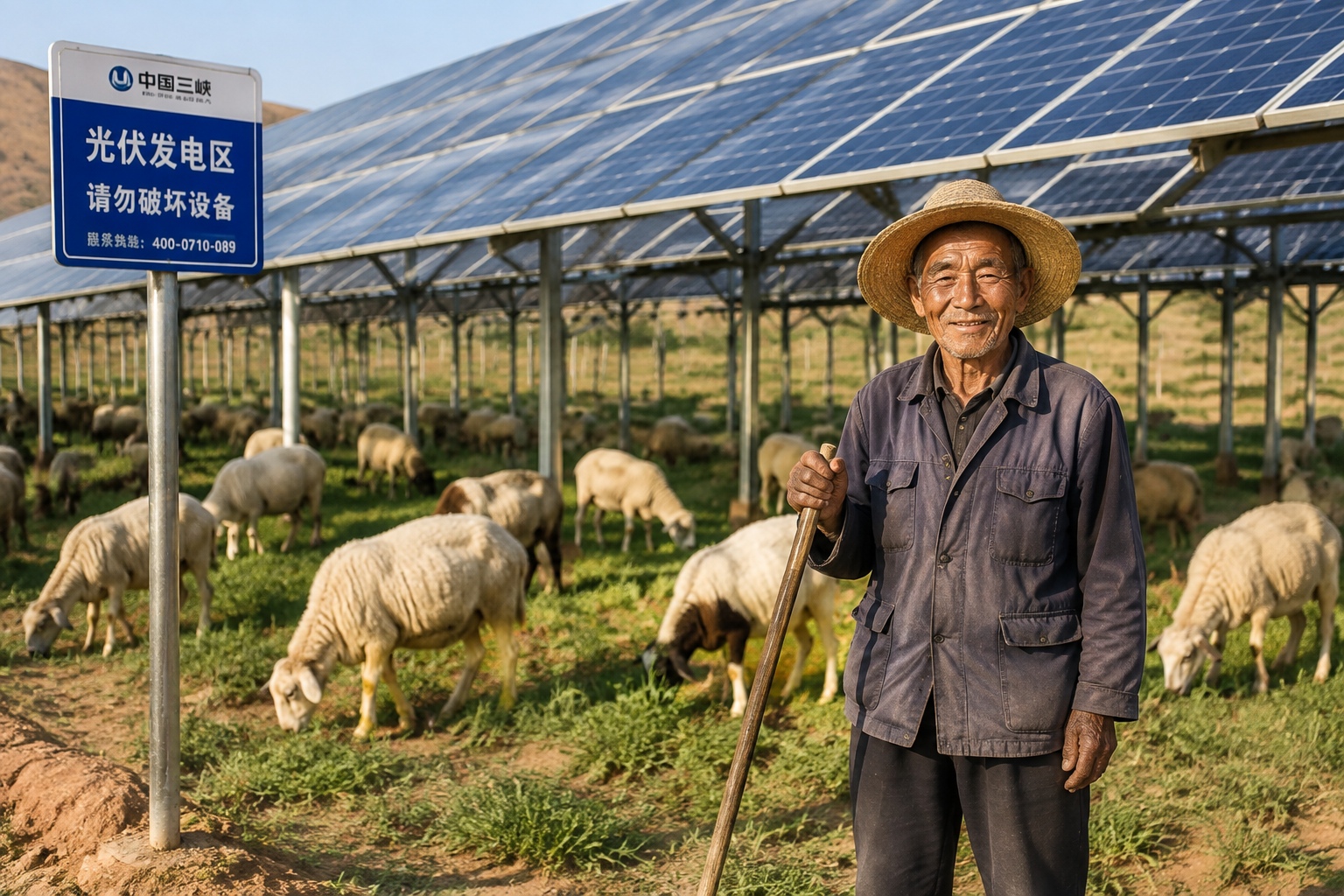
To understand how this transition feels, I walk into a village near the solar base. The name on the map is one of many ancient villages that used to depend on mining or disrupted farmland. An elderly man named Wang is feeding his sheep in a field between two rows of solar panels. He tells me that his family nowadays earns more from leasing their land to the solar company than they ever did growing corn here.
“We used to have to move because the ground was sinking,” he says. “Now we get income without farming, and the sheep like the shade.”
Other locals work in different ways. Some young people have been trained as maintenance workers, checking inverter temperatures and cleaning dusty panels. A woman who runs a small food stall near the base says business is better than during the mining era — there are more workers, and they are younger, and they come at regular hours.
The air, too, has changed. “When I was a child, in winter we’d have to rinse out our noses when we came in,” the stall owner says. “Now we don’t need to. The wind still blows coal dust off the piles near the railway, but it’s not like before.”
Not everyone shares that optimism. In the nearby communities, underground mining still employs thousands. A taxi driver who once worked at a state mine talks about friends still underground: “They hope it lasts a few more decades. They don’t know how to do anything else.” He gestures toward the solar panels on the hillside. “That’s the new thing, but it doesn’t hire many people.”
Hard Problems to Solve
It would be misleading to say the transition is smooth. First, the economics of battery storage are still fragile. While prices of lithium batteries have fallen dramatically over the past decade, a utility-scale storage station can still cost millions of dollars. The revenue streams — selling stored electricity during peak times and providing grid services — are not yet enough on their own to pay for the system without government support. Subsidies are being phased out, and the market mechanism for storage is still developing.
Second, the grid itself needs strengthening. Solar farms are often built far from industrial load centres, so electricity must be transmitted over long distances. Datong’s grid was designed for a one-way flow from coal plants to consumers; absorbing variable solar power requires more flexible transmission control and more investment.
Third, the social dimension is perhaps the hardest. A solar farm is far less labour-intensive than a coalmine. The transition may bring new jobs in manufacturing and installation, but they are not necessarily in the same place or for the same skills. Many miners are in their 50s and unsure about retraining. Local governments are exploring programmes for resettlement and skill-building, but the challenge is huge.
A Model for China’s Energy Shift?
Despite these challenges, Datong’s experiment is being watched closely across China. It is not only about producing clean kilowatts; it is about what to do with land that has been ruined by resource extraction. In other regions — from Fuxin in northeastern Liaoning province to Yulin in Shaanxi — similar ideas are taking shape. The country’s total installed wind and solar capacity now far exceeds that of coal, and the expansion continues, with energy storage soon to grow at an even faster pace.
The idea of using mining subsidence areas for solar takes advantage of land that is useless for almost anything else. It restores a kind of productivity, and it gives the local economy a new identity. At the same time, the batteries serve as a bridge between the old world of constant coal-fired generation and the new world of intermittent renewables.
Conclusion
Standing on a windswept ridge near Datong’s former mines, the view is both strange and hopeful. To your left, solar panels stretch as far as the eye can see. To your right, a white storage station hums quietly, ready to release energy that was harnessed hours earlier. Behind you is a century of mining; ahead is an experiment that may not be perfectly clean, but at least attempts to move forward.
Datong doesn’t claim to have all the answers. It still burns coal, and its coal industry still dominates. But the fact that one of China’s most coal-heavy cities is now a national showcase for integrated solar and storage is itself a sign of change. The sun that always shone over the loess plateau is finally being treated as a resource — one that doesn’t have to be extracted, and doesn’t leave holes behind.
Start the discussion at forum.chinacomes.com