


Introduction: A Foreigner’s Confusion
When my American friend Mark first opened a Chinese news app, he stared at the headlines in bewilderment. ‘Today’s hot search: “Rescuers pull all-nighters, 21 survivors”—where’s the verb? Is it “found” or “saved”? And this one: “Shanghai, heavy rain, subway delays”—it’s just a list of nouns!’ His confusion is common among non-native readers. Chinese news headlines often strip away subjects, verbs, and function words, leaving a dense cluster of keywords that resemble a fill-in-the-blank exercise. But for Chinese readers, this is not a puzzle—it’s a feature of their language and reading habits.
The Grammar of Efficiency: How Chinese Omits
Chinese is a topic-prominent language, meaning the topic often takes precedence over the subject-verb-object structure. A headline like “河南暴雨 救援进行中” (Henan heavy rain, rescue ongoing) is perfectly grammatical in Chinese, though an English version would require a verb: “Rescue operations are underway during heavy rain in Henan.” The omission of the copula “are” and the preposition “during” is natural in Chinese, where context fills the gaps. Additionally, Chinese characters carry a high information density—each character often has multiple meanings—so a short headline can pack a surprising amount of news.
For example, the headline “日本核废水排海 中国批不负责” (Japan nuclear wastewater discharge sea, China criticizes irresponsible) contains 11 characters but conveys subject (Japan), action (discharge), location (sea), agent (China), opinion (criticizes), and judgment (irresponsible). In English, this would require at least 15–20 words: “Japan discharges nuclear wastewater into the sea; China criticizes it as irresponsible.” The Chinese version achieves the same meaning with fewer characters, relying on the reader to infer the verb “discharges” and the logical connection between the two clauses.
This efficiency is rooted in classical Chinese, where brevity was prized. Modern headlines carry forward this tradition, especially in the fast-paced digital age, where every character matters in a limited space.
The Reader’s Role: Filling in the Blanks Instantly
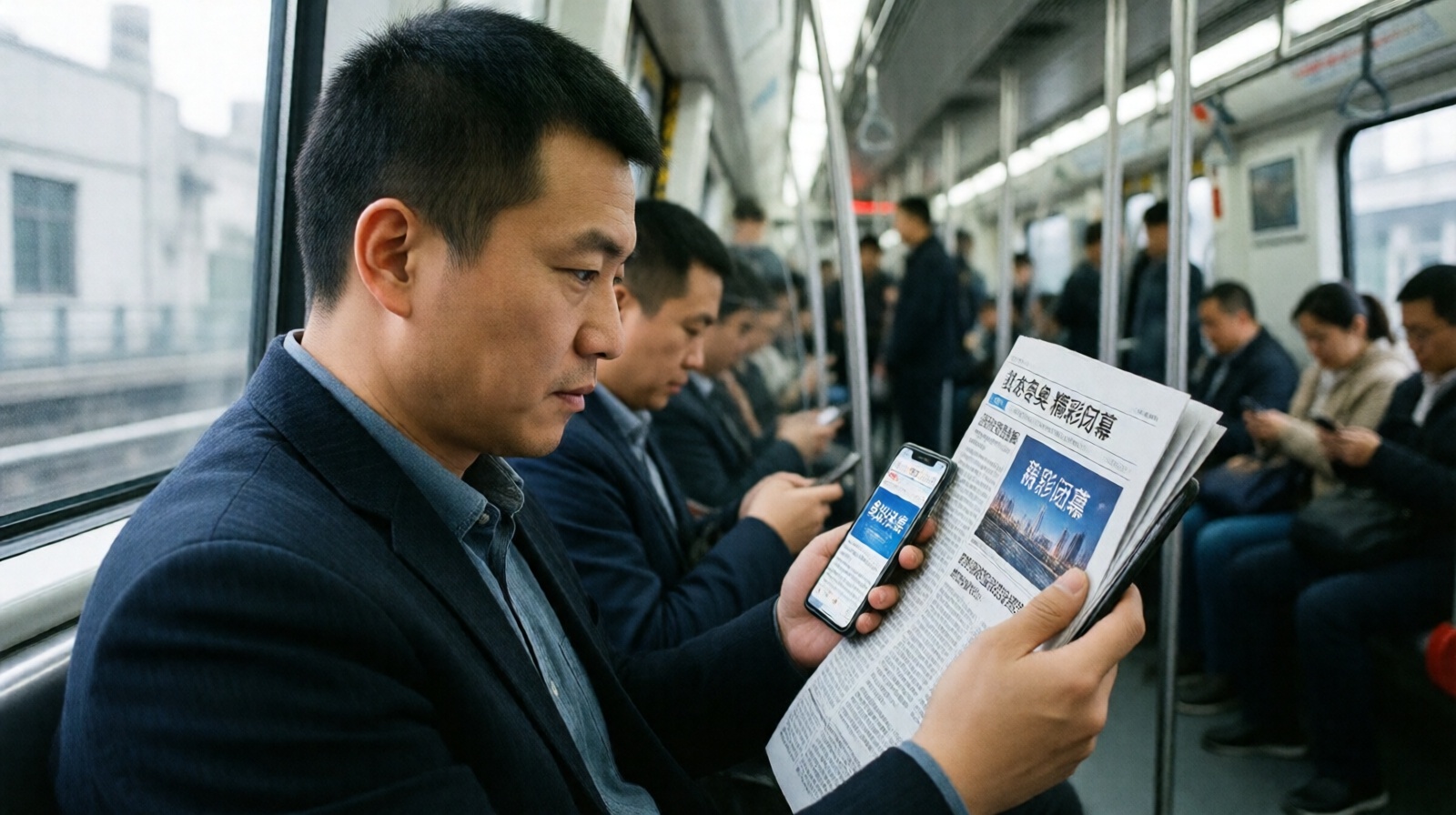
How do Chinese readers decode these minimalist headlines? The answer lies in their deep familiarity with language patterns and cultural context. A headline like “北京冬奥 精彩闭幕” (Beijing Winter Olympics, splendid closing) triggers an automatic mental fill-in: “The Beijing Winter Olympics concluded with a splendid closing ceremony.” The reader supplies the verb “concluded” and the noun “ceremony” based on common knowledge. Similarly, “楼市调控 多地加码” (Housing market regulation, many places tighten) is understood as “Many local governments are tightening housing market regulations.” The reader adds the missing preposition “on” and the auxiliary “are.”
This process is so swift that native speakers don’t notice it. It’s akin to how English speakers understand “Hotel California” as a song title without a verb—the mind completes the structure. But in Chinese, this is the norm for news headlines. The language encourages a high-context communication style, where the audience actively co-constructs meaning.
Moreover, Chinese readers have grown up with a literacy system that rewards character recognition and semantic inference. Unlike alphabetic languages where words are parsed letter by letter, Chinese characters are processed as visual wholes, allowing faster identification of key information. This visual-spatial reading skill makes scanning a headline and filling in gaps a subconscious habit.

Social Context: Speed and Attention in the Digital Age
Beyond linguistics, the rise of mobile news consumption in China has amplified the trend. On platforms like Weibo, Toutiao, and WeChat, headlines are the primary gateway to content. Users scroll through hundreds of posts daily, and a headline must grab attention and convey the core message in under 2 seconds. Omission of less critical words (e.g., “the,” “a,” “is,” “are”) allows for maximum information density. A full sentence like “Local government announces new subsidy policy for electric vehicles” might become “多地对电动车推补贴新政” (Many places for electric cars push subsidy new policy). The verb “push” is kept, but articles and prepositions are gone.
This style also reflects China’s fast-paced urban lifestyle. In cities like Shanghai or Beijing, commuters read headlines on the subway, during a coffee break, or while waiting in line. They need a concise snapshot of the news, not a grammatically complete sentence. The headline acts as a teaser; if interested, they click for the full story.
Furthermore, the Chinese press has a tradition of using succinct language to convey authority and objectivity. Official Xinhua News Agency headlines are famously terse, often using four-character idioms or parallel structures. For example: “全国两会 开幕在即” (National Two Sessions, opening soon). This brevity is seen as professional and informative.
Comparison with English: A Different Logic
English news headlines, by contrast, tend to preserve a full sentence structure, albeit with some compression (e.g., “Trump Slams Media Over Leaks”). The verb is almost always present because English grammar requires a finite verb for a clause to be complete. Prepositions and articles are sometimes dropped, but the core subject-verb-object skeleton remains. A Chinese-style headline like “中美元首通话 聚焦贸易” (China US presidents phone call, focus trade) would feel incomplete in English: “China-US presidential phone call, focus on trade” is not a proper sentence; a reader would expect “Chinese and US presidents discussed trade during a phone call.”
Why the difference? English is a subject-prominent language where the subject-verb relationship is explicit. Chinese, as a topic-prominent language, allows the topic to stand alone, with the comment implied. Additionally, English relies on word order and function words for grammatical clarity, while Chinese uses word order and context more flexibly.
For foreign learners, this can be frustrating. But understanding the logic helps: Chinese headlines are not poorly written English; they are a different system optimized for efficiency. Once you learn the fill-in-the-blank pattern, reading headlines becomes addictive—like solving mini puzzles.
Conclusion: Not a Barrier, but a Bridge
The next time you see a Chinese news headline that looks like a stack of nouns, remember: it’s not a test of your language skills, but a mirror of how Chinese people process information. This style is a natural product of linguistic features (high information density, topic prominence), cultural habits (high-context communication), and social demands (speed, digital consumption). For Chinese readers, it’s not a puzzle—it’s a seamless part of everyday reading. For outsiders, it’s a fascinating window into the efficiency of the Chinese language and the rhythm of modern life in China.