
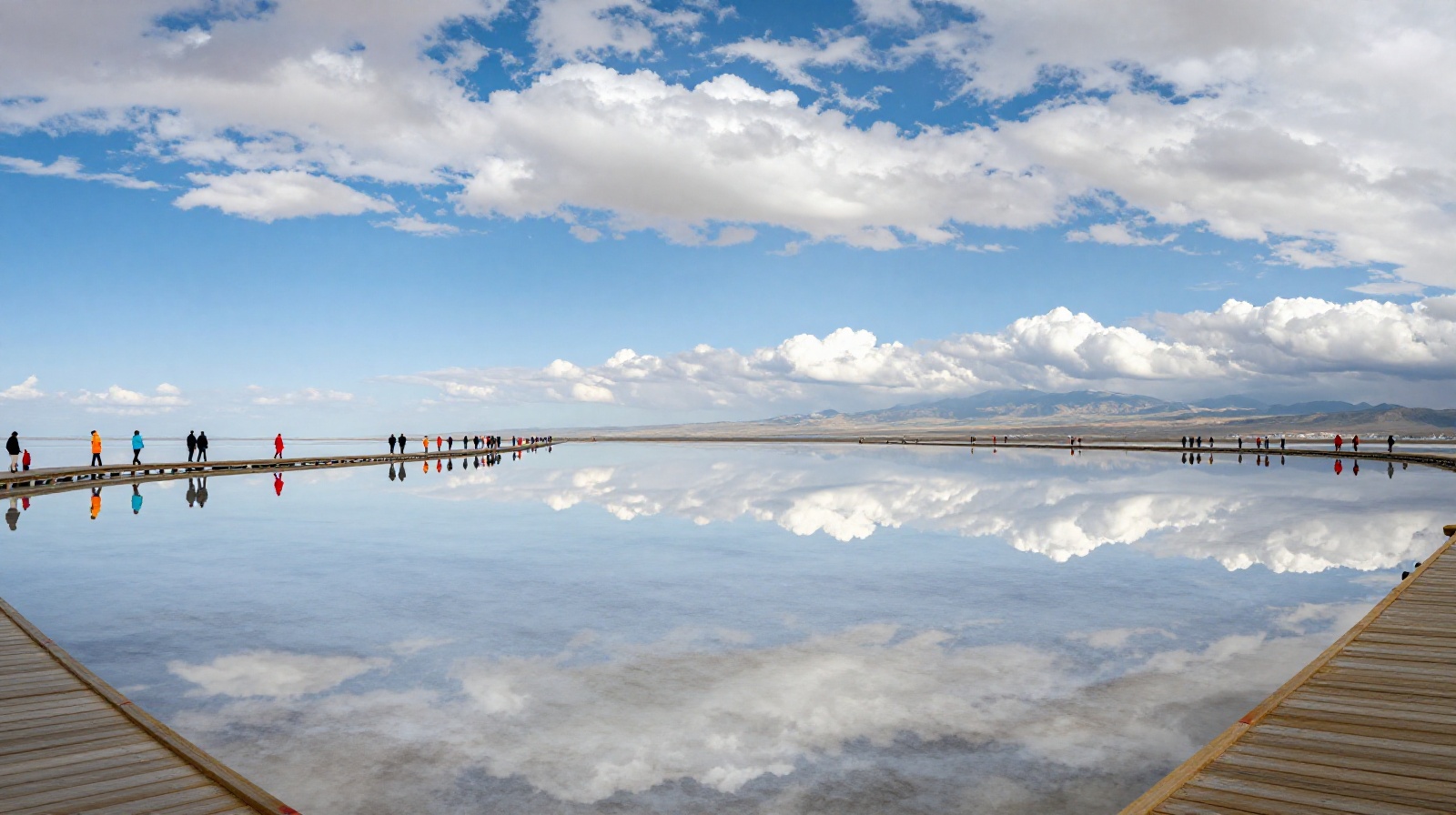

When the Horizon Disappears
The air here is thin and smells faintly of sulfur. It’s 10:30 AM on a crisp Tuesday in July at Chaka Salt Lake. You are standing on a wooden boardwalk that stretches like a scar across a blinding white plain. Before you, the ground isn’t ground—it’s water. Or rather, it’s a layer of salt crystals just millimeters thick over shallow brine.
There is no horizon line. The sky and the earth merge into a single dome of blue. A tourist from Shanghai steps off the path. She lifts her dress, hesitates for a second, then walks onto the crust. Suddenly, she looks weightless. Her reflection follows her exactly, creating a perfect symmetry that feels like walking in two worlds at once.
This is Chaka Salt Lake in Qinghai Province, often called China’s “Sky Mirror.” While it may sound like a cliché from a travel brochure, the experience is visceral. It’s not just about taking photos; it’s about the disorientation of seeing your own image floating beneath your feet while the clouds race overhead.
Beyond the Postcard: The Human Element

Travelers carefully walking on the reflective salt surface at Chaka Salt Lake, Qinghai Province, with mountains in the background.
Chaka isn’t a remote village untouched by time. It is a bustling economic hub for the region. In the last decade, tourism has exploded here. You can see it in the new hotels lining the lake’s edge and the electric trams ferrying thousands of visitors daily from the train station.
But look closer at the people working there. Li Wei, a 28-year-old guide who grew up in the nearby town of Chaka, knows the landscape better than anyone else. “In the morning,” he says, wiping salt dust off his boots, “the light is perfect. But by noon, if there’s wind, the reflection breaks.” He points to a section where tourists have stepped off the designated path. A small patch of white crust has turned into black mud.
This tension between beauty and fragility defines modern Chinese tourism. The lake isn’t just a backdrop; it’s an active workplace for millions of tons of salt production every year, alongside the influx of visitors seeking that perfect selfie.
The Cost of Perfection
Walking on the salt lake feels magical until you realize how easily it breaks. The “mirror” only works when a thin layer of water covers the salt crust. Too many people walking in one spot crushes this delicate balance, turning the reflective surface into rough, unusable mud.
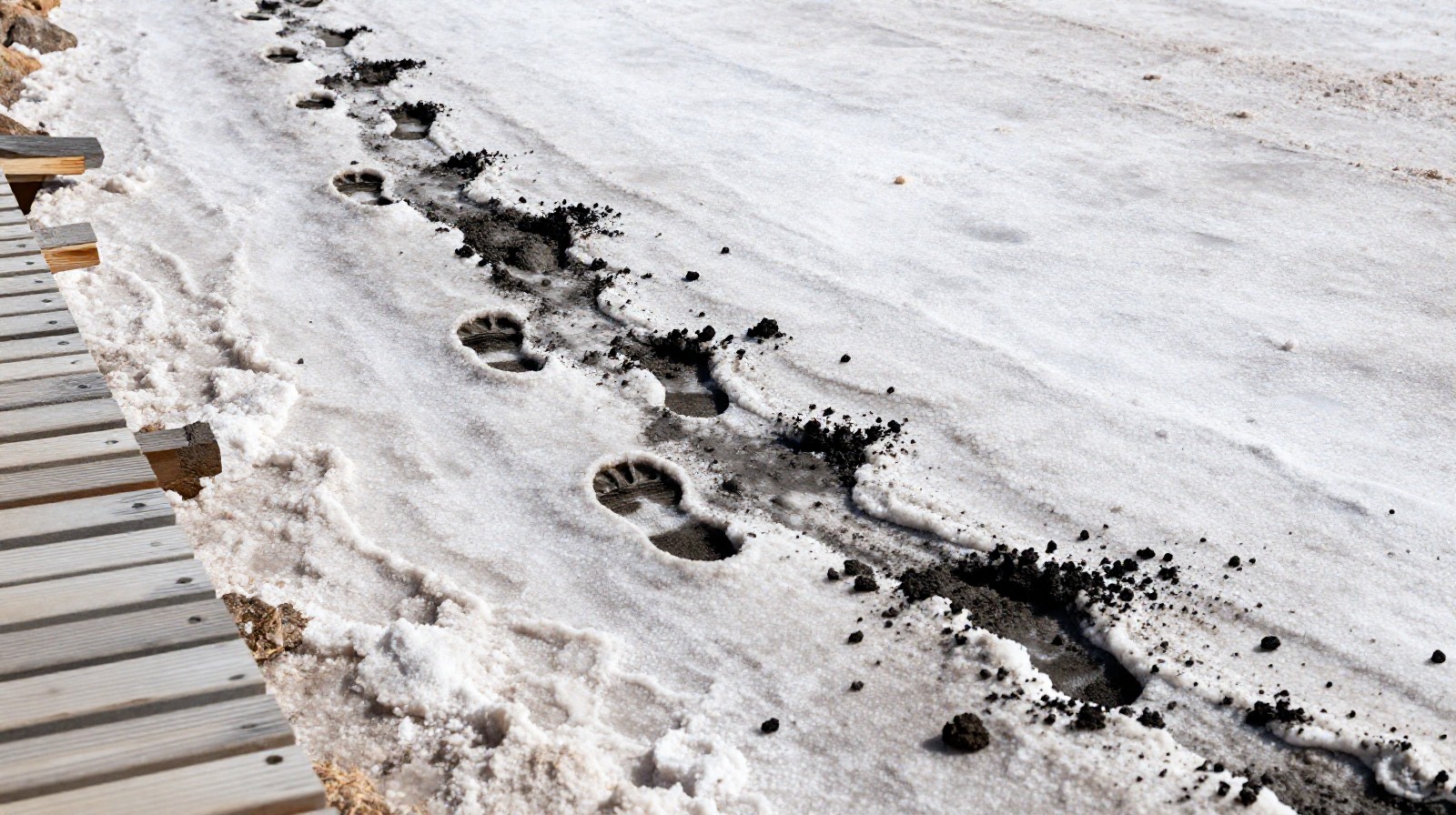
A close-up view of cracked salt crust and muddy footprints showing the impact of heavy foot traffic on Chaka Salt Lake’s surface.
Local officials have had to intervene. The old days of free-for-all walking are gone. Now, specific paths are marked with ropes or wooden planks. In some areas, entry is strictly prohibited during high tide or windy seasons to allow the crust to recover. There are even drones flying overhead, not just for scenic shots, but monitoring foot traffic density in real-time.
For the average visitor, this means a shift in behavior. It’s no longer about stamping all over the place. The new norm is “leave no trace” tourism. Visitors are encouraged to stay on the boardwalks, wear special shoes provided by the park, and avoid stepping into the shallow water unless it’s a designated walking zone.
A Sustainable Future for the Mirror
The story of Chaka Salt Lake is a microcosm of China’s broader environmental shift. For decades, rapid development often came at nature’s expense. Today, the conversation has changed. It’s not just about how many tourists can come; it’s about whether the lake will still be there in ten years.
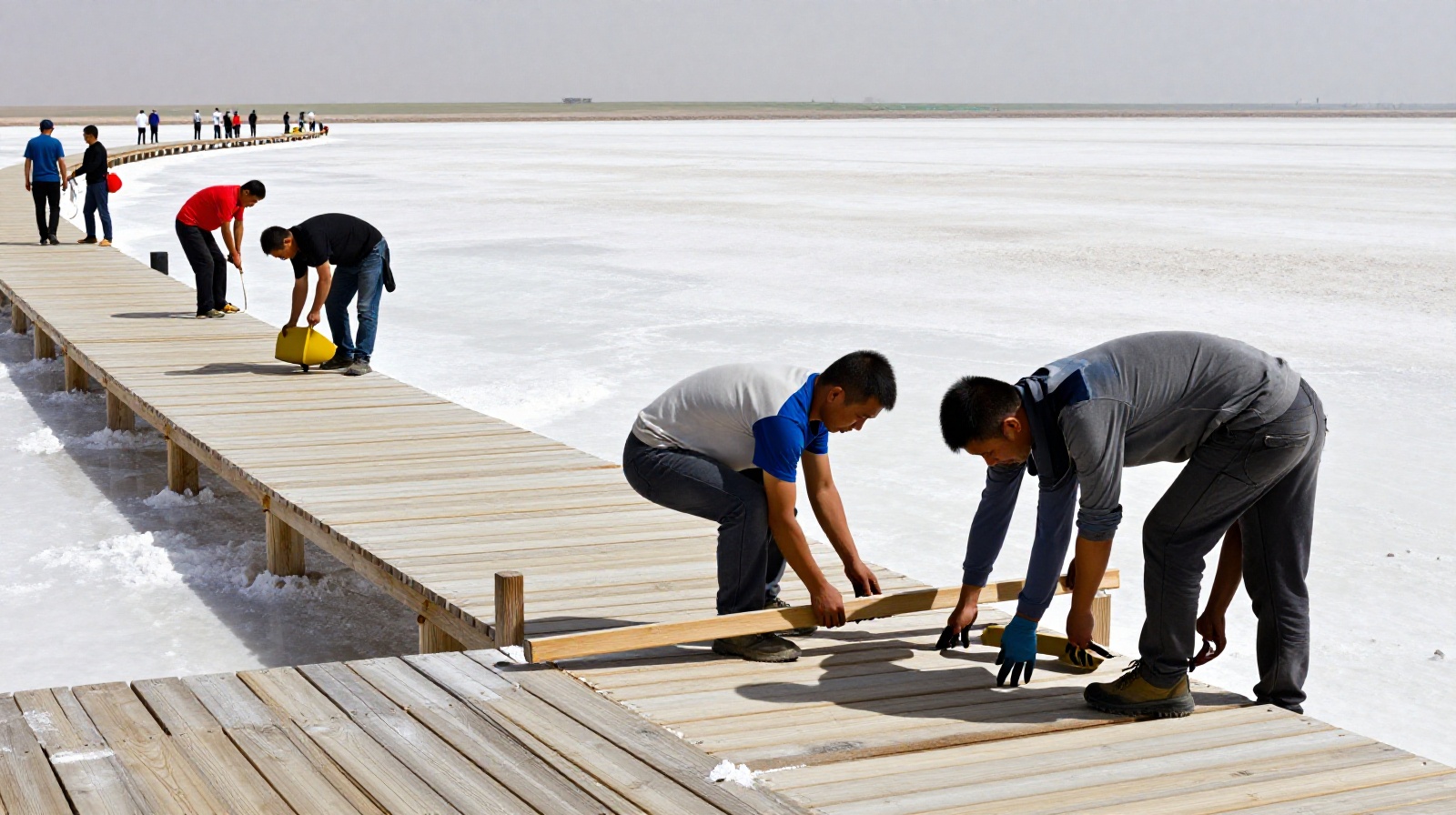
Workers repairing wooden boardwalks along the edge of Chaka Salt Lake to minimize environmental damage while accommodating visitors.
Eco-friendly initiatives are becoming standard. The local government has partnered with tech companies to install sensors that measure water depth and salt crust thickness. If a zone is stressed, access is automatically closed via digital signage. This blend of high-tech monitoring and low-tech preservation strategies represents the new face of Chinese nature conservation.
For travelers, visiting Chaka means accepting these rules not as restrictions, but as the price of admission to one of Earth’s most surreal places. The silence here is profound. When you stand on the edge of that white expanse, watching your reflection dance with the clouds, you realize that this place belongs to everyone—and to no one.
The “Sky Mirror” isn’t just a photo op; it’s a lesson in balance. As long as we respect the thin line between land and sky, Chaka will continue to reflect the world perfectly. But if we step off the path too often, the mirror will crack, and the reflection will vanish.