


The Day My GPS Told Me to Swim
If you download a map app in Chongqing, your phone will likely apologize before it even starts. “Recalculating” isn’t just an error message here; it’s the city’s standard operating system.
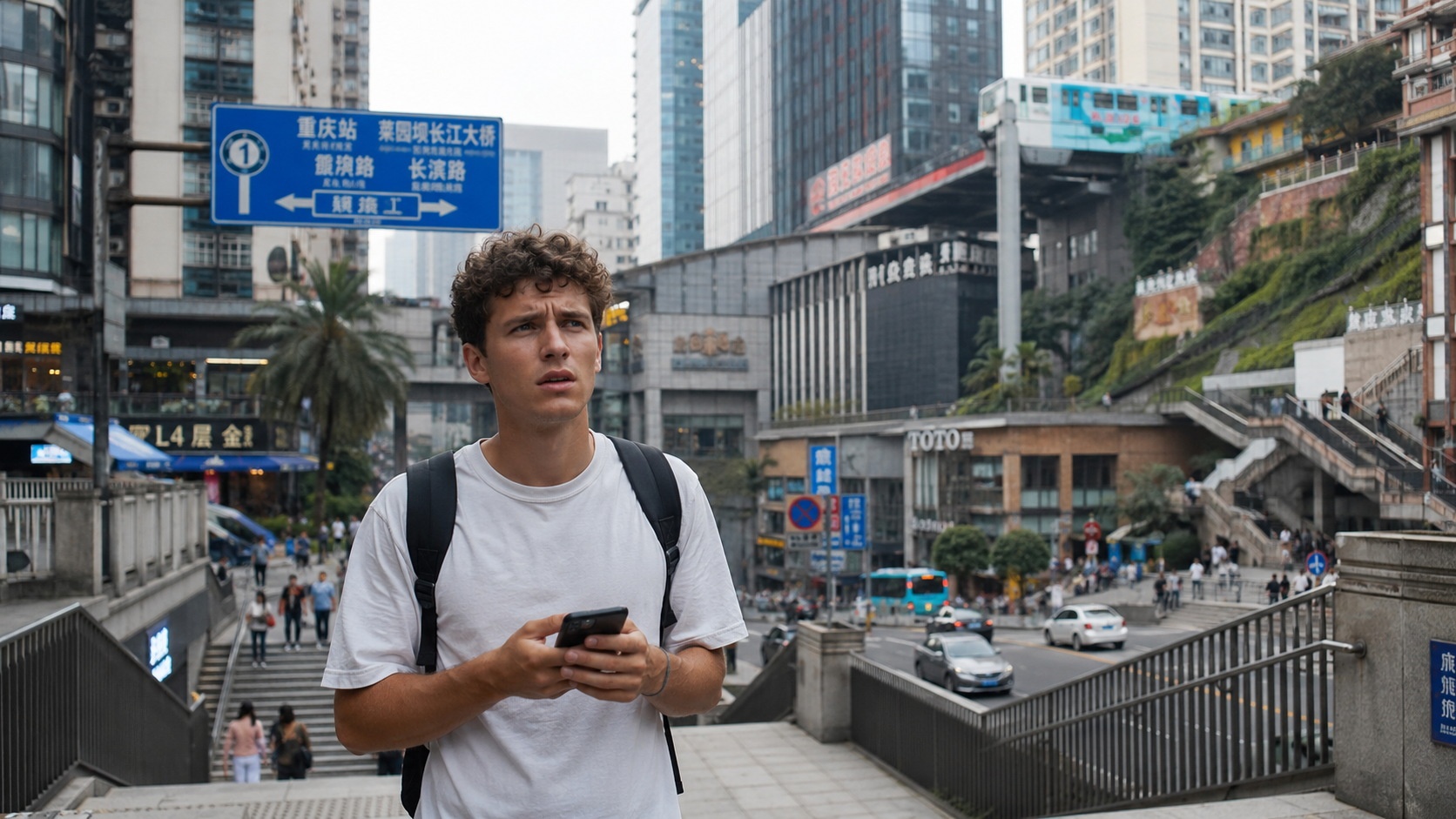
I learned this on a Tuesday morning, standing on what Google Maps insisted was a main road. My screen showed a blue dot moving smoothly along a straight line. In reality, I was frozen at a crossroads where one path led to a subway entrance and another climbed up a staircase so steep it looked like a ladder for goats. The algorithm had no idea that the “straight line” actually meant crossing three buildings, descending two flights of stairs, and negotiating with a delivery scooter.
Chongqing is famous online as an “8D city,” but that’s marketing speak for what locals experience daily: a place where the first floor might be the roof of a building on the tenth floor of another street. For young residents here, navigating isn’t just about getting from point A to B. It’s an interactive puzzle where technology is useful, but people are mandatory.
When the Map Meets the Mountain
To an outsider, Chongqing looks like a concrete jungle that forgot which way is up. The geography is aggressive. Hills rise sharply from the river valley. Roads split and merge like tangled yarn. What appears to be two separate buildings might actually share a floor. A convenience store on “Level 1” of one street could be tucked under the parking deck of “Level 20” on the adjacent hill.
GPS works well in flat cities where streets form grids. In Chongqing, the data struggles with verticality and constant change. The algorithm assumes a static map, but this city is alive. Construction happens weekly. New pedestrian bridges pop up overnight. A shortcut that worked last month might be blocked by scaffolding today.
Young professionals in Chongqing have adapted by treating navigation apps as rough guides rather than absolute truths. They check the app to get their bearings, then switch to instinct and observation. “I use the map for the big picture,” says Lin, a 26-year-old product designer who lives near the Jiangbei district. “But if I see an old person walking down a specific alley with confidence, I follow them. That’s the real-time update that no server can provide.”
The Human Wi-Fi Network
This is where the “anti-algorithm” habit kicks in. It’s not that Chongqing youth are Luddites. They order food via apps, pay for coffee with a QR code, and stream dramas on subways. The rejection of GPS isn’t anti-tech; it’s pro-human.
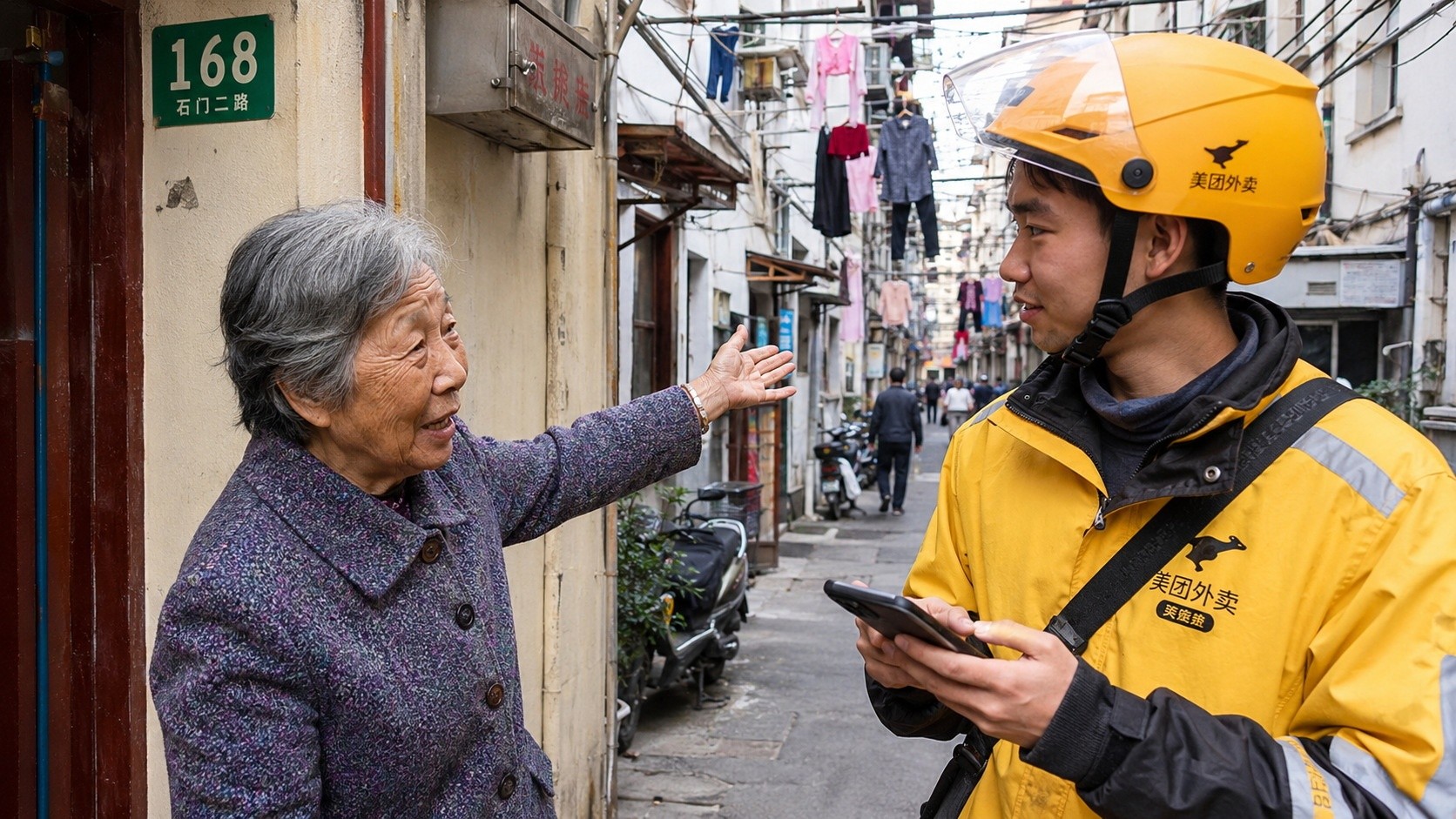
Asking for directions has become a small cultural ritual. When Xiao Ya, a university student looking for a hidden noodle shop recommended by an online forum, couldn’t find the address, she didn’t keep spinning her phone around. She stopped at a stall selling spicy skewers and asked an auntie in local dialect.
The result was instant. The auntie pointed toward a narrow passage behind a laundry line, then added, “Go past the blue door, turn left, and tell Master Wang you’re looking for the beef noodles; he makes them better today.”
In one exchange, Xiao Ya got precise instructions that an app would have missed, plus a guarantee about food quality. More importantly, she felt a spark of connection. In a city where people live stacked on top of each other in high-rises, these micro-interactions keep the community alive.
Why Turn Off the Screen?
You might wonder why anyone would choose the slow path. Efficiency is king in modern China, right? But efficiency isn’t just about speed; it’s about avoiding wrong turns that waste time and energy.
In Chongqing, the fastest route on paper can be a trap. An algorithm might send you through a pedestrian tunnel that closes for maintenance during lunch hour. Or it might guide you to a road where cyclists are banned but scooters swarm freely, creating chaos at intersections.
Locals know these nuances. The “old hands” of the neighborhood possess a mental map filled with annotations: “The stairs here have no handrail,” “This shopkeeper hates deliveries on Tuesdays,” “There’s a shortcut through this office building if you ask nicely.”
Young people are tapping into this knowledge base not out of necessity alone, but because it adds texture to their day. Asking directions breaks the isolation of screen-based living. It forces you to look up, make eye contact, and engage with the neighborhood. For many, it’s a small rebellion against the friction-less, lonely commute that defines so many other megacities.
Delivery Riders as Urban Sensors
You can’t talk about Chongqing navigation without mentioning the delivery riders. These young workers are the city’s human sensors. They move through the streets with a fluidity that apps struggle to replicate.
Lao Chen, a rider who has covered the Yuzhong district for four years, laughs when I ask if he trusts his route planner. “The app tells me the distance,” he says. “But it doesn’t tell me which shopkeeper is in a good mood, or which stairwell is open.”
Riders optimize routes based on social capital as much as geography. They know which gate to knock on, which elevator is faster, and how to navigate crowded markets without blocking the flow. Their existence proves that technology can map the world, but only people can move through it.

The Best Compass Is a Conversation
Chongqing teaches a lesson that resonates far beyond its mountains and rivers: tools are only as good as the hands that use them. The city’s complexity doesn’t make technology obsolete; it makes human wisdom essential.
For young residents, the “anti-algorithm” commute is a balance. They embrace digital convenience when it helps, but they never forget to ask. Turning off the screen and trusting a stranger’s gesture isn’t a step backward. It’s a reminder that behind every building, alley, and staircase is a person who knows where you’re going.
So if you ever visit Chongqing and your GPS starts screaming at you, do yourself a favor. Put the phone away. Find someone standing on a balcony smoking or chatting with neighbors. Ask for directions. You might get lost for five minutes, but you’ll likely find something better than a route: you’ll find the city.