


The Roar That Starts the Night
Walk into any mid-to-high-end bar in Shanghai, Beijing, or Chengdu on a Friday night, and you will hear it before you see it: a rhythmic, chaotic clatter of ceramic dice hitting wooden cups, followed by loud, overlapping shouts. “Five threes!” someone yells. “Six twos!” another counters.
If this sounds like noise pollution, wait until you realize it’s actually the heartbeat of Chinese nightlife socializing. This game is called Liar’s Dice (Chinese: 大话骰, Dàhuàtóu; or colloquially, 吹牛, Chuīniú). It is not a slot machine trick. It is not gambling for money in legitimate venues. It is a pure social lubricant, a psychological battle royale that turns strangers into frenemies within ten minutes.
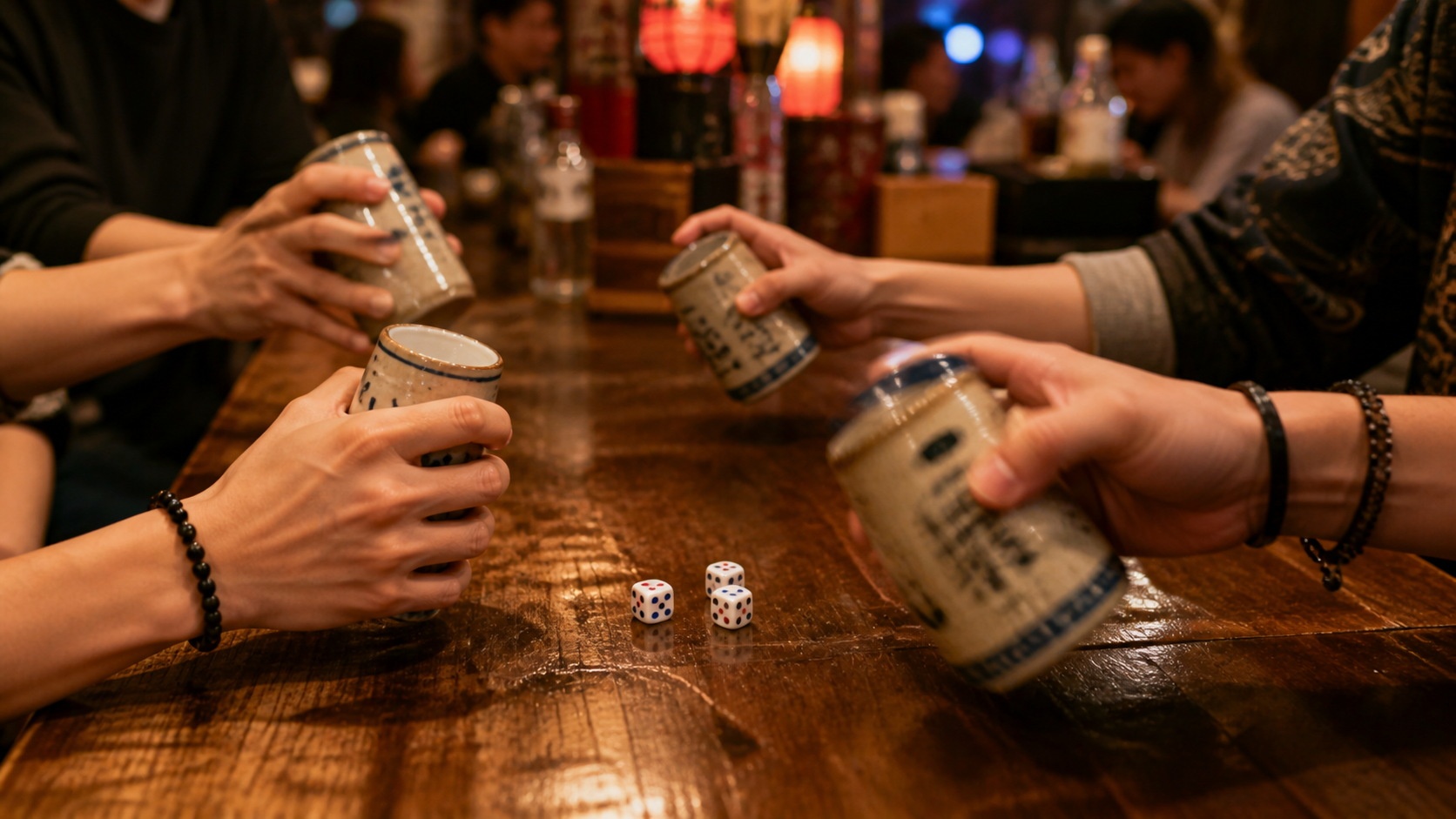
What Is Liar’s Dice? (And Why No Money?)
At its core, Liar’s Dice is a game of incomplete information. Each player gets five dice and a cup. You shake them under the table or on the bar top, but no one can look inside their own cup without losing face.
The goal? To guess the total number of specific dice faces across all cups at the table. If you call “Four Sixes,” you are claiming that between all players’ hidden dice, there are at least four sixes (or a designated “wild” die, more on that later).
Here is the crucial context for Western readers: In China’s regulated nightlife industry, this game involves zero monetary betting. You do not put cash on the table. The “stakes” are social capital. Losing means you take a sip of your drink (often a harsh local baijiu or a watery beer) and stay in the round. Winning means others drink. It is about endurance, wit, and fitting in, not getting rich.
The Rules: Keep It Simple
You don’t need a rulebook. Here is how it works in practice:
- Setup: Everyone gets 5 dice and a cup.
- Shaking: Shake vigorously. Cover your cups.
- Bidding: Players take turns calling out the number and face value of dice they believe exist at the table (e.g., “Three Fours”).
- Escalation: The next player must either raise the bid (more dice, or higher face value) or challenge it by shouting “Dou!” (Double/Challenge).
- The Reveal: If challenged, all cups are opened. If your claim was false (e.g., you called 3 Fours, but there were only 2), you lose the round and drink. If your claim was true, the challenger drinks.
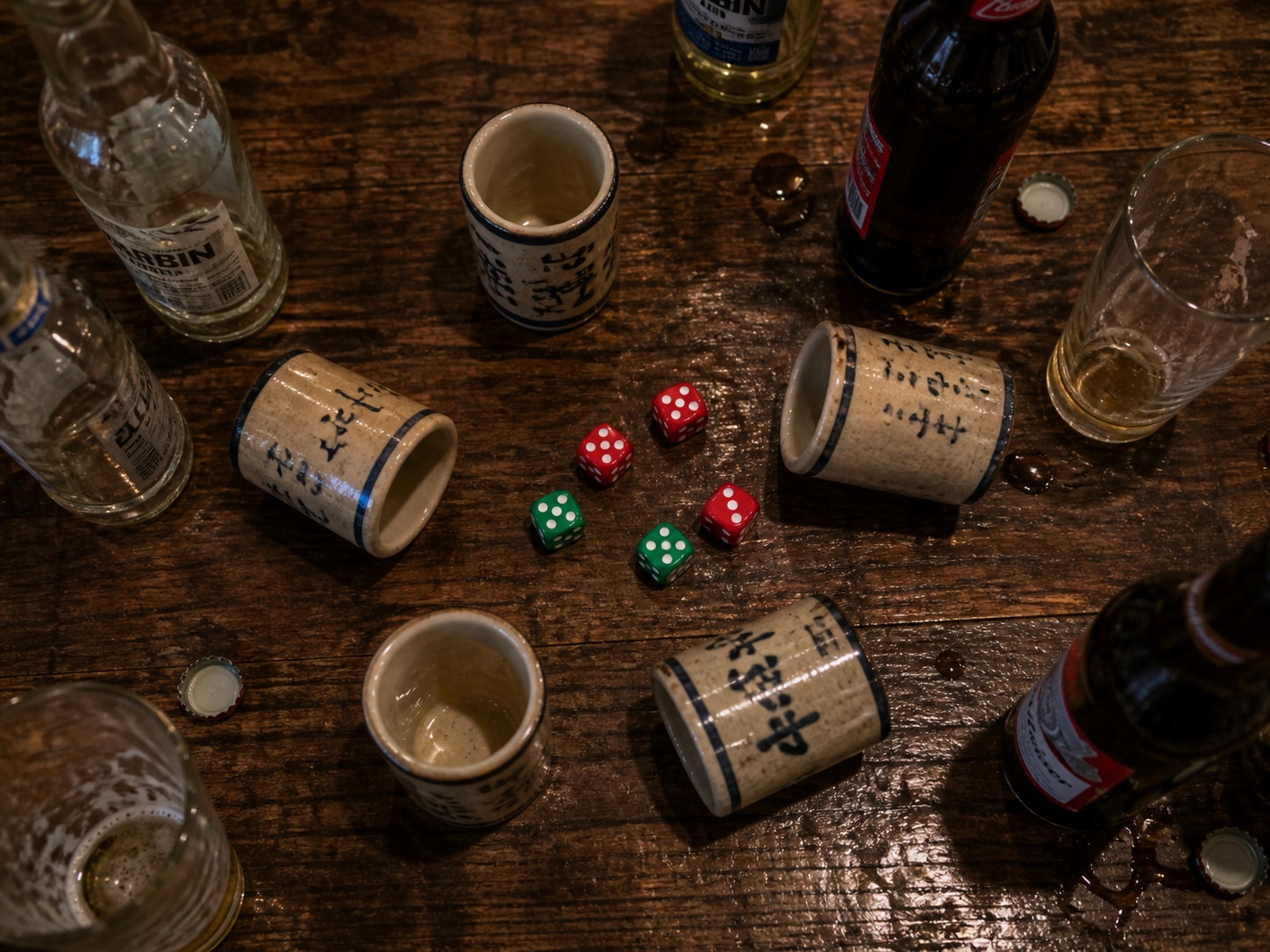
Revealing the dice: The moment of truth in every round.
The “Wild” Card: The Power of Ones
Most Chinese bars play with a variation where 1s are wild. This is the game-changer. A “1” can count as any number you need.
This creates the famous “Blind Bidding” (Mang Jiao) phase. Early in the game, when bids are low and probabilities are uncertain, players will shout bids without looking at their own dice. They are bluffing based on gut feeling and crowd psychology. This is where the real fun begins.
Decoding the Shouts: A Mini Glossary
To participate, you need to speak the language. Here are the essential terms:
- [Face] [Number]: e.g., “Five 3s” (Wu Ge San). You claim there are at least five dice showing a 3 across all cups.
- Dou (斗): Challenge. You think the previous player is lying.
- Chui Niu (吹牛): Literally “Blowing Cow.” It means bluffing or exaggerating. If someone makes a crazy high bid, you might laugh and say, “You are chui niu!”
- Quan Shou (全收): “All in/All out.” A dramatic move where a player risks everything on one final, impossible-sounding bid.
How to Play Like a Local: 3 Pro Tips
You don’t need to be a mathematician. You just need to read the room.
1. Master the Art of “The Stare”
When it’s your turn, look at your dice for exactly two seconds. Then look up and make intense eye contact with the person next to you or across the table. Do not rush. Confidence sells the lie.
2. Count Your Own, Estimate the Rest
If you have three “6s” in your hand, you know there are at least three at the table. If five people are playing (25 dice total), and you hold three 6s, a bid of “Four 6s” is statistically safe. A bid of “Eight 6s” is likely a bluff.
3. Watch the Body Language
If someone whispers their bid to the person on their right instead of shouting it to the table, they are weak. They don’t believe in their own lie. If someone slams their cup down loudly and shouts “Dou!” with a grin, they likely have what they need. Play along.
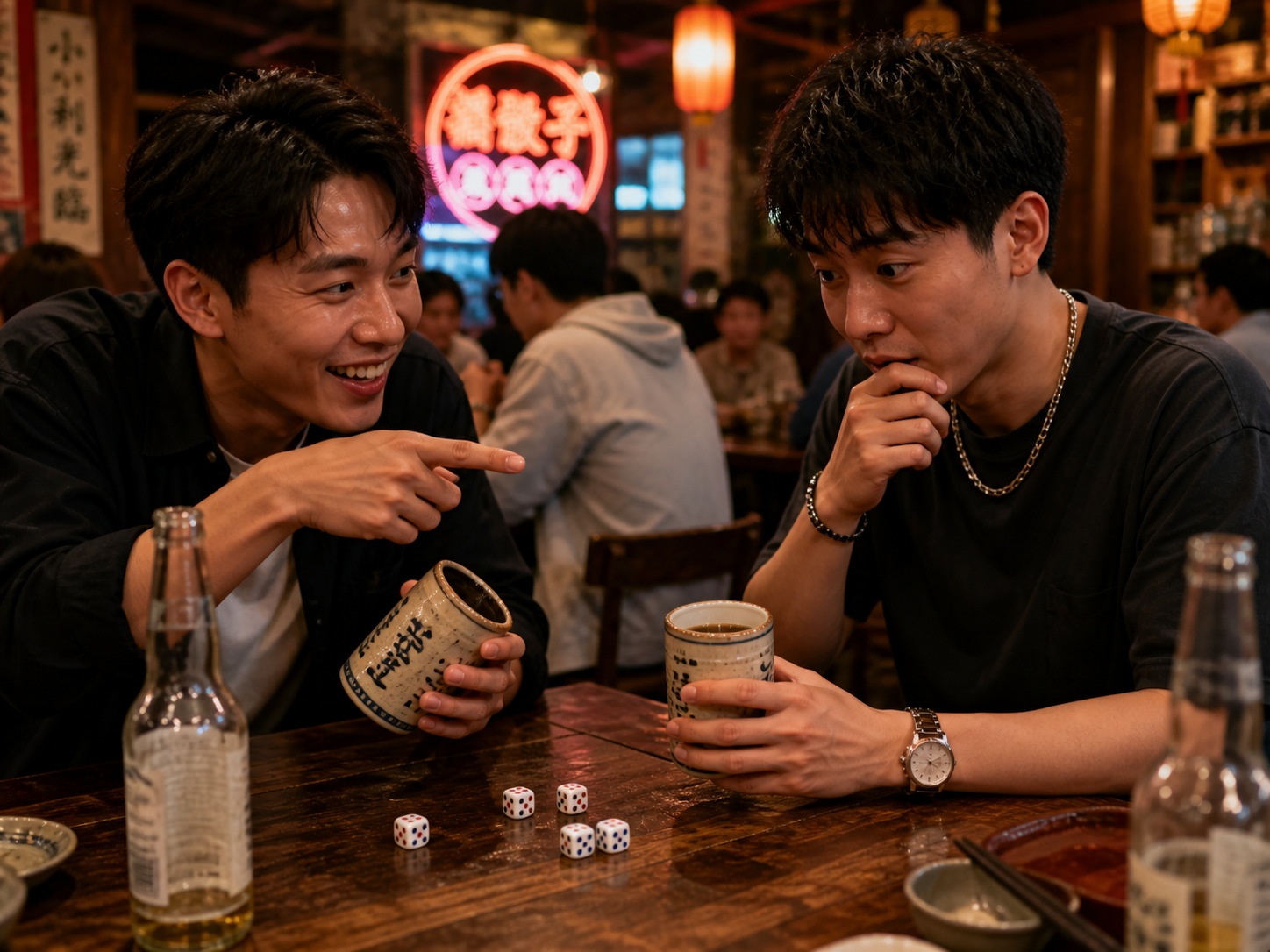
Reading your opponent: It’s not just about luck, it’s about psychology.
Why Chinese Love This Game
Unlike poker, which can feel isolating or purely transactional, Liar’s Dice is inherently communal. Everyone is looking at everyone else. The “wild 1s” rule ensures the game never stalls; there is always a logical path to raise the bid.
It reflects a broader Chinese social value: Rengre (liveliness). Silence in a group setting can be awkward. Shouting, debating, and laughing at failed bluffs breaks down barriers faster than small talk about the weather. It is a safe space to be loud, to take risks, and to fail publicly without real consequence.
The Verdict
Next time you are in China and invited to a bar or KTV, put down your phone. Pick up a cup. Shake the dice. Whether you end up drinking warm beer or winning the night’s respect, participating in Liar’s Dice is one of the fastest ways to understand the chaotic, vibrant, and deeply social nature of modern Chinese nightlife.
Just remember: Keep it friendly, keep it clean, and whatever you do, don’t look at your own dice too long. Everyone knows you’re bluffing.