


The Hidden Theater of a Beijing Alley
It is just past dawn in a quiet corner of Dongjiaominxiang, Beijing. The air smells faintly of steamed buns and damp stone from the nearby hutong walls. Inside a small room overlooking a narrow courtyard, 24-year-old Li Wei sits cross-legged on an old wooden chair. He takes a deep breath, his cheeks puffing slightly, and then lets out a sound that is impossibly loud.
It isn’t a recording playing from a speaker. It is the sharp, piercing whistle of a steam locomotive, followed by the rhythmic clacking of wheels on tracks. Then, without a pause, he shifts his tone to mimic a bustling morning market: vendors shouting, bicycles honking, and chickens squawking in the background.
This is Kouji, China’s traditional art of oral mimicry. For centuries, it was a staple of street performances across imperial China. Today, Li Wei is one of the few young practitioners left trying to keep this “sculpting with sound” alive in an era dominated by screens and noise-canceling headphones.

The History in Throat and Mouth
For many Westerners, the concept of mimicking complex sounds without any instruments might seem like a party trick. But Kouji is a disciplined art form with roots stretching back over 2,000 years. Historically known as “Jingzhao” or “Shengji,” it was once a primary source of entertainment in bustling teahouses and village squares.
The skill lies not just in volume, but in the precision of the mouth cavity, tongue placement, and breath control. A master can replicate the roar of a tiger, the gurgling of a waterfall, or the specific mechanical rhythm of an old factory machine—all generated solely from human anatomy.
Unlike visual arts that rely on sight, Kouji is purely auditory. It requires the audience to close their eyes and visualize the scene through sound alone. This immersive quality made it a favorite during China’s pre-digital era, where imagination was fueled by live performance rather than high-definition video.
A Modern Dilemma: Why the Sounds Are Fading
Despite its rich history, Kouji is now classified as an Intangible Cultural Heritage at risk. The challenge isn’t a lack of talent; it’s a shift in how people consume culture.
In Li Wei’s daily life, the silence of modern urbanization works against him. High-speed trains have replaced steam engines, making the specific sounds he mimics rare in real life. Younger generations, raised on TikTok and short video platforms, are accustomed to instant visual gratification. Listening intently to a 15-minute oral performance feels like an effort they rarely make.
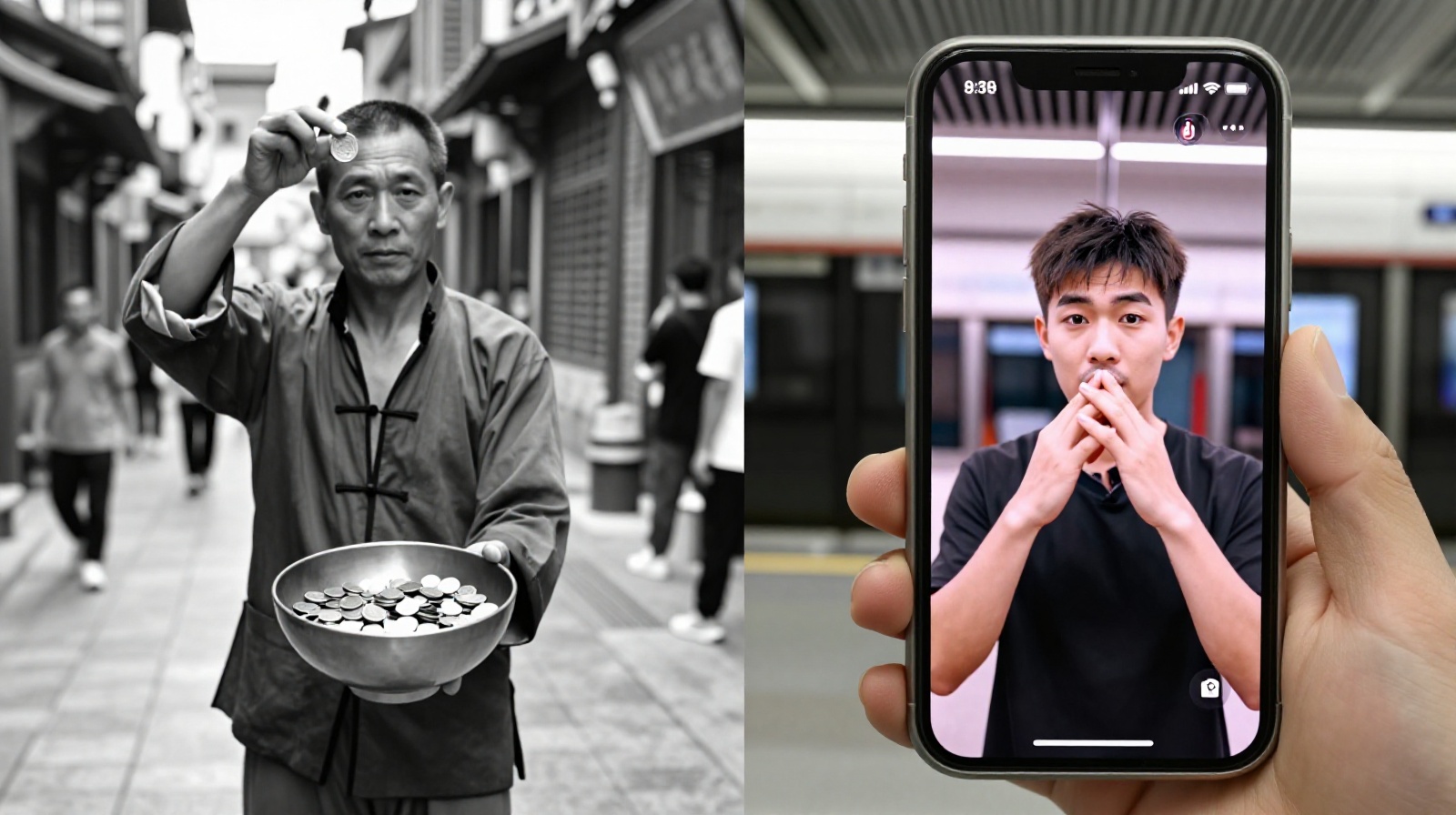
Furthermore, the economics of the art form have collapsed. Traditional street performers used to earn a living by collecting coins from passersby. Today, with cashless payments and distracted pedestrians, that revenue stream is nearly gone. Many older masters retired before passing their skills on, leaving gaps in the lineage that are hard to fill.
The Digital Turn: Saving Tradition Online
Li Wei knows he cannot rely solely on street corners or small theaters to survive. To reach a global audience and secure a future for Kouji, he has turned to the very technology that threatens its traditional form.
He now maintains an active presence on Douyin (the Chinese version of TikTok) and Bilibili. His videos often feature him performing in unexpected locations—subway stations, high-rise rooftops at sunset, or inside a modern server room. In one viral clip, he mimics the sound of a rocket launch using only his mouth, set against a backdrop of real engineering footage.
He is also experimenting with VR (Virtual Reality). By recording high-fidelity audio and pairing it with 360-degree video, he allows viewers to feel like they are sitting right in front of him. This digital preservation effort is crucial; without it, the specific nuances of these sounds might vanish forever as the physical environments that inspired them disappear.
A Conversation with the Artist
When we speak, Li Wei’s voice drops to a normal tone. He explains that making a living from Kouji is still difficult. “I spend hours practicing breath control every day,” he says. “If I miss one note, the illusion breaks.” His income comes from a mix of online tips, teaching workshops for children, and occasional corporate events where his act provides a unique cultural showcase.
There are moments of doubt. He remembers the old masters who sat in silence after their performances, waiting for coins that never came. But he also sees hope. When young students come to him asking to learn, not just as a hobby but as a career path, he feels the lineage continuing.

Listening to China’s Silent Stories
The story of Kouji is more than just about an art form fading away; it reflects China’s broader struggle to balance rapid modernization with deep cultural roots. As cities grow taller and faster, the soundscape changes, often erasing the acoustic history that defined previous generations.
Li Wei represents a new generation of preservers who are not just guarding the past but reimagining it for the future. By turning his voice into a bridge between ancient tradition and digital innovation, he ensures that the roar of the steam engine and the crow of the rooster remain part of China’s auditory memory.
In a world increasingly filled with synthetic voices and automated noise, the raw, human sound of Kouji stands as a testament to what is still uniquely possible. It reminds us that even in the age of AI and algorithms, there is still room for the delicate, imperfect, and incredibly complex sculpture of a human voice.