
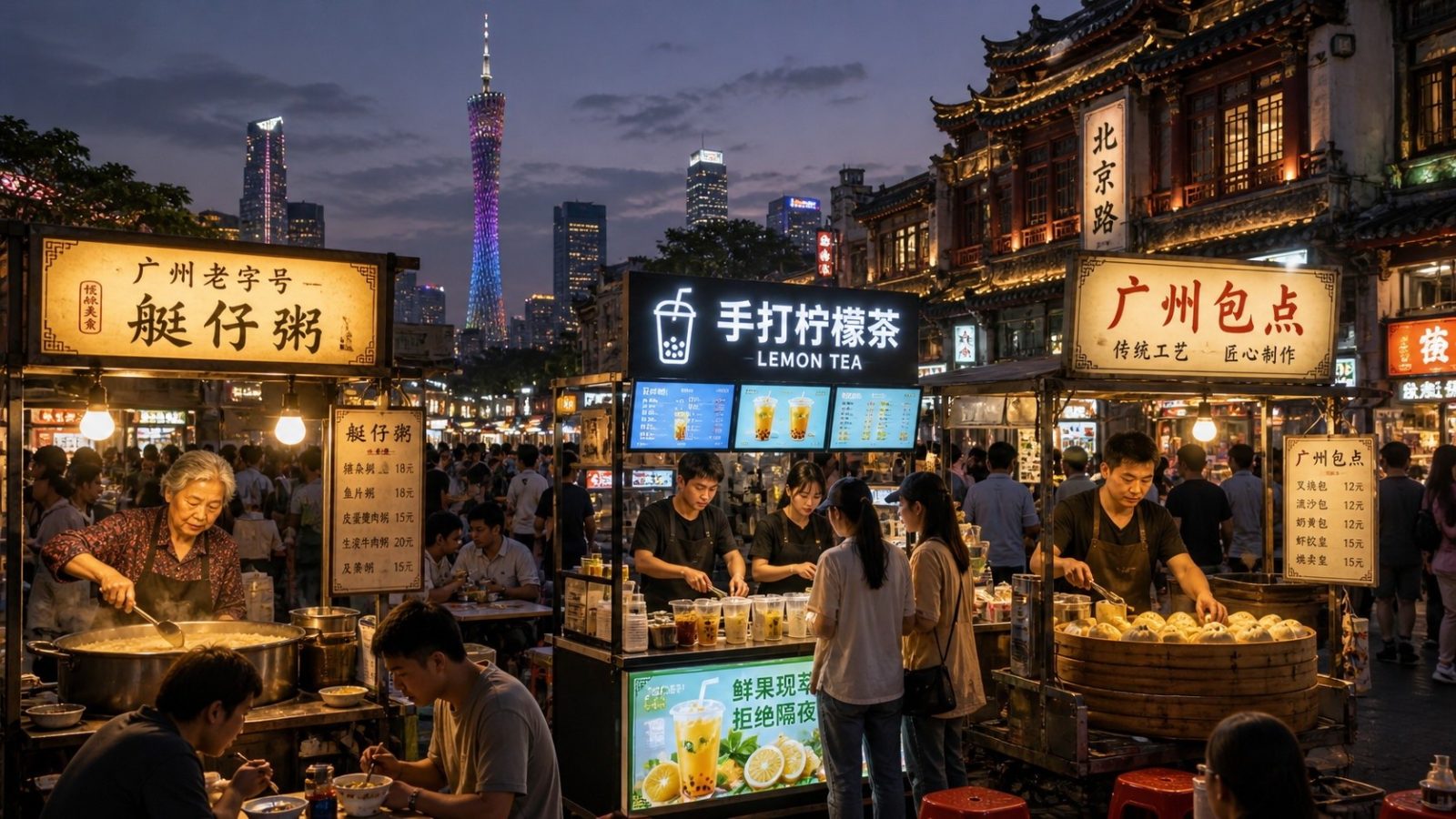

The Night Market as a Micro-Economy
If you walk through Guangzhou’s night markets at 10 PM, the air is thick with the scent of charred meat, steaming buns, and herbal tea. For tourists, it’s a sensory overload. For locals, it’s dinner. But for thousands of vendors lining these streets, this chaos is their office, their bank, and their safety net.
In a city known as China’s commercial hub, the gap between high-tech skyscrapers and humble street stalls can feel stark. Yet, these small businesses are not relics of the past; they are adaptive responses to modern economic realities. For many families, street food isn’t a romantic hobby—it’s the primary income source that pays for rent, school fees, and healthcare.
The ‘Old Guard’: Stability Through Reputation
At 4 AM, Chen Wei is already awake in her small apartment in Liwan District. By 6 AM, she is stirring a massive pot of pork rib congee at her stall near an old residential compound. This has been her routine for fifteen years.
Che’s stall doesn’t have Wi-Fi or social media accounts. She accepts WeChat Pay only because her grandson insisted. Her income is modest—roughly 12,000 yuan ($1,650) a month—but it is steady. “I don’t need to chase trends,” she says, ladling rice porridge into paper bowls. “My customers know that if I’m here at 6 AM, the congee will be hot and fresh.”
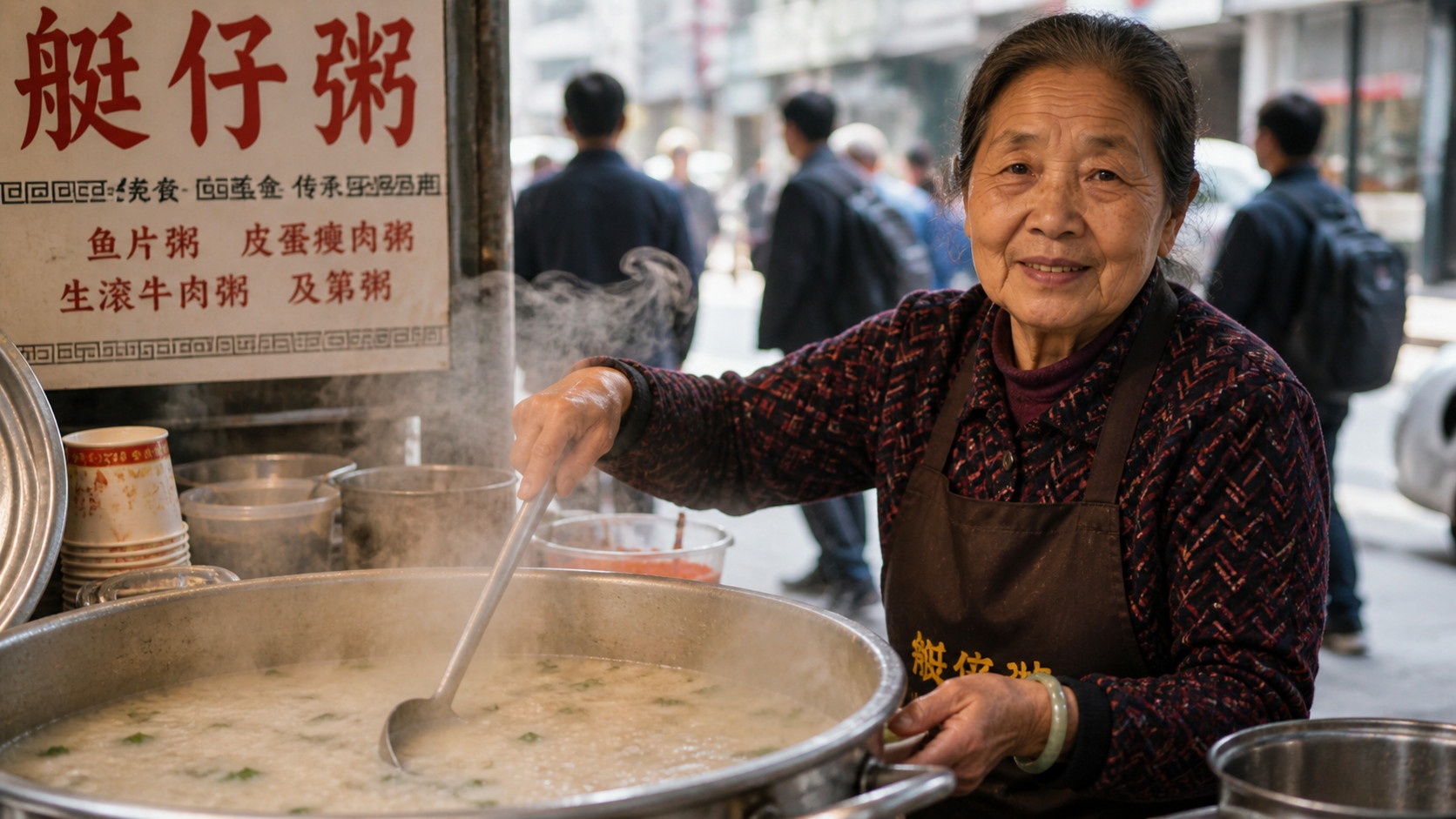
Chen’s story highlights a different side of China’s gig economy: one built on long-term trust rather than algorithmic visibility. Her regulars include elderly neighbors who pay on credit for weeks at a time, and young office workers who commute early. In an era of economic volatility, Chen’s consistency provides a rare anchor. She isn’t fighting for viral fame; she is securing a basic livelihood through reputation.
The ‘Digital Native’: The Algorithm as Boss
Three kilometers away in the trendy Dongshankou neighborhood, Li Jie and his wife run a brightly lit bubble tea and snack stall. They are in their late twenties, dressed in matching aprons with branded logos. Their business model is entirely digital.
Lijie checks his phone constantly, monitoring orders from Meituan (China’s leading delivery platform) and Douyin (TikTok). “We make money online first, then serve the customers who pick up their orders,” he explains. The couple earns about 15,000 yuan ($2,070) a month, but after paying rent for the tiny kiosk, purchasing ingredients, and covering platform commissions—which can reach 20-25% of sales—their net profit is tight.
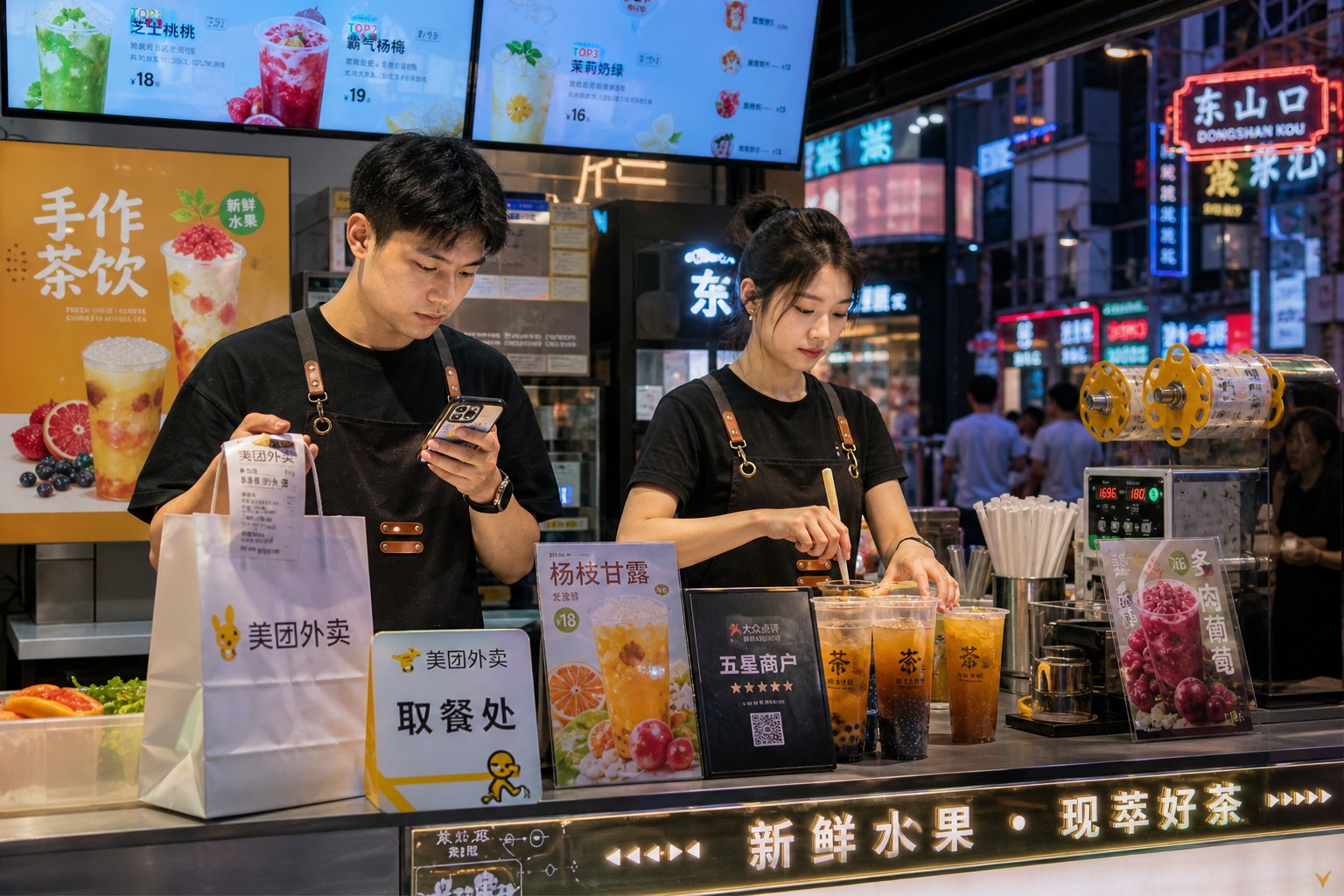
“The algorithm pushes our stall if we post videos,” Li Jie says. “So I spend two hours filming cooking processes every day. If the views are low, orders drop.” This is the double-edged sword of modern street vending in China: technology lowers the barrier to entry but creates a new kind of pressure. Li Jie and his wife work 12-hour days, not just serving food, but acting as marketers, photographers, and customer service agents.
The ‘Side Hustle’: Filling the Gaps
For Zhang Min, a 34-year-old delivery rider for a major logistics company, street vending is a weekend supplement. On weekdays, he delivers packages across Guangzhou’s sprawling urban landscape, earning a base salary plus tips. But with rising costs of living and plans to start a family, one income stream isn’t enough.
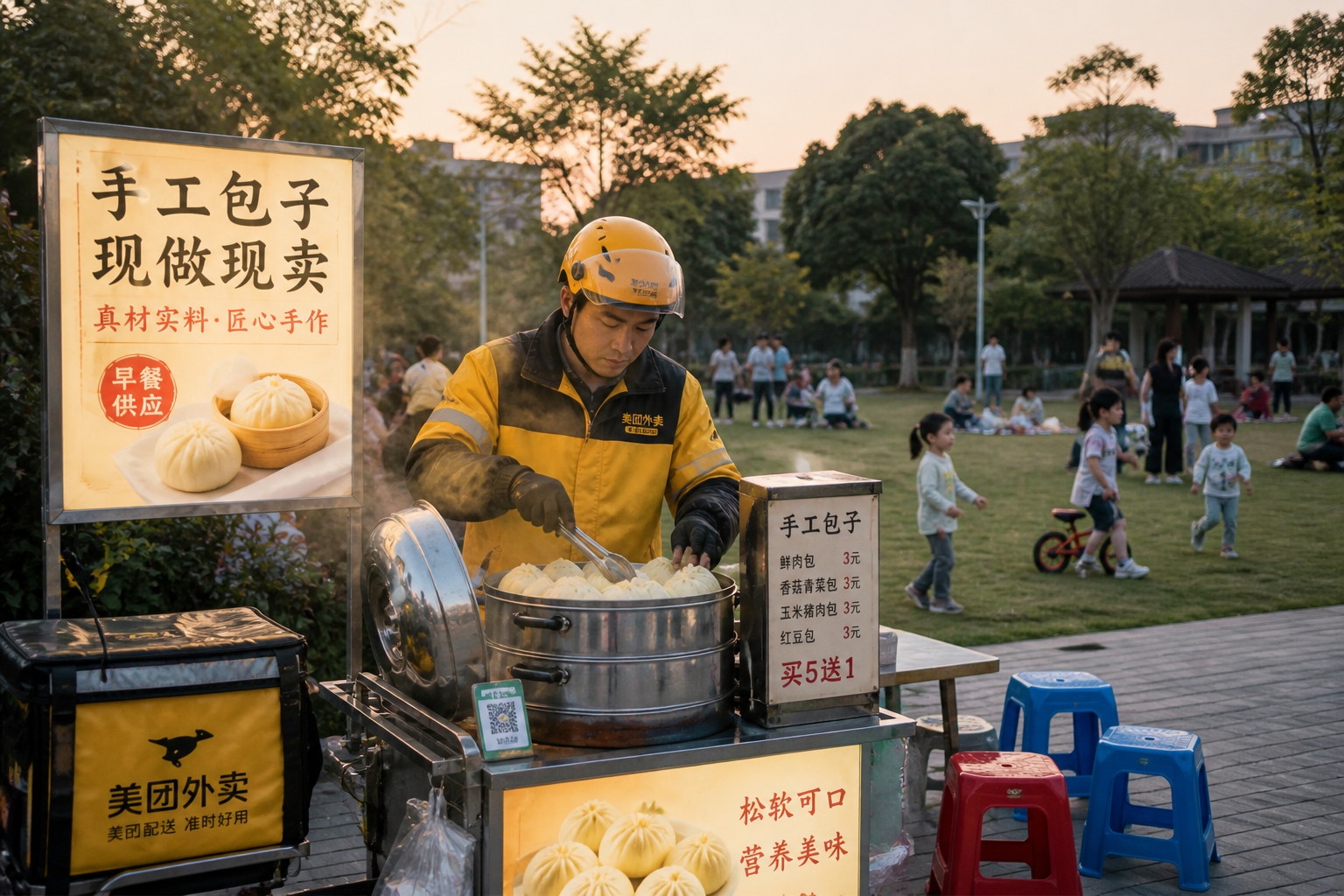
On Saturdays and Sundays, Zhang sets up a small cart selling handmade steamed buns in a community park near his home. He makes the dough himself, using recipes passed down from his mother. His stall is simple: plastic stools, a portable steamer, and a handwritten price list.
Zhang’s story reflects a broader trend among China’s urban workforce: the blurring line between formal employment and informal side hustles. “When I deliver packages in the rain, I think about my bun sales,” he says. “If orders are slow that week, I stay late at the stall.” This flexibility allows him to buffer against economic shocks. He isn’t looking for a career change; he is building a resilient financial ecosystem.
More Than Just Food
Chen Wei’s steady congee, Li Jie’s algorithm-driven snacks, and Zhang Min’s weekend buns represent three distinct strategies for survival in contemporary Guangzhou. They show that the “street food economy” is not a monolith. It adapts to the individual’s needs, skills, and risk tolerance.
For overseas readers wondering about China’s economic landscape, these stalls offer a grounded perspective. Behind every bite of street food is a family making calculated decisions about time, labor, and trust. Whether through decades of local loyalty or clicks on a smartphone screen, these vendors are not just feeding the city—they are sustaining their own futures.