
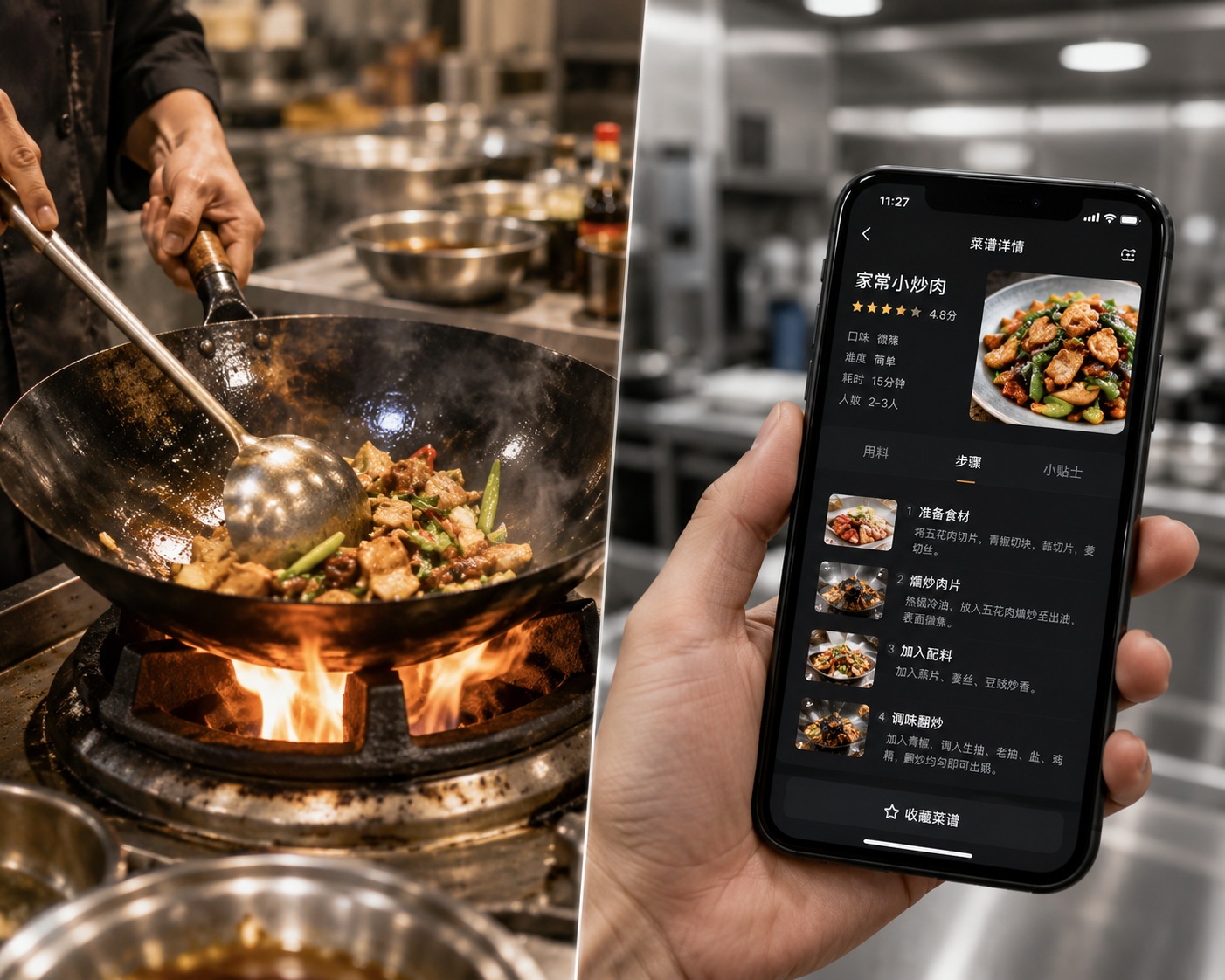

The Algorithm vs. The Wok
“Turn the flame down,” Chef Zhang says, not looking at the digital thermometer clipped to his apron. He is watching the steam rise from a clay pot, his eyes narrowed against the heat. “If you rely on the sensor, the lion’s head meatball will be dry. You have to listen to the soup.”
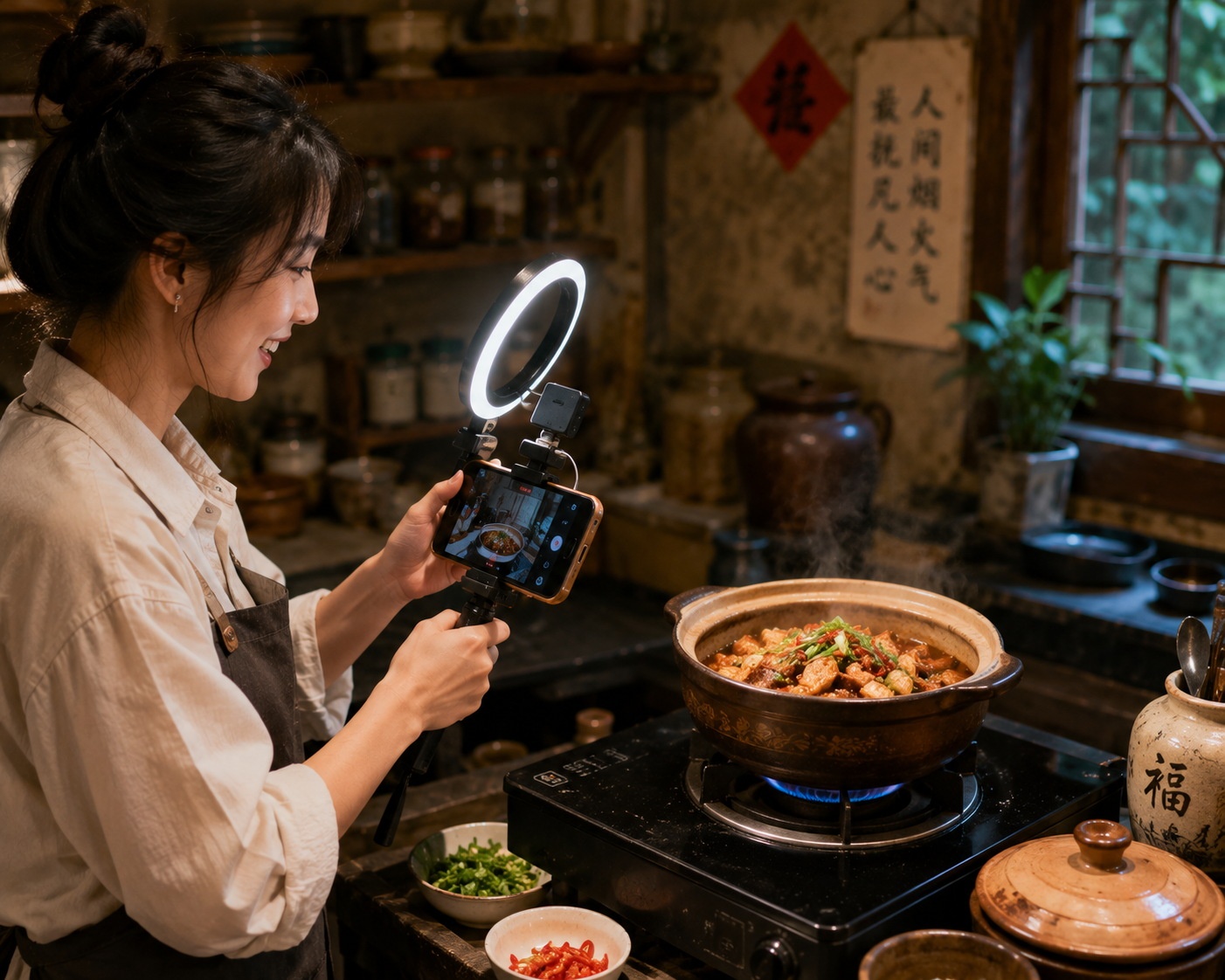
Opposite him stands Lin, a 28-year-old food content creator with a ring light mounted on his tripod. Lin is here to film a viral-style video: “How to Cook True Su Cuisine in 15 Seconds.” He looks at the pot, then at his phone, frustrated.
“But Chef, the app says the water should be at exactly 92 degrees Celsius for this stage,” Lin argues gently. “If I tell my followers to ‘listen to the soup,’ they’ll think I’m joking.”
This is the quiet tension playing out in kitchens across China today. It’s not just about cooking; it’s a negotiation between two worlds. On one side is Su cuisine (Jiangsu cuisine), one of China’s eight great culinary traditions, known for its delicate knife work, light flavors, and obsession with timing. On the other is the digital age, where success is measured in views, shares, and standardized recipes that can be copied by anyone with a smartphone.
What Is ‘Huohou’?
To understand this conflict, you first need to understand huohou (火候). In English, it’s often translated as “heat control” or “cooking time.” But that misses the point. Huohou is the intuitive sense of when an ingredient has reached its perfect state.
It’s the difference between a scallion that smells fragrant and one that burns black. It’s knowing that the pork in a braised dish needs three minutes less heat because the humidity in the kitchen was high today, or because the meat came from a different supplier yesterday.
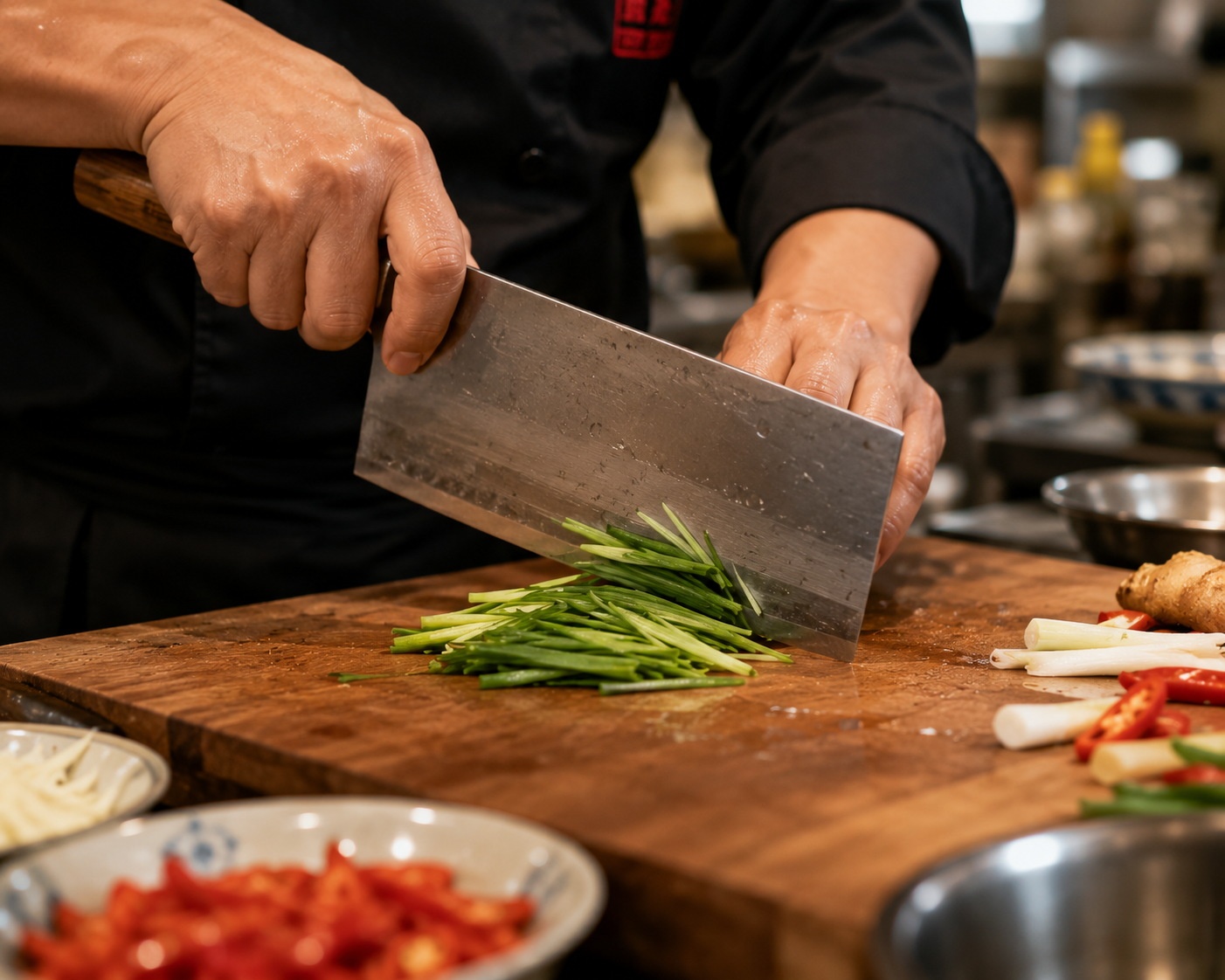
“You can teach someone how to chop a carrot into 24 equal strips,” Chef Zhang says, demonstrating with a large cleaver. The knife moves in a blur, producing uniform slices that could be measured with calipers. “This is skill. Any apprentice can learn this in six months.”
He pauses, wiping his hands on a towel.
“But huohou? That cannot be taught. It is not data. It is memory in your fingers. It is the smell of the oil. It is the sound of the bubbles. If you try to put it into an algorithm, the dish loses its soul.”
The Price of Perfection
Lin, the blogger, isn’t trying to disrespect tradition. He just wants to share it. His channel has 2 million followers who love Chinese food but feel intimidated by its complexity. They want shortcuts.
“I tried to film the Qingdun Xiefen Shizitou (Clear-Steamed Crab Roe Lion’s Head) last week,” Lin admits. “It took four hours to simmer. The algorithm pushed videos that were under 60 seconds. I felt like a liar when I edited it down.”
This is the dilemma of modern cultural transmission. How do you explain that Su cuisine requires patience? That the broth must be clear as water but rich with flavor, achieved by skimming impurities for hours? That the crab roe must be added at the very last second to preserve its sweetness?
“Young people don’t have four hours,” Chef Zhang says, not unkindly. “They have 30 minutes for lunch. But they still want the taste of home.”
He points to a small gas stove in the corner of the kitchen. “Maybe this is where technology helps. We use induction cookers now for safety and consistency. But the chef still decides when to turn it off. The machine doesn’t know when the meat is tender. Only you do.”
Not Replacing, but Adapting
Interestingly, the gap between the master and the blogger is closing. Lin isn’t trying to replace Chef Zhang; he’s trying to translate him. In recent months, Lin has started using split-screen videos: one side shows his quick, app-guided method; the other shows Chef Zhang’s traditional, slow process.
“I call it ‘The Two Kitchens,'” Lin explains. “My followers love seeing the contrast. They learn that there is a ‘fast’ way to eat, but a ‘true’ way to cook.”
Even Chef Zhang is adapting. He has started offering private cooking classes on WeChat, where he teaches small groups the basics of huohou. “I tell them to close their eyes,” he laughs. “Feel the heat on your face. That is how you start.”
This mirrors a broader trend in China’s culinary scene. Young chefs are not rejecting tradition; they are reinterpreting it. They use precision tools to achieve traditional results, and they use social media to tell the stories behind the food. The huohou remains human, but the delivery is modern.
The Human Element Remains
As the interview ends, the lion’s head meatballs are finally ready. Chef Zhang lifts the lid. A cloud of aromatic steam hits Lin’s camera lens. For a second, the blogger forgets to check his angles. He just smells it.
“It smells like… my grandmother’s house,” Lin says quietly.
“That is huohou,” Chef Zhang says, handing him a spoon. “Now you know. No app can teach that.”
In a country changing at lightning speed, where AI writes code and robots deliver packages, the kitchen remains a place where human intuition still matters. Because some things—like the perfect bite of a traditional dish—cannot be quantified. They can only be felt.